Commercial Vs Pro Forma Invoice: Understanding FedEx Options

airSlate SignNow simplifies document management with seamless eSigning and cost-effective solutions, empowering your business to thrive.

Award-winning eSignature solution

Understanding commercial vs pro forma invoice FedEx requirements

A commercial invoice and a pro forma invoice serve different purposes for international shipments through carriers like FedEx. A commercial invoice is an official customs document that declares the value, quantity, and origin of goods for duty assessment and clearance. A pro forma invoice is a preliminary declaration often used for samples, quotations, or goods not intended for sale; it provides an estimated value but does not replace a commercial invoice when duties are assessed. Proper selection and accurate completion of the appropriate invoice reduce customs delays and incorrect duty assessments.

Why accurate invoice selection matters for FedEx shipments

Choosing the correct invoice type ensures compliant customs processing, accurate duty calculations, and faster clearance through FedEx. It also reduces the risk of returns, fines, or shipment holds caused by misdeclared value or documentation mismatches.

Why accurate invoice selection matters for FedEx shipments

Common documentation challenges with FedEx invoices

  • Mislabeling pro forma as commercial leads to incorrect duty billing and customs holds.
  • Incomplete HS codes or descriptions delay clearance and trigger additional inspection.
  • Undervalued or missing declared values increase risk of fines and penalties.
  • Failure to attach required certificates or licenses causes refusals or returns.

Representative user profiles for invoice handling

Logistics Manager

Oversees end-to-end shipment preparation for multiple carriers including FedEx, coordinates customs paperwork, and ensures invoice accuracy to avoid delays and unexpected duty assessments for export and import operations.

Customs Broker

Handles tariff classification, duty calculation, and formal customs submissions on behalf of clients, verifies whether a commercial or pro forma invoice is appropriate, and communicates required corrections to shippers.

Who typically manages commercial and pro forma invoices for FedEx

Logistics and compliance teams coordinate invoice selection and completion before FedEx shipment to meet customs requirements.

  • Logistics managers who prepare shipping paperwork and coordinate carriers.
  • Customs brokers responsible for tariff classification and duty filings.
  • Exporters and importers ensuring correct commercial or pro forma usage.

Clear role assignments and document checklists help these users reduce errors and speed FedEx customs clearance when shipping internationally.

Advanced features that support commercial vs pro forma invoice FedEx workflows

Leverage automation, APIs, multilingual support, and security controls to scale accurate invoice handling across global FedEx shipments.

Automation

Auto-populate invoice fields from order data to reduce manual entry and speed documentation for recurring FedEx shipments across SKUs and destinations.


APIs

Integrate invoice generation with order management and carrier systems to attach documents automatically to FedEx manifests and electronic shipment records.

Templates

Manage multiple templates for commercial and pro forma invoices covering region-specific requirements and language variations for global FedEx services.

Multi-language support

Provide translated invoice fields and attachments to meet destination country expectations and improve customs processing reliability.

Mobile signing

Enable authorized signers to approve invoices on mobile devices so shipments are not delayed waiting for physical signatures.

Compliance controls

Enforce required fields, document retention, and audit trails to align with customs and regulatory expectations for FedEx international freight.

be ready to get more

Choose a better solution

Core tools to streamline commercial vs pro forma invoice FedEx handling

Use document templates, clear validation checks, eSignature, and integration to reduce errors and speed customs processing for FedEx shipments.

Document Templates

Prebuilt templates for commercial and pro forma invoices standardize fields like HS codes, commodity descriptions, and declared values to reduce manual errors and ensure consistent, carrier-ready documentation.

Validation Rules

Field-level validation highlights missing HS codes, incomplete values, or incorrect currency formats before submission, lowering the chance of customs inquiries or shipment holds.

eSignature Integration

Electronic signing captures authorized approvals for invoices and supports legal acceptance under ESIGN and UETA in the United States for customs and carrier workflows.

Carrier Attachment

Directly attach completed invoices to FedEx shipment manifests or digital uploads so customs receives required paperwork with the airway bill for faster processing.
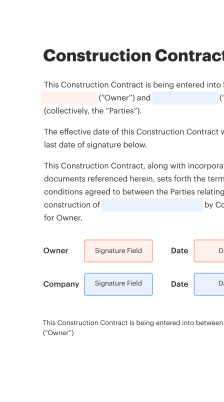
How the invoice process flows with FedEx

A typical invoice workflow with FedEx moves from selection to signing, attachment, and customs submission.

  • Identify use: Decide commercial or pro forma use case.
  • Fill invoice: Enter detailed item descriptions and values.
  • Sign document: Add authorized signature and date.
  • Provide to FedEx: Attach physical or electronic invoice to shipment.
Collect signatures
24x
faster
Reduce costs by
$30
per document
Save up to
40h
per employee / month

Step-by-step: preparing the right FedEx invoice

Follow these steps to choose, complete, and submit the correct invoice type for FedEx international shipments.

  • 01
    Assess shipment: Determine if goods are for sale or samples.
  • 02
    Select invoice: Choose commercial or pro forma accordingly.
  • 03
    Complete fields: Provide HS codes, values, and country of origin.
  • 04
    Attach to shipment: Include invoice with FedEx paperwork and electronic manifest.

Practical checklist for completing invoices before FedEx pickup

Use this checklist to confirm readiness of commercial or pro forma invoices prior to handing paperwork to FedEx.

01

Verify HS codes:

Confirm classification accuracy
02

Confirm values:

Ensure declared totals match orders
03

Add country of origin:

Include for each line item
04

Attach supporting docs:

Include licenses or permits
05

Obtain signature:

Collect compliant authorization
06

Link to AWB:

Attach invoice to airway bill
be ready to get more

Why choose airSlate SignNow

  • Free 7-day trial. Choose the plan you need and try it risk-free.
  • Honest pricing for full-featured plans. airSlate SignNow offers subscription plans with no overages or hidden fees at renewal.
  • Enterprise-grade security. airSlate SignNow helps you comply with global security standards.
illustrations signature

Sample workflow settings for invoice automation with FedEx

Configure these workflow settings to standardize invoice creation, validation, and attachment to FedEx shipments.

Document Workflow Setting Name Header Default configuration and recommended values
Reminder Frequency for Signers 48 hours after initial send
Invoice Template Selection Rule Auto-select by product category
Mandatory Field Validation Rule Enforce HS code and value
Automatic FedEx Attachment Attach to AWB on creation
Retention and Archive Policy Retain for five years

Device and platform considerations for invoice signing and FedEx uploads

Confirm platform compatibility and browser requirements to ensure invoices and signatures work reliably before attaching to FedEx shipments.

  • Desktop browsers: Chrome, Edge, Safari supported
  • Mobile platforms: iOS and Android apps available
  • PDF handling: Native PDF support and rendering

Testing on target devices and coordinating with FedEx upload methods prevents format issues and ensures signed invoices are accepted by customs systems and carrier manifest processes.

Security controls for electronic invoices used with FedEx

Data encryption: AES 256-bit encryption
Access controls: Role-based permissions
Audit logging: Comprehensive event trail
Document integrity: Tamper-evident records
Authentication methods: Multi-factor options
Retention policies: Configurable retention periods

Real-world examples: commercial vs pro forma invoice FedEx scenarios

Two practical examples illustrate when to use a commercial invoice versus a pro forma invoice for FedEx shipments and how documentation affects clearance.

Retail Exporter

A mid-size retailer ships sold merchandise via FedEx with an accurate invoice showing value, quantity, and HS codes for customs clearance

  • Uses a commercial invoice to declare sale and value
  • Enables timely duty calculation and avoids holds

Resulting in faster clearance and predictable landed costs for the importer.

Sample Shipments

A manufacturer sends free samples for testing and marks them as not for resale on a pro forma invoice

  • Provides estimated values and clearly states no sale occurred
  • Reduces the likelihood of improper duty assessment when supported by clear documentation

Leading to fewer disputes and smoother temporary import handling by customs.

Best practices for secure and accurate invoices with FedEx

Adopt consistent processes, clear roles, and verification steps to minimize errors when preparing commercial and pro forma invoices for FedEx shipments.

Standardize templates and required fields
Maintain centrally managed invoice templates that include mandatory fields such as complete item descriptions, HS codes, declared values, currency, and country of origin so staff follow a consistent, auditable process.
Validate HS codes and valuations
Use internal or broker verification to confirm tariff classifications and declared values prior to shipment to avoid duty miscalculations and customs queries that delay FedEx clearance.
Record approvals and signatures
Capture who prepared and authorized each invoice with dated signatures or compliant eSignatures to support audits, customs inquiries, and internal accountability for international shipments.
Keep supporting documentation
Retain purchase orders, contracts, and proof of export alongside invoices to substantiate declared values and transaction intent in case customs requests additional evidence after FedEx submission.

FAQs About commercial vs pro forma invoice FedEx

Common questions cover selection, completion, and legal acceptance of invoices used with FedEx international shipments.

Feature comparison: commercial vs pro forma invoice FedEx support

Compare how selected eSignature solutions support invoice creation, validation, and FedEx attachment for international shipments.

Feature and Capability Comparison Table signNow (Recommended) DocuSign Adobe Acrobat Sign
Integrated customs forms support
Pro forma invoice templates
Advanced authentication methods MFA available MFA available MFA available
Direct FedEx attachment Via integration Via integration
be ready to get more

Get legally-binding signatures now!

Timing and retention considerations for FedEx invoice documents

Plan lead times and retention to meet customs filing windows and long-term recordkeeping obligations for international shipments.

Customs filing lead time:

Submit invoices before carrier pickup

Pre-shipment verification window:

Allow 24 to 72 hours for checks

Retention for audit purposes:

Retain records for five years

Deadline for corrected invoices:

Correct within 30 days where possible

Electronic manifest cutoff:

Meet FedEx digital upload deadlines

Key risks of incorrect invoice usage

Regulatory fines: Monetary penalties
Shipment delays: Held at customs
Goods seizure: Temporary confiscation
Duty reassessment: Back charges applied
Return shipments: Additional transport costs
Reputation damage: Supplier reliability questioned

Pricing and feature matrix for invoice workflows with FedEx

High-level comparison of plan-level features relevant to commercial and pro forma invoice handling for FedEx shipments across common eSignature providers.

Plan and Feature Matrix signNow (Recommended) DocuSign Adobe Acrobat Sign Dropbox Sign PandaDoc
Free trial availability Offers trial periods for evaluation Offers trial periods Offers trial periods Offers trial periods Offers trial periods
Subscription billing options Monthly and annual plans available Monthly and annual plans Monthly and annual plans Monthly and annual plans Monthly and annual plans
ESIGN and UETA compliance Compliant across U.S. usage scenarios Compliant Compliant Compliant Compliant
Bulk sending and templates Supports templates and bulk send features Advanced bulk send Template support Template and bulk send Strong template capabilities
API access for automation Full API available for integrations Enterprise-grade APIs Developer APIs provided APIs via Dropbox platform Robust API and webhooks
Carrier integrations and attachment Direct FedEx attachment options or integrations Integrations via partners Integrations supported Integrations supported Integrations supported

Understanding Commercial Invoices

A commercial invoice is a key document used in international trade. It serves as a bill for the goods sold, detailing the items, their value, and the terms of sale. This invoice is crucial for customs clearance, as it provides the necessary information for assessing duties and taxes. When using FedEx for shipping, a commercial invoice must be accurately filled out to ensure timely delivery and compliance with regulations.

Key elements typically included in a commercial invoice are:

  • Seller and buyer information
  • Description of goods
  • Quantity and unit price
  • Total value of the shipment
  • Shipping terms and conditions

Exploring Pro Forma Invoices

A pro forma invoice is a preliminary bill of sale sent to buyers before the actual sale occurs. It outlines the expected costs and details of the transaction but is not a request for payment. This document is often used for international shipping to provide buyers with an estimate of the total costs, including shipping and duties.

When preparing a pro forma invoice for FedEx shipments, it is important to include:

  • Detailed descriptions of the goods
  • Estimated shipping costs
  • Terms of sale and payment
  • Validity period of the pro forma invoice

Key Differences Between Commercial and Pro Forma Invoices

Understanding the differences between commercial and pro forma invoices is essential for businesses engaged in international trade. The primary distinctions include:

  • A commercial invoice is a legally binding document, while a pro forma invoice is not.
  • Commercial invoices are used for actual sales transactions, whereas pro forma invoices are used for estimates.
  • Commercial invoices are required for customs clearance, while pro forma invoices may be used for quotations or preliminary agreements.

Using FedEx for Shipping with Invoices

When shipping with FedEx, it is important to choose the correct type of invoice based on the nature of your transaction. For actual sales, a commercial invoice is necessary to facilitate customs clearance. In contrast, if you are providing a quote or estimate, a pro forma invoice may be more appropriate.

To prepare these invoices efficiently, users can utilize digital document solutions to create, edit, and manage their invoices. This ensures accuracy and compliance with shipping requirements.

Best Practices for Invoice Preparation

To ensure smooth shipping and customs processes, consider the following best practices when preparing commercial and pro forma invoices:

  • Double-check all information for accuracy, including item descriptions and values.
  • Use clear and concise language to avoid misunderstandings.
  • Ensure that the invoice format meets FedEx requirements for international shipping.
  • Keep copies of all invoices for your records and future reference.

Integrating Digital Solutions for Invoice Management

Utilizing digital document management tools can streamline the process of creating and managing invoices. With features like eSign Templates and the ability to edit and sign documents online, businesses can enhance their efficiency. This integration allows users to prepare and send invoices quickly, ensuring that all necessary documentation is in place for FedEx shipments.

By adopting digital solutions, businesses can reduce errors, save time, and maintain compliance with shipping regulations, ultimately leading to smoother operations in international trade.


walmart logo
exonMobil logo
apple logo
comcast logo
facebook logo
FedEx logo
be ready to get more

Get legally-binding signatures now!