Sign Documents Offline with SignNow

airSlate SignNow allows you to sign documents offline. Simply use your mobile app to sign, send and fill electronic documents no matter where you are.

Award-winning eSignature solution

What it means to sign documents offline

Signing documents offline refers to capturing legally valid electronic signatures without a continuous internet connection, then synchronizing the signed files and metadata once connectivity is available. Offline signing typically relies on secure local storage, tamper-evident logs, and cryptographic protections to preserve authenticity and integrity. In the United States, records created and retained electronically can meet ESIGN and UETA requirements when proper audit trails and access controls are maintained. Platforms such as signNow provide functionality to collect signatures while offline and later upload compliant evidence to cloud storage and audit logs.

Why organizations use offline signing capabilities

Offline signing supports business continuity in low-connection environments, reduces delays for field teams, and preserves a complete audit trail for compliance purposes, helping organizations maintain secure workflows where internet access is intermittent.

Why organizations use offline signing capabilities

Common challenges when signing documents offline

  • Ensuring tamper-evident storage on the device until synchronization completes.
  • Verifying signer identity without real-time authentication services available.
  • Managing version conflicts when multiple offline copies are later merged.
  • Complying with industry-specific rules like HIPAA when transmitting offline data.

How different roles use offline signing

Office Manager

An office manager uses offline signing to collect approvals during site visits and vendor deliveries, syncing signed contracts to the central repository at the end of the day while preserving audit metadata and signer details for compliance reviews.

Field Technician

A field technician completes service orders and captures customer signatures on a mobile device without network access, then relies on automatic synchronization when returning to coverage to update the CRM and billing systems with timestamped evidence.

Typical users and teams that rely on offline signing

  • Field service technicians completing work orders in remote locations.
  • Healthcare staff collecting patient consents at bedside with privacy controls.
  • Real estate agents completing closings in areas with unreliable service.

Organizations prioritize offline signing where speed, mobility, and audited recordkeeping are required, and they put in place synchronization policies to ensure records are uploaded and verified promptly.

Advanced features for enterprise offline signing

Larger deployments benefit from features that improve security, scale, and integration for offline signature capture and management.

Mobile App

A native mobile app provides offline document caching, local signature capture, and encrypted storage, plus controlled synchronization to enterprise systems once the device reconnects to a secure network.

Two-Factor Auth

Optional two-step authentication for device or signer validation reduces impersonation risk when identity confirmation is required but online verification is unavailable.

Templates

Predefined templates ensure consistent field placement and required data capture, reducing errors in the field before documents are signed and later synchronized.

API Access

APIs allow automated download of documents to devices and later programmatic ingestion of signed records into CRM and document management systems during sync.

Role-Based Access

Granular permissions control who can preload, sign, or synchronize documents, enabling separation of duties and stronger compliance posture.

Bulk Processing

Batch operations permit multiple documents to be prepared for offline use and later uploaded and processed in bulk to streamline administrative handling.

be ready to get more

Choose a better solution

Core features that support signing documents offline

Key platform features enable reliable offline signing and later synchronization while maintaining integrity and compliance of the signed records.

Offline Mode

Allows documents to be signed without connectivity, stores cryptographic evidence locally, and queues files for secure upload once the device reconnects to the network to preserve signature validity.

Local Audit Log

Creates a tamper-evident record of signer identity, timestamps, IP placeholders, and device metadata that remains with the document and is merged into the central audit trail upon synchronization.

Device Encryption

Encrypts cached documents and signing metadata on the mobile device using strong cryptography to protect personal and confidential information until secure transmission to cloud storage.

Seamless Sync

Automatically uploads signed documents and associated logs to the central system when connectivity is restored, resolving version conflicts and updating workflow status across integrated systems.

How offline signing works in practice

This overview explains the flow from document preparation through offline signing and final synchronization to maintain evidentiary records.

  • Prepare Document: Create and assign signature fields in advance
  • Download Copy: Save a working copy to the device cache
  • Collect Signatures: Capture signatures and required metadata locally
  • Upload Evidence: Synchronize signed documents and logs when online
Collect signatures
24x
faster
Reduce costs by
$30
per document
Save up to
40h
per employee / month

Quick steps to set up offline signing

Follow these basic steps to prepare devices and documents for offline signature capture using an eSignature platform.

  • 01
    Install App: Install the signNow mobile app on device
  • 02
    Preload Documents: Download forms to the device ahead of time
  • 03
    Enable Offline Mode: Set app to allow local signing
  • 04
    Sync Later: Upload signed files when online again

Detailed sync and verification checklist

Follow this checklist to verify signed documents are complete, secure, and properly synchronized after offline use.

01

Confirm Signatures:

Verify all required fields are completed
02

Check Timestamps:

Ensure each signature has a local timestamp
03

Validate Identity Records:

Confirm captured signer metadata is present
04

Resolve Conflicts:

Address duplicate or modified files before upload
05

Encrypt for Transport:

Use TLS and secure channels for upload
06

Confirm Server Receipt:

Verify central system shows completed audit entries
be ready to get more

Why choose airSlate SignNow

  • Free 7-day trial. Choose the plan you need and try it risk-free.
  • Honest pricing for full-featured plans. airSlate SignNow offers subscription plans with no overages or hidden fees at renewal.
  • Enterprise-grade security. airSlate SignNow helps you comply with global security standards.
illustrations signature

Typical workflow settings for offline signing

Configure these settings to balance usability with security when enabling offline signing across a team.

Setting Name Configuration
Offline Sync Interval On connect
Maximum Offline Retention 7 days
Local Encryption Enabled Yes
Require Device Authentication Yes
Automatic Conflict Resolution Prompt user

Device and platform requirements for offline signing

  • Supported OS: iOS 13+ and Android 9+
  • Storage Space: At least 100 MB free
  • App Permissions: Local storage and camera access

Regularly update devices and applications, enforce encryption and lockscreen policies, and confirm backup routines to minimize risk of data loss before synchronization.

Security controls for offline signatures

AES Encryption: Local files encrypted at rest
Access Controls: Device-level authentication required
Audit Trails: Signed events logged locally
Integrity Checks: Hashing prevents tampering
Secure Sync: TLS protected uploads
Role Restrictions: Permissioned access to records

Industry examples of offline signing in practice

Below are two real-world scenarios where offline signature capture reduces delays and preserves compliance when internet connectivity is unreliable.

Real Estate Closing

Agents in rural locations complete buyer and seller signatures on a mobile device using offline capture and store cryptographic evidence locally

  • Uses field-ready signature fields and local timestamping to preserve intent
  • Prevents closing delays and speeds title processing when connectivity returns

Resulting in timely transaction records uploaded to the broker system and a complete audit trail for later review.

Healthcare Consent

Nurses gather informed consent at a bedside where Wi-Fi is not available, capturing signatures with a compliant offline workflow

  • The app records signer identity and consent details while respecting HIPAA controls
  • This reduces administrative burden and ensures immediate documentation of patient decisions

Leading to secure synchronization with the electronic health record once network access is restored, preserving legal evidence of consent.

Recommended practices for secure offline signing

Adopt operational and technical controls to reduce risk and ensure signed records remain admissible and compliant after offline capture.

Preload and lock documents before field use
Distribute finalized templates to devices ahead of assignments, restrict local editing of forms, and ensure required signature fields and data validations are present to avoid later disputes over document content.
Require device-level authentication and encryption
Protect devices with strong passcodes or biometrics and enable full-disk or app-level encryption so locally stored signed records are unreadable if the device is lost or stolen.
Establish sync policies and logging procedures
Define maximum offline retention periods, automatic synchronization triggers, and verification checks that confirm successful upload and integrity of signed documents once connected.
Train staff on signer verification and documentation
Ensure personnel can confirm signer identity offline, record any witness or ID checks, and capture supplemental notes or attachments that support the signature event for future audits.

FAQs about signing documents offline

Common questions and concise answers about capturing, storing, and synchronizing signatures when working without internet access.

How signNow compares for offline signing support

This comparison highlights availability and technical characteristics of offline signing across popular eSignature vendors.

Feature signNow (Recommended) DocuSign Adobe Sign
Offline signing support Limited Limited
Mobile app offline mode Limited
Audit trail preserved offline
HIPAA compliance options Available Available Available
be ready to get more

Get legally-binding signatures now!

Operational limits and retention considerations

Set clear timelines and retention rules for offline-signed documents to manage compliance and storage requirements.

01

Maximum offline period

Limit to defined days

02

Retention start point

Begin at synchronization

03

Backup intervals

Schedule regular cloud backups

04

Archival policy

Move inactive records to cold storage

Suggested synchronization and retention milestones

Use these milestones to keep offline signing workflows auditable and timely in regulated environments.

Document preload timing:

1-2 days before field use

Maximum offline duration:

Prefer under 7 days

Automatic sync trigger:

On network restore or Wi-Fi

Retention for audit:

Maintain 6 years or required period

Secure archival review:

Annual compliance checks

Risks and compliance consequences

Noncompliance fines: Monetary penalties
Contract disputes: Enforceability challenges
Data breaches: Regulatory exposure
Loss of records: Evidence gaps
Operational delays: Invoice and workflow hold
Reputational harm: Client trust erosion

Pricing and feature comparison for offline-capable plans

Compare starting costs and key plan features across vendors; signNow is listed first and shown as Featured for reference when considering offline signing capabilities.

Plan / Feature signNow (Featured) DocuSign Adobe Sign HelloSign PandaDoc
Starting monthly price From $8/user/month From $10/user/month From $14.99/user/month From $15/user/month From $19/user/month
Free tier or trial Free trial available Limited trial Trial available Trial available Trial available
Team seat options Small to enterprise teams supported Standard and business tiers Individual and business tiers Business plans available Multiple team tiers
Advanced security features SOC 2 and optional HIPAA SOC 2 and HIPAA options SOC 2 and enterprise controls Basic security controls SOC 2 for higher tiers
API and integrations API available on paid plans Robust API and ecosystem API and Adobe integrations API access on paid plans API with document automation

How to sign documents offline with airSlate SignNow

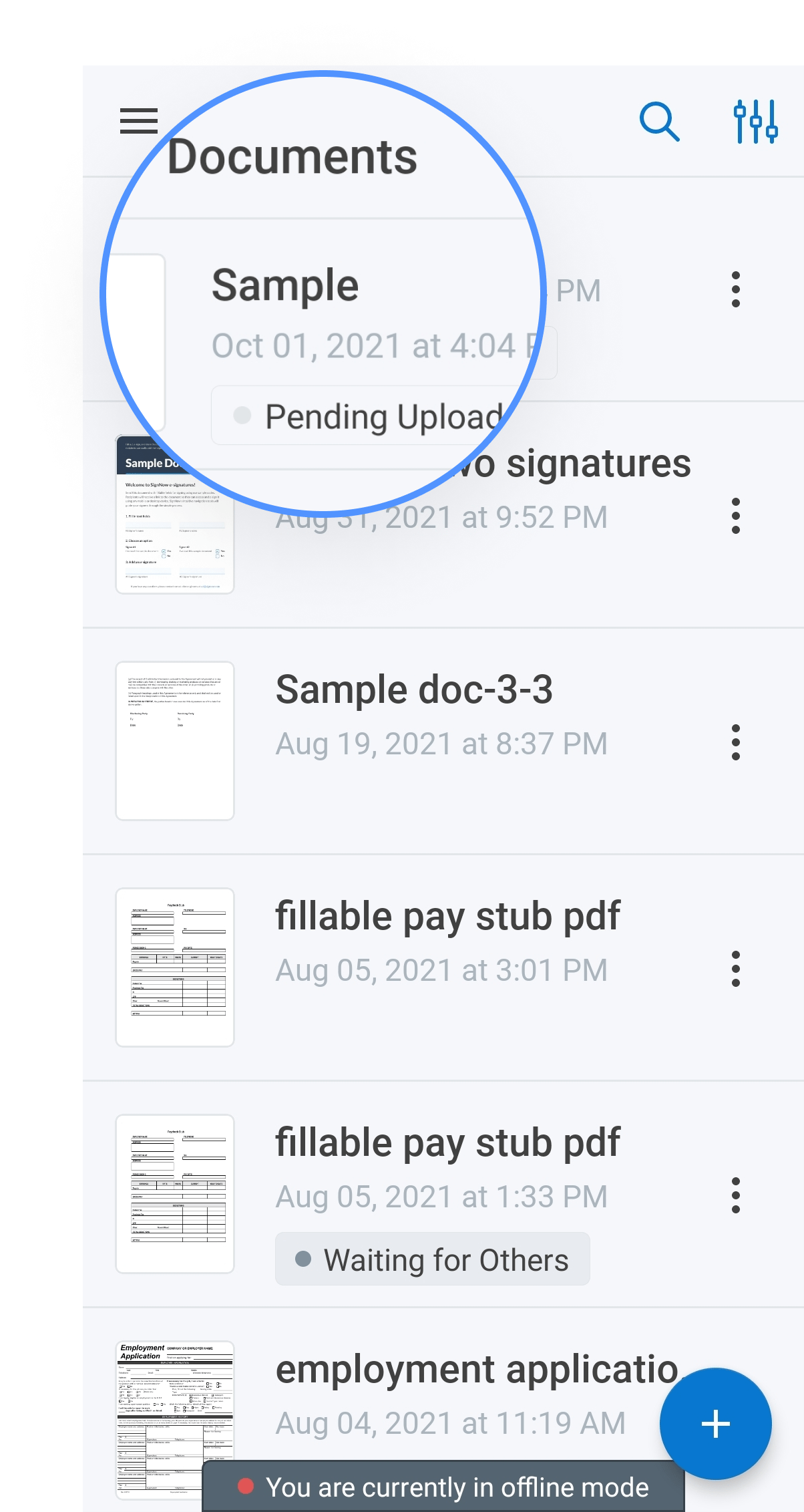
When you have no internet connection, you can still sign documents anytime and anywhere. However, your signed documents won’t be synced with the server until your connection is restored.

Upload documents offline

You can upload and edit a document even if your internet connection is temporarily lost (for example, during a flight or on the road). Your document will display in your dashboard and will be synced with the airSlate SignNow server as soon as you’re back online.
fill-guide-illustration

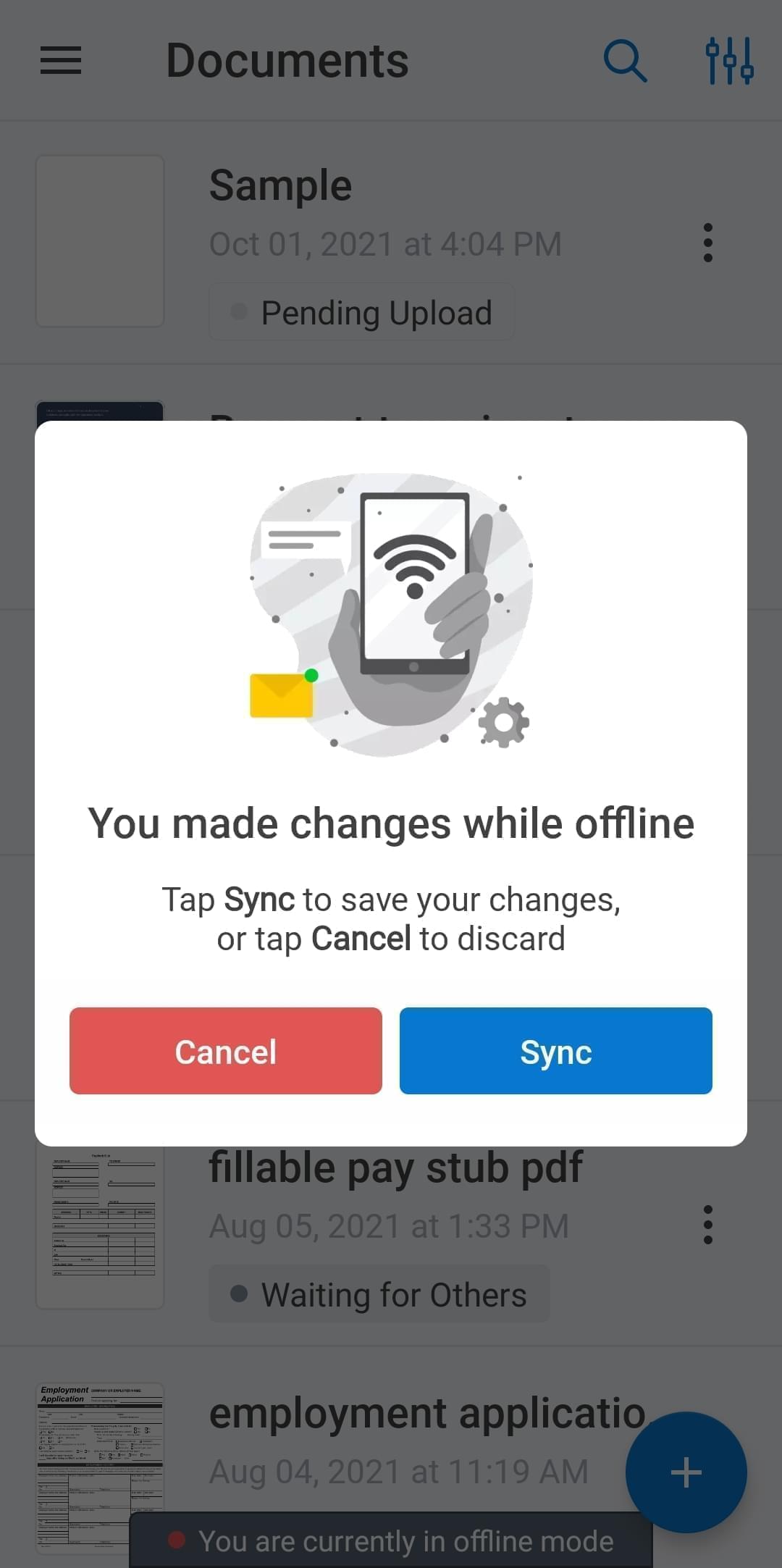
Sign documents offline

To sign a document in offline mode, add your signature as usual. It will appear in the document and will be saved and updated once you are reconnected to the internet.

fill-guide-illustration
walmart logo
exonMobil logo
apple logo
comcast logo
facebook logo
FedEx logo
be ready to get more

Get legally-binding signatures now!









