Establishing secure connection…Loading editor…Preparing document…

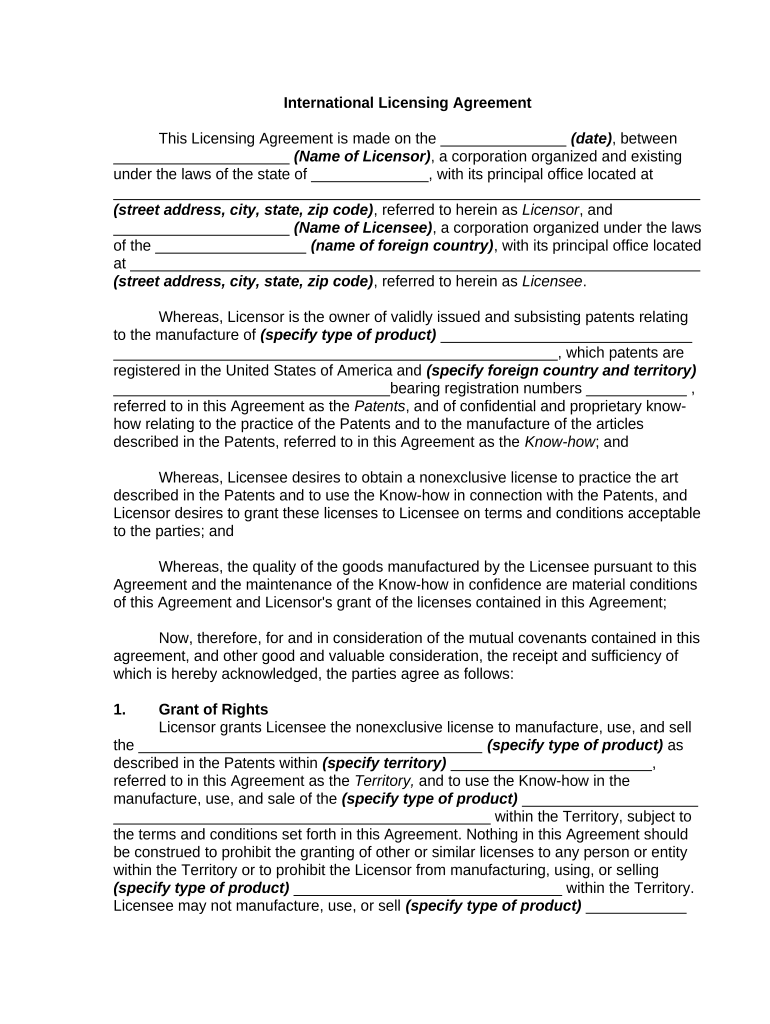
Licensing Agreement

This template is fully customizable. Edit the text, fill out the fields, and send it for signature. Give it a try!
Licensing Agreement

What a Licensing Agreement Covers

A Licensing Agreement is a legally binding contract in which a rights holder (licensor) grants another party (licensee) permission to use defined intellectual property, technology, trademarks, or other assets under specified terms. Typical provisions address the licensed subject matter, exclusivity, geographic scope, term and renewals, financial consideration (royalties or fees), permitted uses, quality controls, confidentiality, indemnities, termination triggers, and governing law. For U.S. transactions the agreement's enforceability follows standard contract principles; electronic execution is accepted under federal ESIGN and applicable state UETA or state statutes.

Why a Clear Licensing Agreement Matters

A well-drafted Licensing Agreement reduces ambiguity about rights and obligations, allocates risk, and preserves enforceability of license terms. It clarifies payment, usage limits, and remedies while creating a record suitable for audits, regulatory review, and commercial enforcement under ESIGN (15 U.S.C. ch. 96) or state law.

Why a Clear Licensing Agreement Matters

Who Typically Prepares and Signs Licensing Agreements

Licensing Agreements are prepared by business and legal teams and signed by authorized corporate representatives; multiple internal stakeholders often review before execution.

  • Corporate Legal — Counsels or outside attorneys who draft or review terms, protect IP, and advise on indemnity and warranty language.
  • Business Development — Product or licensing managers who define scope, pricing, and commercial deliverables for the license.
  • Finance and Revenue — Teams that verify royalty structures, invoicing, and tax treatment before final approval.

Final signatories should be authorized representatives with explicit signing authority; some agreements also require countersignature by a second officer or board approval depending on corporate bylaws.

Essential Elements to Include

A complete Licensing Agreement groups commercial terms, IP definitions, compliance obligations, and remedies into clearly labeled sections so each party can identify rights and duties quickly.

Grant

Precisely describe the rights granted (e.g., reproduce, distribute, modify), exclusive versus nonexclusive status, permitted sublicensing, and territorial scope.
Term

State commencement and expiration dates, renewal mechanisms, and early termination events including material breach, insolvency, or change-of-control clauses.

Consideration

Specify royalties, fixed fees, payment schedule, invoicing, audit rights, and late-payment consequences to avoid later disputes.

Quality & Use

Include performance standards, branding guidelines, permitted channels, and inspection or approval rights to protect the licensor's reputation.

Confidentiality

Define confidential information, permitted disclosures, duration of secrecy obligations, and carve-outs for required disclosures.

Indemnity & Liability

Allocate responsibility for third-party claims, caps on damages, and insurance obligations to manage litigation and remediation risk.

Required Identification and Core Fields

Parties: Full legal names
Effective Date: MM/DD/YYYY
Term: Start and end dates
Licensed Scope: Rights and territory
Payment Terms: Amount and schedule
Signatures: Name, title, date

Step-by-Step: Completing and Executing the Agreement

Follow these steps to assemble, review, and execute a Licensing Agreement with a clear audit trail.

  • 01
    Draft: Prepare complete draft including exhibits and schedules.
  • 02
    Internal Review: Legal, finance, and business teams review changes.
  • 03
    Counterparty Review: Exchange redlines and finalize agreed text.
  • 04
    Execution: Sign electronically or on paper; retain copies and audit trail.

Customizing an Online Signing Workflow

Configure a consistent digital workflow so each execution captures authentication, signatures, and relevant attachments before finalization.

Field Configuration
Upload Document PDF or DOCX upload; attach exhibits as separate files
Signer Roles Assign Licensor/Licensee roles and required sequence
Authentication Choose email, SMS code, or KBA per risk level
Template Save Save fields and attachments for repeat transactions

Where to Send or File the Executed Agreement

Determine routing to ensure both parties, internal records, and any required registries receive the executed copies promptly.

  • Counterparty: Send final signed PDF and execution certificate to the other party
  • Corporate Records: File executed agreement with corporate secretary or contract repository
  • Accounting: Notify finance for invoicing and royalty tracking
  • Third‑Party Registry: If required, register with patent or trademark office or other registry

Delivery and Distribution Options

Licensing Agreements can be distributed by email, secure link, or integrated systems; choose methods that preserve integrity and audit logs.

  • Email Delivery: Signed PDF via secure email
  • Secure Link: Access-controlled signing URL
  • System Integrations: CRM or document repository sync

Use solutions that capture an audit trail, store the final signed file in a secure repository, and integrate with your accounting and contract management systems for lifecycle tracking.

Common Timing and Notice Deadlines

Licensing Agreements include several time-sensitive dates and notice windows; documenting these avoids missed obligations and default events.

Effective Date:

Date when rights and obligations begin

Payment Due Dates:

Royalties or fees as scheduled in the consideration clause

Renewal Notice:

Advance notice period required to renew or terminate

Breach Cure Period:

Time allowed to remedy a material breach

Recordkeeping Deadlines:

Audit access and reporting periods defined in agreement

Common Preparation Mistakes to Avoid

  • Vague scope language that fails to specify permitted uses and channels, creating later disputes over implied rights or additional compensation.
  • Missing royalty mechanics or audit rights, which can prevent accurate reporting and recovery of underpaid amounts during audits.
  • Failure to confirm signatory authority, causing executed agreements to be challenged as unauthorized or voidable.
  • Neglecting to align governing law and dispute resolution clauses with business realities, increasing litigation costs and complexity.

Consequences of an Incorrect or Incomplete Agreement

Contract Voidance: Possible
Monetary Damages: Compensatory and consequential
Injunctive Relief: Court orders possible
Tax Exposure: Withholding issues
Regulatory Fines: Industry-specific penalties
Reputational Harm: Business disruption

Real-world Examples of Licensing Agreements in Use

Organizations across sectors use Licensing Agreements to formalize usage rights while maintaining compliance and operational efficiency.

Optica Ventures — COO

Optica adopted a standard license template to streamline deals across portfolio companies

  • saved negotiation time per contract
  • this standardized approach reduced execution cycles and improved customer experience while preserving legal protections and auditability for IP rights.

Martin Properties — Founder

Martin Properties shifted to online execution for licensing and lease‑related IP agreements

  • improved turnaround and compliance
  • adopting digital workflows allowed remote execution with complete audit trails and reduced in‑person meeting dependency for transactions.

Who Signs and Who Approves

Licensor Representative

A senior officer or authorized signatory who can bind the licensor; they confirm the licensor's authority to grant the specified rights and accept financial terms, indemnities, and audit obligations on behalf of the company.

Licensee Representative

An executive or authorized procurement contact who accepts the license scope and payment terms; they are responsible for ensuring internal compliance with permitted uses and for coordinating invoicing and renewal actions.

Practical Tips to Reduce Execution Risk

Follow these practices to speed execution and reduce post‑signing disputes.

Use Clear Definitions
Define key terms such as 'Licensed Materials', 'Net Sales', and 'Territory' to avoid differing interpretations that can derail enforcement or financial reconciliation.
Preserve Audit Trails
Capture signer identity, timestamps, IP addresses, and an execution certificate to support enforceability under ESIGN (15 U.S.C. ch. 96) and UETA where applicable.
Limit Boilerplate Ambiguity
Avoid overly broad assignment, sublicense, or modification language. Require written amendments to prevent implied contractual expansions.
Align Payments and Reporting
Specify reporting cadence, acceptable supporting records for royalty calculations, and the auditor's scope to reduce later disputes.

Download, Export, and Supporting Documents

Maintain signed files and related exhibits in stable formats and include supporting documentation for audits and regulatory purposes.

PDF Signed Copy

Save the fully executed agreement as a PDF with embedded audit trail to preserve presentation and timestamp integrity for future reference.

Source Document

Retain the original editable DOCX or source file to enable redlines and version history during dispute resolution or amendment.

Certificate

Include a signed certificate of completion showing signer emails, timestamps, and authentication method for evidentiary value.

Supporting Exhibits

Attach exhibits, schedules, and any approvals or invoices referenced in the agreement to maintain a single contractual record.

eSignature Vendor Pricing and Feature Snapshot

Comparison of starting price and selected capabilities for common eSignature providers; signNow is listed first for reference and competitive context.

signNow DocuSign Adobe Sign PandaDoc HelloSign
Starting Price $8/user/mo $15/user/mo $14/user/mo $19/user/mo $15/user/mo
Bulk Send Yes Yes Yes Yes No
Audit Trail Yes Yes Yes Yes Yes
HIPAA Compliant Yes Yes Yes No No
Envelope Cap No cap 100 envelopes/user/year Varies by plan Varies by plan Varies by plan

Frequently Asked Questions — Execution and Enforcement

Answers to common concerns about signing, validity, and technical setup for Licensing Agreements executed electronically.


Need help? Contact support

be ready to get more
Join over 28 million airSlate SignNow users