§7.401PROXY STATEMENTS: STRATEGY & FORMS
7-589J © 1997 Jefren Publishing Company, Inc.
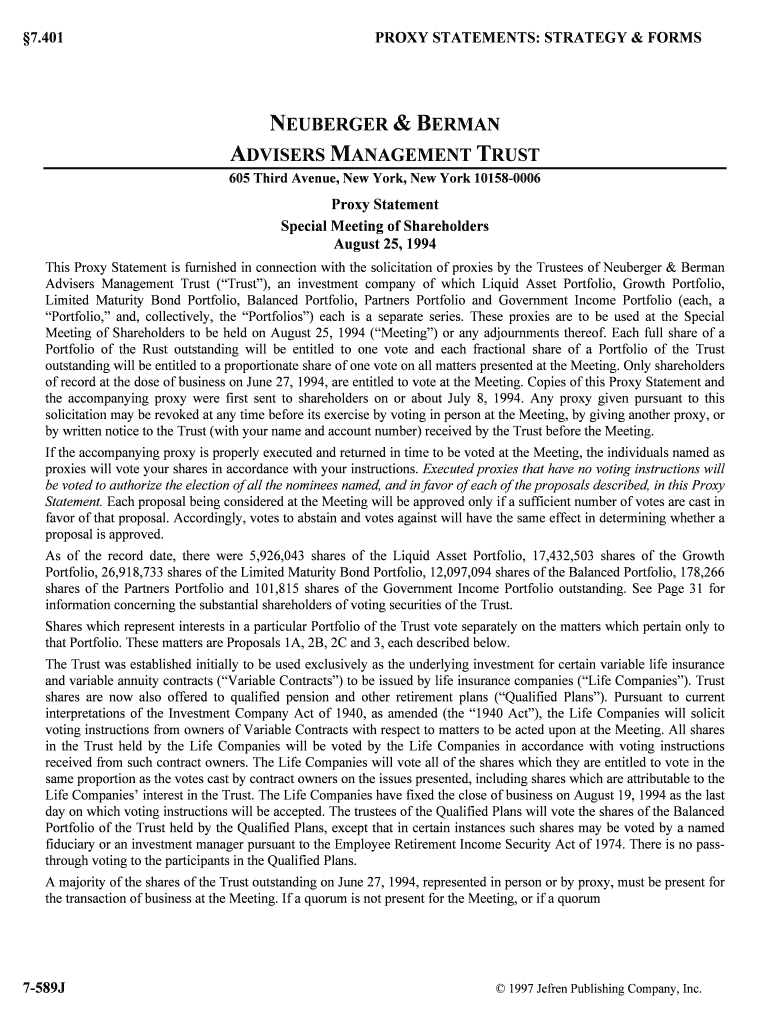
NEUBERGER & B ERMAN
A DVISERS MANAGEMENT TRUST
605 Third Avenue, New York, New York 10158-0006
Proxy Statement
Special Meeting of Shareholders August 25, 1994
This Proxy Statement is furnished in connection with the solicitation of proxies by the Trust ees of Neuberger & Berman
Advisers Management Trust (“Trust”), an investment company of which Liquid Asset Portfolio, Growth Portfoli o,
Limited Maturity Bond Portfolio, Balanced Portfolio, Partners Portfolio and Government Income Port folio (each, a
“Portfolio,” and, collectively, the “Portfolios”) each is a separate series. These proxie s are to be used at the Special
Meeting of Shareholders to be held on August 25, 1994 (“Meeting”) or any adjournments thereof. Each full share of a
Portfolio of the Rust outstanding will be entitled to one vote and each fractional share of a Portfolio of the Trust
outstanding will be entitled to a proportionate share of one vote on all matters pre sented at the Meeting. Only shareholders
of record at the dose of business on June 27, 1994, are entitled to vote at the Meeting. Copie s of this Proxy Statement and
the accompanying proxy were first sent to shareholders on or about July 8, 1994. Any proxy given pursuant to thi s
solicitation may be revoked at any time before its exercise by voting in person at the Meeting, by giving another proxy, or
by written notice to the Trust (with your name and account number) received by the Trust before the Meeting.
If the accompanying proxy is properly executed and returned in time to be voted at t he Meeting, the individuals named as
proxies will vote your shares in accordance with your instructions. Executed proxies that have no voting instructions will
be voted to authorize the election of all the nominees named, and in favor of each of the proposals described, in this Proxy
Statement. Each proposal being considered at the Meeting will be approved only if a sufficient number of votes are cast in
favor of that proposal. Accordingly, votes to abstain and votes against will have the same effect in determining whether a
proposal is approved.
As of the record date, there were 5,926,043 shares of the Liquid Asset Portfolio, 17,432,503 shares of the Growth
Portfolio, 26,918,733 shares of the Limited Maturity Bond Portfolio, 12,097,094 shares of the Balanced Portfolio, 178,266
shares of the Partners Portfolio and 101,815 shares of the Government Income Portfolio outstanding. See Page 31 for
information concerning the substantial shareholders of voting securities of the Trust.
Shares which represent interests in a particular Portfolio of the Trust vote separately on t he matters which pertain only to
that Portfolio. These matters are Proposals 1A, 2B, 2C and 3, each described below.
The Trust was established initially to be used exclusively as the underlying investme nt for certain variable life insurance
and variable annuity contracts (“Variable Contracts”) to be issued by life insurance com panies (“Life Companies”). Trust
shares are now also offered to qualified pension and other retirement plans (“Qualified Plans” ). Pursuant to current
interpretations of the Investment Company Act of 1940, as amended (the “1940 Act”), the Life Companies will solicit
voting instructions from owners of Variable Contracts with respect to matters to be acte d upon at the Meeting. All shares
in the Trust held by the Life Companies will be voted by the Life Companies i n accordance with voting instructions
received from such contract owners. The Life Companies will vote all of the shares whic h they are entitled to vote in the
same proportion as the votes cast by contract owners on the issues presented, including shares whi ch are attributable to the
Life Companies’ interest in the Trust. The Life Companies have fixed the close of business on August 19, 1994 as the last
day on which voting instructions will be accepted. The trustees of the Qualified Plans will vote the shares of the Balanced
Portfolio of the Trust held by the Qualified Plans, except that in certain instanc es such shares may be voted by a named
fiduciary or an investment manager pursuant to the Employee Retirement Income Securit y Act of 1974. There is no pass-
through voting to the participants in the Qualified Plans.
A majority of the shares of the Trust outstanding on June 27, 1994, represented in person or by proxy, must be prese nt for
the transaction of business at the Meeting. If a quorum is not present for the Meeting, or if a quorum
CORPORATE RESTRUCTURING§7.401
September 19977-588K
is present but sufficient votes in favor of any of the proposals described in this Proxy Statement are not received, the
persons named as proxies may propose one or more adjournments of the Meeting to permit further sol icitation of proxies.
Any such adjournment will require the affirmative vote of a majority of the shares present in person or represented by
proxy at the session of the Meeting to be adjourned. The persons named as proxies will vote those proxies which instruct
them to vote in favor of any of the proposals to be considered at the adjourned meeting for such an adjournment, and will
vote those proxies which instruct them to vote against or abstain from voting on all of t he proposals to be considered at
the adjourned meeting against such adjournment.
This solicitation, the cost of which will be borne by the Trust, will be made primari ly by mail, but may also include
telephone, facsimile, telegraph or oral communications by employees of the Trust or of Neube rger & Berman
Management Incorporated, the Trust’s investment adviser (“Manager”), which will not receive any compensation therefor
from the Trust. The Life Companies will assume the costs associated with the solic itation of voting instructions from their
respective contract owners.
SUMMARY OF PROPOSALS
The matters submitted for shareholder approval at the Meeting relate to several i tems. The Trust is proposing to
reorganize into a structure commonly known as a “master/feeder” fund. In the process, the Trust would be reorganized
from a Massachusetts business trust to a Delaware business trust. Each Portfolio of the Trust would be converted into a
series of the new Delaware business trust. (For purposes of this proxy statement, the new Delaware business trust is
referred to as the “Successor Trust” and each converted Portfolio is referred to as a “ Successor Portfolio.”) Unlike the
current structure, in which each Portfolio invests directly in securities, the Successor Portfol ios would invest in a series of
a newly-formed investment company called Advisers Managers Trust. Advisers Managers Trust, in turn, wi ll invest in
securities. (For purposes of this proxy statement, Advisers Managers Trust is referred to as “Managers Trust ” and each
series in which a Successor Portfolio would invest is referred to as a “Series.”) The Trustee s believe this new structure
offers the flexibility necessary to attract additional assets, and that the Trust as a whole will benefit from such growth.
The investment objectives and investment policies of the Series would be substantiall y the same as the investment
objectives and investment policies of the current Portfolios. Neuberger & Berman Management Incorporated would
continue to serve as the Manager and Neuberger & Berman L.P. (“Neuberger & Berman”), would cont inue to serve as the
sub-adviser. The trustees of the Successor Trust would be the same as those of the current Trust. T he Independent
Auditors would also remain the same. In order to implement the new structure, the Suc cessor Trust would have to take
certain actions as an investor in Managers Trust.
Under the Trust’s current structure, each Portfolio pays an investment advisory fee to the Manager, which covers both
investment advisory and administrative services. Under the new structure, the Manager would be paid an administration
fee by each Successor Portfolio and a management fee by each Series. The combined ma nagement and administration fees
would be higher than the current investment advisory fee by 0.15% of average daily net assets annually.
Under the new structure, all of the Series would have management fees that decline with increasing assets. At present,
only two of the Portfolios, Growth and Partners, have such fee structures. The Trustees believe that the introduction of
such “breakpoints” for all Series will help assure that contractholders share in the benefi ts expected to arise if the new
structure succeeds in attracting additional assets.
The matters for consideration at the Meeting also include the adoption of a new “non-fee” Distribution Plan, subject to
approval of the new structure described above. Currently, each Portfolio is part of a distribution pl an that permits the
Portfolio to pay up to 0.25% of its average daily net assets for certain items relati ng to the sale of its shares. (In the current
year, the Trust projects actual expenses under the plan equivalent to 0.09% of average da ily net assets.) Adoption of the
new “non-fee” Distribution Plan would result in the termination of the current distribution pla n, eliminating these
expenses.
§7.401PROXY STATEMENTS: STRATEGY & FORMS
7-589L © 1997 Jefren Publishing Company, Inc.
The foregoing matters are reflected in the following proposals described in this proxy statement. They are:
Proposal 1A Conversion of the Trust into the Successor Trust; investment by Successor Portfolios in Serie s having
substantially the same investment objectives and investment policies as the current Portfolios.
Proposal 1B Election of Trustees of Successor Trust
Proposal 2 Authorize votes at meetings of investors in the Series 2A Elect Trustees of Managers Trust
2B Approve the Management Agreement and the new Sub-Advisory Agreement
2C Ratify the selection of Independent Auditors of the Series
Proposal 3 Approve a non-fee Distribution Plan
Proposal 4 Ratify the Selection of Independent Auditors of the current Portfolios
PROPOSAL 1, APPROVE THE CONVERSION
Proposal 1A. Approve the Conversion of Each Portfolio of the Trust To a Series of & Delaware Business Trust Authorized To Invest All of Its Investable Assets In a Series of Managers Trust Having
Substantially the Same Investment Objective and Investment Policies as the Portfolio and the
Successor Portfolio
On April 13, 1994, the Trustees unanimously approved a proposal by the Manager to change the operating structure of the
Trust. The purposes of this proposal are to modernize the Trust and enable it to enjoy cert ain advantages afforded under
Delaware law, to improve the efficiency of operations, and to create a potential for certain cost savings for the Trust and
its shareholders. See “Evaluation by the Trust’s Trustees,” below. Under this proposal, if approved by t he shareholders,
(A) pursuant to an Agreement and Plan of Conversion and Termination (“Conversion Plan”), each Portfol io of the Trust
would be converted (“Conversion”) from a portfolio of an unincorporated Massachusetts business trust to a separate series
(“Successor Portfolio”) of a Delaware business trust (“Successor Trust”); and (B) each Successor Portfol io, pursuant to its
authority, would invest all of its investable assets (comprised of cash, securities, a nd receivables relating to securities) in a
series (“Series”) of the recently organized Managers Trust in exchange for a beneficial i nterest in the Series
(“Investment”). Thereafter, the only investment securities held by the Successor Portfolio woul d be its interest in the
Series. See “Implementation of the Investment,” below.
Each Series is a series of an open-end management investment company having substantia lly the same investment
objective and investment policies and limitations as those of its corresponding Portfolio and Successor Portfolio. Subject
to shareholder approval of Proposal 2B, the Manager would provide investment advisory and administrative services to
the Series under an agreement (“Management Agreement”) substantially similar to t he investment advisory agreement
currently in effect between the Manager and the Trust (“Current Advisory Agreement”), and Neube rger & Berman (“Sub-
adviser”) would continue to have primary responsibility for providing portfolio investment advisory service s through the
Manager to the Series under a sub-advisory agreement (“New Sub-Advisory Agreement”) substantially simi lar to the
agreement currently in effect between the Manager and the Sub-adviser (“Current Sub-Advisory Agree ment”). In
addition, the Manager would provide administrative services to the Successor Portfolio simila r to those it provides to the
Portfolio, pursuant to an administration agreement (“Administration Agreement”). The combine d fees paid under the
Management Agreement and the Administration Agreement would be 0.15% of average dally net assets higher than those
paid under the Current Advisory Agreement.
A copy of the Conversion Plan is attached as Exhibit 1 to this Proxy Statement. For a discussion of certain differences
between the investment objectives and policies of the Portfolios and those of the Succ essor Portfolios and the Series, see
“Investment Objectives and Policies,” below. The principal differences between the Trust and the Successor Trust are
explained below under “Certain Comparative Information About the Trust
CORPORATE RESTRUCTURING§7.401
September 19977-588M
and the Successor Trust.” See “Information Regarding the Management Agreement and the Current Advisory Agreement”
and “Information Regarding the New Sub-Advisory Agreement and the Current Sub-Advisory Agreement” under
Proposal 2B below for a discussion of those agreements.
If this Proposal 1A is approved and implemented with respect to one or more of the Portfolios, the Manager will continue
to distribute shares of the corresponding Successor Portfolios under a new distribution agreement. Se e “Distributor;
Distribution Agreement” under “Other Information,” below.
Trustees’ Recommendation and Required Vote
The Trustees unanimously recommend that shareholders of each Portfolio vote in favor of Proposal 1A de scribed herein.
For a discussion of the reasons for the Trustees’ recommendation, see “Evaluation by the Trust ’s Trustees,” below. If the
shareholders approve Proposal 1A, then (a) the Conversion of the Portfolio to the corresponding Successor Portfolio
pursuant to the Conversion Plan will be Implemented, subject to the contingencies discussed below under “Summary of
the Conversion Plan”; (b) certain current investment policies of the Portfolio will be wa ived to permit the Conversion (see
“Temporary Waiver of Certain Investment Policies,” below); and (c) the Successor Portfolio wi ll invest all of its
investable assets In the corresponding Series in exchange for a beneficial interest in t hat Series. For each Portfolio,
adoption of this Proposal requires the vote of a majority of that Portfolio’s outstanding shares. If this Proposal is not
approved by the shareholders of a Portfolio, that Portfolio will continue to operate as it does currently, as a separate series
of an unincorporated Massachusetts business trust.
Summary of the Conversion Plan
The following summary of the principal terms of the Conversion Plan is qualified in its entirety by reference to the
Conversion Plan itself, which is attached as Exhibit I to this Proxy Statement.
The Successor Trust, Neuberger & Berman Advisers Management Trust, was formed pursuant to a Trust Instrument dated
May 23, 1994 (“Trust Instrument”). On the closing date of the Conversion (“Closing Date”), each Portfoli o of the Trust
will transfer all of its assets to the corresponding Successor Portfolio, a series of the Suc cessor Trust, in exchange for the
assumption by the Successor Portfolio of all of the Portfolio’s liabilities and the issuanc e of that number of shares of the
Successor Portfolio (“Successor Portfolio Shares”) equal to the number of outstanding shares of the Portfolio on such
date. Immediately thereafter, in liquidation of the Portfolio, the Portfolio will dist ribute the Successor Portfolio Shares to
each Portfolio shareholder on the basis of one Successor Portfolio Share for one outstanding Portfolio share (“Port folio
Shares”). Following that liquidating distribution, the Portfolio will be terminated and, a s soon as practicable thereafter,
will be wound up and dissolved. Upon completion of the Conversion, each Portfolio shareholder will be the owner of
full and fractional Successor Portfolio Shares equal In number and aggregate net asset value to his or her Portfolio
Shares. Of course (except for the Liquid Asset Portfolio) the value of a shareholder’s investment will fluctuate thereafter,
based on the investment performance of the Successor Portfolio.
Approval of this Proposal 1A authorizes each Portfolio as shareholder of the series of the Successor T rust, after transfer to
it of the Successor Portfolio Shares but before their distribution to Portfolio shareholders, to vote: (1) to authorize the
Investment; and (2) to ratify the selection of the independent auditors named in Proposal 4 in the same manner that
shareholders of the Portfolio vote.
If the Conversion Plan is approved, the Closing Date of the Conversion is expected to be on or a bout September 23, 1994,
unless the Trustees of the Successor Trust determine that it would not be in the best i nterests of a Portfolio and its
shareholders to dose at that time or at all. The Closing Date may be postponed if necessary to obtain certain exemptive
relief from the Securities and Exchange Commission (“SEC”). The obligations of the T rust and the Successor Trust under
the Conversion Plan are subject to various conditions as stated therein. The Conversion Plan m ay be terminated or
amended at any time prior to the Conversion by mutual agreement of the parties, not withstanding the approval of the
Conversion Plan by shareholders of the Trust, but no such amendment after approval of the Conversion Pla n by
shareholders of the Trust may have a material adverse effect on the interests of Trust shareholders.
§7.401PROXY STATEMENTS: STRATEGY & FORMS
7-589N © 1997 Jefren Publishing Company, Inc.
Continuation of Successor Portfolio Shareholder Accounts
The transfer agent of the Successor Trust will establish an account for each Successor Port folio shareholder containing the
appropriate number of Successor Portfolio Shares to be received by that shareholder pursuant to the Conversion Plan.
Such accounts will be identical in all material respects to the accounts currently maintained by the Trust’s transfer agent
for each Portfolio shareholder.
Tax Consequences of the Conversion
The Trust and the Successor Trust shall have received an opinion from their special c ounsel, Kirkpatrick & Lockhart, on
or prior to the Closing Date, that, with respect to the Conversion of each Portfolio, no gain or loss will be recognized for
federal income tax purposes to the Portfolio, the corresponding Successor Portfolio, or the Portfolio’s sharehol ders
pursuant to sections 361, 1032(a) and 354(a)(1), respectively, of the Internal Revenue Code of 1986, as amended,
(“Code”) upon (i) the transfer of the Portfolio’s assets in exchange solely for the corresponding Successor Portfolio Shares
and the assumption by the Successor Portfolio of the Portfolio’s liabilities or (ii) the dist ribution of those Successor
Portfolio Shares to the Portfolio’s shareholders in liquidation of the Portfolio. The opinion will furthe r provide, among
other things, that (a) the basis for federal income tax purposes of the Successor Portfolio Shares to be received by each
Portfolio shareholder will be the same as that of his or her Portfolio Shares constructivel y exchanged therefor (Code
section 358(a)(1)); and (b) each Portfolio shareholder’s holding period for his or her Successor Portfolio Shares wil l
include that shareholder’s holding period for the Portfolio Shares constructively exchanged therefor, provi ded that those
Portfolio Shares were held as capital assets on the date of the exchange (Code secti on 1223(1)). No ruling has been
requested from the Internal Revenue Service (“IRS”) concerning the foregoing, and the IRS is not bound by the opinion of
counsel.
Appraisal Rights
Appraisal rights are not available to Portfolio shareholders. However, shareholders retain the right to redeem their shares
at net asset value at any time.
Certain Comparative Information About the Trust and the Successor Trust
The following is a summary of the principal differences between the Trust, which is a Massachusetts business trust, and
the Successor Trust, which is a Delaware business trust.
The Successor Trust and the Successor Portfolios
The Successor Trust was established pursuant to the Trust Instrument under the laws of the Stat e of Delaware. The
investment objective, policies, and limitations of each Series and of each Successor Portfolio will be the same as those of
the corresponding Portfolio, with the exception of certain changes discussed under “Investment Obje ctives and Policies,”
below. The fiscal year for the Successor Trust and for each of its Successor Portfolios will be se t by its trustees and may
be changed in their sole discretion. Prior to the Conversion, each Successor Portfolio will have only nominal assets and no
liabilities. If the Conversion Plan is approved for a Portfolio, that Portfolio will be t he sole shareholder of the
corresponding Successor Portfolio immediately prior to the distribution of Successor Portfolio Shares to sha reholders of
the corresponding Portfolio pursuant to the Conversion Plan.
As a Delaware business trust, the Successor Trust’s operations will be governed by the Trust Instrument , Bylaws, and
applicable Delaware law rather than by the Amended Declaration of Trust (“Declara tion”), By-laws, and Massachusetts
law that govern the operations of the Trust. The operations of the Successor Trust will cont inue to be subject to the
provisions of the 1940 Act and the rules and regulations of the SEC thereunder and any applicable state securities laws.
Trustees of the Successor Trust
The business and affairs of the Successor Trust shall be managed by or under the direction of it s trustees, who serve
indefinite terms and who shall have all powers necessary to carry out that responsibili ty. The trustees may execute all
instruments and take all action they deem necessary or desirable to promote the i nterests of the Successor Trust. The
responsibilities, powers, and fiduciary duties of the trustees of the Successor Trust will be substantially the same as those
of the Trustees of the Trust. The trustees of the Successor Trust will be those persons whose ele ction to serve as trustees
of the Successor Trust is authorized pursuant to Proposal 1B, if such
CORPORATE RESTRUCTURING§7.401
September 19977-588O
[THE NEXT PAGE IS 7-589A]
CORPORATE RESTRUCTURING§7.401
September 19977-589A
proposal is approved. The eight nominees currently serve as Trustees of the Trust and the Successor Trust. The trustees of
the Successor Trust will elect the officers of the Successor Trust, some of whom may be officers of the Trust.
Shares of the Successor Trust and of
the Successor Portfolios
The Trust Instrument establishes Successor Portfolios, including a Successor Portfolio corresponding to ea ch of the
existing Portfolios. The trustees of the Successor Trust may establish additional Successor Portfoli os. The trustees will
designate the relative rights and preferences of each Successor Portfolio and may divide the shares of any Successor
Portfolio into classes. Shares of each Successor Portfolio shall represent equal proportionate int erests in the assets of only
that Successor Portfolio and have identical voting, dividend, liquidation, and other rights. The liabilities of each Successor
Portfolio shall be home solely by that Successor Portfolio, and no Successor Portfolio will be responsi ble for the liabilities
of another Successor Portfolio. Each Successor Portfolio may issue an unlimited number of shares. Shareholders shall
have no preemptive or other right to subscribe to any additional shares. Upon redemption of shares of any Successor
Portfolio, a shareholder will be paid solely out of the funds and property of that Successor Portfolio.
The Trust has ten classes or series of stock, and the Declaration does not grant the Trustees the power to authorize the
issuance of shares of any classes (or series) of stock in addition to the ten provided for in t he Declaration. Shareholders
have no preemptive or other right to subscribe for any additional shares. The Trust is authorize d to issue an unlimited
number of shares.
Liability of Successor Trust Shareholders and of the Trust’s Shareholders
Generally, Successor Trust shareholders will not be personally liable for obligations of the Succe ssor Trust under
Delaware law. The Delaware Business Trust Act (“Delaware Act”) provides that a sharehol der of a Delaware business
trust shall be entitled to the same limitation of personal liability exte nded to shareholders of private corporations for profit.
No similar statutory or other authority limiting business trust shareholder liability exi sts in many other states. As a result,
to the extent that the Successor Trust or a shareholder is subject to the jurisdicti on of courts in those states, the courts may
not apply Delaware law, and may thereby subject Successor Trust shareholders to liabili ty. To guard against this risk, the
Trust Instrument: (i) requires that every written obligation of the Successor Trust contai n a statement that such obligation
may be enforced only against the assets of the Successor Trust, but also states that the omission of such a disclaimer will
not operate to create personal liability for any shareholder; and (ii) provides for indemni fication out of Successor Trust
property of any shareholder held personally liable for the obligations of the Successor Trust. Thus, the risk of a Successor
Trust shareholder incurring financial loss beyond his or her investment because of shareholder liabil ity is limited to
circumstances in which: (i) a court refuses to apply Delaware law; (ii) no contractua l limitation of liability was in effect;
and (iii) the Successor Trust itself would be unable to meet its obligations. In light of Delaware law, the nature of the
Successor Trust’s business, and the nature of its assets, management believes that the risk of personal liability to a
Successor Trust shareholder is extremely remote.
Under Massachusetts law, which governs the Trust, shareholders may, under certain circumstances, be held personally
liable as partners for obligations of the Trust. The Declaration pursuant to which the T rust is organized, however, contains
an express disclaimer of shareholder liability for acts or obligations of each Portfolio of the Trust and provides for
indemnification or reimbursement out of the relevant Portfolio’s property for any shareholders sought t o be held
personally liable for the obligations of that Portfolio.
Voting Rights of Successor Trust Shareholders and of the Trust’s Shareholders
Neither the Successor Trust nor the Trust regularly holds annual shareholder meetings. The Trust Instrument provides that
a special meeting of shareholders of any Successor Portfolio or class shall be called by the trustees upon written request of
shareholders owning at least 10% of the outstanding shares of that Successor Portfolio entitled to vote. Shareholders are
entitled to at least fifteen days’ notice, given as determined by the trustee s, of any special meeting. The Declaration
provides, with respect to the Trust, that a special meeting of shareholders may be ca lled upon the written request of
shareholders owning at least 10% of the outstanding shares entitled to vote. Shareholders are enti tled to not less than ten
nor more than sixty days’ notice of any shareholder meeting, given by mail or in person, or by l eaving such notice at the
residence or place of business of the shareholder.
§7.401PROXY STATEMENTS: STRATEGY & FORMS
7-589B © 1997 Jefren Publishing Company, Inc.
Each Successor Portfolio, like each Portfolio of the Trust, will operate as a series of an open-end management investment
company registered with the SEC and governed by the 1940 Act. Shareholders of a Successor Portfolio, wi ll, therefore,
have the power to vote at special meetings with respect to, among other things, cha nges in fundamental investment
policies of that Successor Portfolio and ratification of the selection by trustees of t he independent auditors for the series of
the Successor Trust. If, at any time, less than a majority of the trustees holding office have been elected by shareholders,
the trustees then in office will promptly call a meeting of shareholders of the Succe ssor Trust for the purpose of electing
trustees.
The Trust Instrument provides that shareholders shall have the power to vote only with respect to the election of trustees,
the removal of trustees, the approval of any investment advisory or management contract, a ny termination of the
Successor Trust, any amendment affecting shareholders’ voting rights, any modifications to the ame ndment provision of
the Trust Instrument itself, and on such additional matters relating to the Successor Trust as may be required or authorized
by law, the Trust Instrument, or the By-laws, or any registration with the SEC or any state , or as the trustees may consider
desirable. Pursuant to the Declaration, the shareholders of the Trust have the power to vote with respect to the election of
trustees, the removal of trustees, the approval or termination of any investment advisory or ma nagement agreement, any
amendment to the Declaration, and with respect to any merger, consolidation, share excha nge, transfer of assets, or
dissolution of the Trust.
Under the Trust Instrument, a trustee may be removed with or without cause by written instrum ent signed by at least two-
thirds of the other trustees, or at any meeting of shareholders by a vote of at least two-thi rds of the outstanding shares of
the Successor Trust. The Trust’s Declaration also permits removal of a Trustee by acti on of two-thirds of the remaining
trustees, or by a declaration in writing signed by, or by votes cast at a meeting by, the holders of record of not less than
two-thirds of the outstanding shares of the Trust. The Trust Instrument provides that one-third of the shares shall
constitute a quorum; the Declaration requires a majority of shares to establish a quorum for a meeting.
Liability of Trustees
The Trust Instrument provides that the trustees shall not be liable for any act or omissi on as trustee, so long as they have
exercised reasonable care and have acted under the reasonable belief that their actions are in the best interest of the
Successor Trust, but nothing protects a trustee against liability to the Successor Trust or to its shareholders to which he or
she would otherwise be subject by reason of willful misfeasance, bad faith, gross negligence, or re ckless disregard of the
duties involved in the conduct of his or her office. Furthermore, a trustee is entitled to indemnification against any
foregoing liability and to all reasonable expenses, under certain conditions, to be paid from the assets of the Successor
Trust. The Trust Instrument also provides that the Successor Trust may purchase and maintain di rectors’ and officers’
liability insurance, and limits the retroactive application of any changes to the Trust Instrument or the By-laws which
adversely affect the limitations on liability. Additionally, the Successor Trust m ay advance money for expenses, provided
that the trustee undertakes to repay the Successor Trust if his or her conduct is later determined to preclude
indemnification, and one of the following conditions is met: (i) the trustee provides sec urity for the undertaking; (ii) the
Successor Trust is insured against losses stemming from any such advance; or (iii) there i s a determination by a majority
of the Successor Trust’s independent non-party trustees, or by independent legal counsel that there i s reason to believe
that the trustee ultimately will be entitled to indemnification. Finall y, the Trust Instrument requires any shareholder
amendment which would have the effect of reducing the indemnification protection for trust ees to be approved by an
affirmative vote of two-thirds of the outstanding shares of the Successor Trust entitled to vote on the matter. The right of
indemnification may not be narrowed retroactively.
The Declaration and By-laws of the Trust provide that Trustees may not be personally li able to the Trust or its
shareholders for money damages and are entitled to indemnification out of Trust assets t o the fullest extent permitted
under Massachusetts law and subject to certain requirements, but may not be protected against liability by reason of
willful misfeasance, bad faith, gross negligence or reckless disregard of duties. The By-la ws of the Trust permit it to
purchase and maintain directors’ and officers’ liability insurance. The Trust may a dvance expenses to Trustees by vote of
a quorum of Trustees, under terms similar to those in the Trust Instrument.
Implementation of the Investment
If ibis Proposal 1A is approved by the shareholders of a Portfolio, it is expected that the corresponding Successor
CORPORATE RESTRUCTURING§7.401
September 19977-589C
Portfolios will make the Investment on the Closing Date of the Conversion, unless the trustees of the
§7.401PROXY STATEMENTS: STRATEGY & FORMS
7-589D © 1997 Jefren Publishing Company, Inc.
Successor Trust determine that it would not be in the best interests of such Successor Port folio and its shareholders to do
so at that time or at all. Pursuant to the Investment, the Successor Portfolio would tra nsfer all of its cash, securities and
receivables relating to securities to the corresponding Series in exchange for an interest in the Series.
Under this proposed operating structure, a Successor Portfolio would seek to realize its investment objective through its
investment in the corresponding Series, rather than through direct investments In securities. The Series in turn would
invest in securities of substantially the same type, and in accordance with substanti ally the same investment politics, as
does the existing Portfolio. Shareholders would hold shares of the Successor Portfolio and the Successor Portfolio would
hold a beneficial interest in the Series. The rights and privileges of shareholders would re main unchanged, except as
described herein. Instead of having an indirect interest in the investment securities owned by the Portfolio, shareholders
would have an indirect interest in the investment securities owned by the corresponding Se ries. The value of a
shareholder’s investment will be the same immediately after the Conversion of the Portfolio and the Successor
Portfolio’s Investment In the Series as immediately before those transactions. Of course (except for the Liquid Asset
Portfolio) the value of the shareholder’s investment will fluctuate thereafter, based on the investment performance of the
Each Series has been established to serve as the investment vehicle for different types of entities that have the same
investment objective, policies, and limitations as that Series. As of the date of this Proxy Statement, the only entity that
has indicated its interest in investing in each Series is the corresponding Successor Port folio. However, the Manager
expects that additional entities will invest in the Series in the future.
Managers Trust, of which each Series is a series, was organized as a trust under New York l aw as of May 24, 1994. The
beneficial interests in the Series are not available for purchase by members of the general public and are non-transferable.
On March 31, 1994, the net assets of the Portfolios were as follows: Liquid Asset Portfolio, $5.6 million; Growth
Portfolio, $352.0 million; Limited Maturity Bond Portfolio, $362.4 million; Balanced Portfolio, $168.0 million; Partners
Portfolio, $0.9 million; and Government Income Portfolio, $1.0 million. As of the same date, the Series had not yet
commenced operations and had only nominal assets. Each Series expects to commence operations on the date its
corresponding Successor Portfolio makes the Investment.
If a Successor Portfolio makes the Investment, it will no longer require investment advisory se rvices. Therefore, if
shareholders of a Portfolio approve Proposal 2B below, the existing advisory and sub-advisory agreements will be
terminated with respect to that Portfolio and the assets of the corresponding Series will be managed by the Manager
pursuant to the Management Agreement, with sub-advisory services supplied by the Sub-adviser under the New Sub-
Advisory Agreement, as described below under Proposal 2B.
Each Successor Portfolio would be able to withdraw its investment in the corresponding Serie s at any time, if the trustees
of the Successor Trust determine that it is in the best interests of the Successor Portfolio and its shareholders to do so. In
the case of any withdrawal, the trustees would consider what action might be taken, inc luding the investment of all of the
investable assets of the Successor Portfolio in another pooled investment entity having substa ntially the same investment
objective as the Successor Portfolio or the retention of an investment adviser to m anage the Successor Portfolio’s assets
directly.
Actual and Pro Forma Successor Portfolio and Series Expenses
The table below shows the actual expenses of the Liquid Asset, Growth, Limited Maturity Bond and Balanced Portfolios
for the fiscal year ended December 31, 1993, and a pro forma adjustment thereof assuming that the corresponding
Successor Portfolio had made the Investment in the corresponding Series for the entire period t hen ended, and that the
Management Agreement with the Series and the Administration Agreement with the Suc cessor Portfolio were in effect.
Because the Partners and Government Income Portfolios did not commence operations until Ma rch 22, 1994, the
information with respect to these two Portfolios is projected for fiscal 1994. The pro forma adj ustments also assume that
there were no investors in a Series other than the corresponding Successor Portfolios and that the a verage assets invested
by a Successor Portfolio during the period were the same as the average assets of the releva nt Portfolio during the same
period. Following the Conversion, the current investment advisory fee (which covers both investment a dvisory and
administrative services) will be
CORPORATE RESTRUCTURING§7.401
September 19977-589E
divided into a management fee paid by the Series and an administration fee paid by the Successor Portfolio. The
combined management and administration fees will be 0.15% of average daily net assets higher than the current
investment advisory fees.
Liquid Asset Portfolio*
Operating Expenses for the Fiscal Year Ended December 31, 1993 (as a percentage of average net assets)
Pro Forma
Successor
Actual Portfolio Series Total
Investment advisory and administration fees 0.50% 0.14% 0.25% 0.39%
Other expenses 0.38 0.15 0.46 0.61
Total operating expenses 0.88% 0.29% 0.71% 1.00%
** The Manager has capped the expenses of Liquid Asset Portfolio at 1% per annum of average dail y net assets, and
intends to continue to do so after the Conversion. Absent reimbursements from the Manager, pro forma total expenses
would have been 1.26% of average net assets for the year ended December 31, 1993.
Growth Portfolio**
Operating Expenses for the Fiscal Year Ended December 31, 1993 (as a percentage of average net assets)
Pro Forma
Successor
Actual Portfolio Series Total
Investment advisory and administration fees 0.69% 0.30% 0.54% 0.84%
Other expenses 0.12 0.04 0.09 0.13
Total operating expenses 0.81% 0.34% 0.63% 1.97%
** The Manager has capped the expenses of Growth Portfolio, excluding investment advisory fees, at 1% per annum of
average daily net assets, and intends to continue to do so after the Conversion (excluding m anagement and
administration fees).
Limited Maturity Bond Portfolio***
Operating Expenses for the Fiscal Year Ended December 31, 1993 (as a percentage of average net assets)
Pro Forma
Successor
Actual Portfolio Series Total
Investment advisory and administration fees 0.50% 0.40% 0.25% 0.65%
Other expenses 0.14 0.04 0.10 0.14
Total operating expenses 0.64% 0.44% 0.35% 0.79%
***The Manager has capped the expenses of Limited Maturity Bond Portfolio, excluding investment advisory fees, at 1%
per annum of average daily net assets, and intends to continue to do so after the Conversion (excluding management
§7.401PROXY STATEMENTS: STRATEGY & FORMS
7-589F © 1997 Jefren Publishing Company, Inc.
and administration fees).
CORPORATE RESTRUCTURING§7.401
September 19977-589G
Balanced Portfolio*
Operating Expenses for the Fiscal Year Ended December 31, 1993 (as a percentage of average net assets)
Pro Forma
Successor
Actual Portfolio Series Total
Investment advisory and administration fees 0.70% 0.30% 0.55% 0.85%
Other expenses 0.20 0.09 0.13 0.22
Total operating expenses 0.90% 0.39% 0.68% 1.07%
* The Manager has capped the expenses of Balanced Portfolio, excluding investment advisory fee s, at 1% per annum
of averse daily net assets, and intends to continue to do so after the Conversion (excluding management and
administration fees).
Government Income Portfolio**
Anticipated Operating Expenses for the Fiscal Year Ending December 31, 1994 (as a percentage of average net assets)
Pro Forma
Successor
Actual Portfolio Series Total
Investment advisory and administration fees 0.43% 0.02% 0.35% 0.37%
Other expenses 0.57 0.20 0.43 0.63
Total operating expenses 1.00% 0.22% 0.78% 1.00%
** The Manager has capped the expenses of Government Income Portfolio at 1% per annum of averse da ily net assets,
and intends to continue to do so after the Conversion (excluding management and administ ration fees). Absent such
reimbursement, projected expenses for the year ending December 31, 1994, would be 1.17%, and pro forma e xpenses
would be 1.38%.
Partners Portfolio***
Anticipated Operating Expenses for the Fiscal Year Ending December 31, 1994 (as a percentage of averse net assets)
Pro Forma
Successor
Actual Portfolio Series Total
Investment advisory and administration fees 0.70% 0.30% 0.55% 0.85%
Other expenses 0.49 0.10 0.34 0.44
Total operating expenses 1.19% 0.40% 0.89% 1.29%
*** The Manager has capped the expenses of Partners Portfolio, excluding investment advisory fee s, at 1% per annum of
averse daily net assets, and intends to continue to do so after the Conversion (excluding ma nagement and
administration fees).
Investment Objectives and Policies
Each Series and its corresponding Successor Portfolio have substantially the same investment objective as that of their
related Portfolio. As indicted in the following table, some changes have been made to the description of the investment
§7.401PROXY STATEMENTS: STRATEGY & FORMS
7-589H © 1997 Jefren Publishing Company, Inc.
objective of the Series and Successor Portfolio for the Liquid Asset, Growth, and Limited Mat urity Bond Portfolios in
order to make the investment objective identical to that of a similar mutua l fund managed by the Manager that is not
targeted for the insurance market. The Manager believes that conforming
CORPORATE RESTRUCTURING§7.401
September 1997 7-589I
the objectives of the Series and Successor Portfolios to those of these other mutual funds may increase efficiency of
operations by eliminating certain compliance issues when similar funds plan to make substantially ident ical investments.
Invest Objective
Investment Objective of Corresponding Series
Existing Portfolio of Existing Portfolio and Successor Portfolio
Liquid Asset Portfolio To achieve a high level of current Highest current income
income consistent with the consistent with safety and
preservation of capital and liquidity.
liquidity.
Growth Portfolio Seeks capital growth through Capital appreciation without
investments in common stocks of regard to income.
companies that the Manager
believes will have above average
earnings or otherwise provide
investors with above average
potential for capital appreciation.
Limited Maturity Bond Portfolio The Portfolio’s primary Highest current income
investment objective is the consistent with low risk to
highest current income consistent principal and liquidity; and
with low risk to principal and secondarily, total return.
liquidity. As a secondary
objective, the Portfolio also seeks
to enhance its total return
through capital appreciation
when market factors, such as
falling interest rates and rising
bond prices, indicate that capital
appreciation may be available
without significant risk to
principal.
Balanced Portfolio Long-term capital growth and Same.
reasonable current income
without undue risk to principal.
Partners Portfolio Capital growth. Same
Government Income Portfolio Seek a high level of current Same.
income and total return,
consistent with safety of
principal.
Each Series and its corresponding Successor Portfolio also have substantially the same investment policies and limitations
as those of their related Portfolio. Some of these investment policies are “fundament al” and thus may be changed only
with the approval of shareholders. Other investment policies are “non-fundamental” and may be changed by the trustees
without shareholder approval. With respect to the Liquid Asset, Growth, Limited Maturity Bond a nd Balanced Portfolios,
the fundamental investment policies of each Series and its corresponding Successor Portfolio are different in some
respects from those of the existing Portfolios. These differences are described below and are shown in detail in Exhibits 2
through 5 to this Proxy Statement. The fundamental investment policies and limita tions of the Series and corresponding
Successor Portfolios for the Partners and Government Income Portfolios are identical to those of the existing Portfolios.
To the extent that the fundamental investment policies of a Series and its corresponding Successor Portfolio differ from
those of the corresponding existing Portfolio, those differences were recommended by the Manager and a pproved
§7.401PROXY STATEMENTS: STRATEGY & FORMS
7-589J © 1997 Jefren Publishing Company, Inc.
unanimously by the Trustees with respect to that Portfolio. The differences are intended only
CORPORATE RESTRUCTURING§7.401
September 19977-589K
(i) to permit a Successor Portfolio to invest all of its investable assets in the appropriate Series, and (ii) to clarify and
standardize the policies of all similar funds managed by the Manager, thereby making compliance clearer and more
efficient.
Each Successor Portfolio has the following fundamental policy, to enable it to make the Investment:
Notwithstanding any other investment policy of the [Successor] Portfolio, the [Successor]
Portfolio may invest all of its investable assets (cash, securities and receivabl es relating to
securities) in an open-end management investment company having substantially the same
investment objective, policies and limitations as the [Successor] Portfolio.
The discussion below describes the other changes that will be made to the fundamental investment policies of the Liquid
Asset, Growth, Limited Maturity Bond and Balanced Portfolios as a result of the Conversion. Re ferences to a Series are
equally applicable to its corresponding Successor Portfolio. However, because each Successor Portfolio is expected to
invest all of its investable assets in the corresponding Series, the Successor Portfolios’ polici es governing the type of
investments they may make are unlikely to be implemented.
The following fundamental investment policies of the affected Series are in substance the same as those of their
corresponding Portfolios, and differ only in language intended to clarify their intent and standa rdize them with policies of
similar funds managed by the Manager: policies concerning diversification, underwriting, conce ntration of investments in
a single industry, real estate and the issuance of senior securities.
Each Series has a fundamental policy restricting borrowings which permits a larger amount of borrowings from banks for
temporary or emergency purposes than do the similar policies of the existing Portfolios. The Seri es’ policies on
investments in commodities are broader than those of the existing Portfolios, in that the y permit the Series to invest in
futures contracts and related options (but not those on physical commodities) and foreign currency denominated
securities. The fundamental policies of the existing Portfolios on lending prohibit the Portfoli os from making any loans,
although they permit each Portfolio to purchase a portion of an issue of debt securities, e nter into repurchase agreements,
and make securities loans, provided that no more than 30% of total net assets would be loa ned and no more than 10% of a
Portfolio’s total net assets would be loaned to any single borrower. The fundamental policy for ea ch Series on lending is
broader, permitting each Series, in addition to the foregoing, to make loans of up to one-third of its total assets, without
any limitation on loans to one borrower; however, each Series also has a non-fundamental policy prohibiting it from
making loans other than portfolio securities loans.
The existing Portfolios have fundamental policies on investments in illiquid securiti es, short sales, margin transactions,
foreign currency and investments in the securities of other investment companies. The Seri es have similar non-
fundamental investment policies in each of these areas which, in general, provide somewhat broader authority.
The existing Portfolios have a fundamental investment policy regarding investing in compani es for the purpose of
exercising management or control. The Series do not have a similar investment policy, because it is regarded as
unnecessary.
While the Investment policies of the four Series discussed above generally give broader authority to make certain
investments or engage in certain practices than do those of the corresponding Portfolios, the Manager does not
currently intend to change in any material way for a Series the investment strategy or method of operations i t
employs for the corresponding Portfolio.
Tax Consequences of the Investment
The Successor Trust and Managers Trust, on behalf of each Successor Portfolio and Series, intend to apply to the IRS for
a private letter ruling (“Ruling”) that (1) each Series will be treated as a separate partnership that is not a publicly traded
partnership (and thus will not be subject to income tax), (2) each Successor Portfolio, in dete rmining whether it qualifies
as a regulated investment company for federal income tax purposes, will take into ac count its proportionate share of its
corresponding Series’ income and assets, and (3) each proposed Investment will be tax-free. Although there can be no
assurance that the IRS will grant the Ruling, the IRS has provided similar rulings for ot her funds (including funds
managed by the Manager) in similar circumstances. The trustees of the Successor Trust m ay determine not to implement
§7.401PROXY STATEMENTS: STRATEGY & FORMS
7-589L © 1997 Jefren Publishing Company, Inc.
the Investments unless and until the
[THE NEXT PAGE IS 7-590]
§7.401PROXY STATEMENTS: STRATEGY & FORMS
7-590 © 1997 Jefren Publishing Company, Inc.
Ruling is granted in form satisfactory to Kirkpatrick & Lockhart, special counsel to the Trust. Assuming
that the Ruling is granted, the contribution by each Successor Portfolio of all its inve stable assets to a
corresponding Series in exchange for a beneficial interest therein is not expected to have any tax effects
on the shareholders of the Portfolios. If the Ruling is not obtained, the trustees of the Succe ssor Trust may
nevertheless determine to implement the Investments and may condition such determi nation upon receipt
of an opinion from tax counsel acceptable to the trustees, to the effect that ea ch Series will be treated as a
separate partnership that is not a publicly traded partnership, that each Successor Port folio in determining
whether it qualified as a regulated investment company for federal income tax purposes, wi ll take into
account its proportionate share of its corresponding Series’ income and assets, and that the Investments
will be tax-free. The IRS is not bound by an opinion of counsel.
Each year, each Successor Portfolio intends to continue to qualify for treatment as a regulated investment
company under Subchapter M of the Code. In each taxable year that a Successor Portfolio so qual ifies,
the Successor Portfolio (but not its shareholders) will be relieved of federal income ta x on that part of its
investment company taxable income (consisting of net investment income and the exce ss of net short-
term capital gain over net long-term capital loss) and net capital gain (the excess of net long-term capital
gain over net short-term capital loss) that is distributed to its shareholders. The Serie s also are not
expected to be required to pay any federal income or excise taxes. However, distributi ons from the
Successor Portfolios will have the same tax treatment for shareholders as distributions from t he Portfolios
have now.
Expenses
Each existing Portfolio and its corresponding Successor Portfolio shall be responsible for all of thei r
respective expenses of the Conversion, estimated at $100,000 in the aggregate. Each Succe ssor Portfolio
shall be responsible for its expenses in making the Investment, estimated at $300,000 in the aggregate.
Additional Information Regarding the Series
Each Series and its corresponding Successor Portfolio will calculate their respective ne t asset values at the
same time, on the same days, and under the same method as the existing Portfolios cal culate their net
asset value. Investors in the Series will have no preemptive rights to invest in the Series and no
conversion rights. The Series normally will not hold meetings of investors except as required unde r the
1940 Act. Each investor in a Series will be entitled to vote in proportion to it s relative beneficial interest
in the Series. On any issue, each Successor Portfolio will vote its interest in the c orresponding Series in
proportion to the votes cast by the Successor Portfolio’s shareholders. If there are other investors in the
Series, there can be no assurance that any issue that receives a majority of the votes cast by Successor
Portfolio shareholders will receive a majority of votes cast by all investors in the Seri es. A Series would
be required to hold a meeting of investors if at any time less than a majorit y of the trustees holding office
had been elected by investors. Trustees continue to hold office until their successors are e lected and have
qualified. Investors holding at least a 10% interest in a Series may call a mee ting of investors for certain
purposes affecting only that Series, and investors holding at least a 10% interest in Manage rs Trust may
call a meeting to remove any trustee. A trustee may be removed upon a two-thirds vot e of investors
qualified to vote. The 1940 Act requires a Series to assist investors in calling such a meeting.
In addition to a vote to remove a trustee, investors in a Series may vote only on the fol lowing matters: the
election of trustees; approval of an investment advisory agreement; certain amendment s to the
Declaration of Trust of Managers Trust; a merger, consolidation, or sale of substantially a ll the assets of
the Series; or any additional matters required or authorized by law, by the Declarati on of Trust of
Managers Trust, by the By-laws or any registration statement of Managers Trust, or as the truste es may
consider desirable.
Generally, each Successor Portfolio will hold a meeting of its shareholders to obtain inst ructions on how
to vote its interest in the corresponding Series when the Series is conducting a mee ting of its investors.
However, subject to applicable statutory and regulatory requirements, the Successor Portfolio nee d not
CORPORATE RESTRUCTURING§7.401
September 1997 7-591
seek instructions from its shareholders with respect to (i) any proposal relating to the Series which, if
made with respect to the Successor Portfolio, would not require the vote of the shareholders of t he
Successor Portfolio, or (ii) any proposal with respect to the Series that is identical, i n all material respects,
to a proposal that previously has been approved by shareholders of the Successor Portfolio. Examples of
proposals with respect to the Series that would not require the approval of shareholders of the Succ essor
Portfolio include, subject to applicable statutory and regulatory requirements: (a) approval of an
investment advisory agreement with the Manager on
§7.401PROXY STATEMENTS: STRATEGY & FORMS
7-592 © 1997 Jefren Publishing Company, Inc.
terms that do not differ in any material respect from the Management Agreement the n in effect; (b)
election of trustees of Managers Trust who had previously been approved by shareholders of the
Successor Portfolio; and (c) selection of or the ratification of the selection of independe nt auditors that
previously had been approved by shareholders of the Successor Portfolio. Examples of matters with
respect to the Series that would be submitted to shareholders of the Successor Portfolio inc lude: (a)
approval of an investment advisory agreement with an investment adviser other than the Manager, or one
that differed in any material respect from the Management Agreement with the Mana ger then in effect;
(b) election of trustees of Managers Trust (other than those appointed by the remaining trustee s) who
previously had not been approved by shareholders of the Successor Portfolio; and (c) selection of or the
ratification of the selection of independent auditors that previously had not been approved by t he
shareholders of the Successor Portfolio. The trustees of the Successor Trust would vote on any proposal
submitted to investors in the Series which is not required to be voted on by shareholders of t he Successor
Portfolio.
Investments in a Series may not be transferred, but an investor, including a Successor Portfolio, ma y
withdraw all or any portion of its investment at any time at net asset value, subj ect only to those delays
permitted to all registered investment companies by the 1940 Act. Each investor i n a Series, including a
Successor Portfolio, will be liable for all obligations of the Series, but not of the other Series. However,
the risk of an investor in a Series incurring financial loss on account of such liability would be limited to
circumstances in which the Series had inadequate insurance and was unable to meet its obligations out of
its assets. Upon liquidation of a Series, investors would be entitled to share pro rata in the net assets of
the Series available for distribution to investors.
If Proposal 2A is approved by the shareholders, the nominees named in Proposal 1B, below, will be
elected to serve as trustees of both Managers Trust and of the Successor Trust. A majority of those
trustees will not be “interested persons” as defined in the 1940 Act of either the Suc cessor Trust or
Managers Trust. The eight nominees (all of whom are Trustees of the Trust) are also all currently serving
as trustees of both Managers Trust and the Successor Trust.
Evaluation by the Trust’s Trustees
After considering the matters in Proposal 1A at a meeting on April 13, 1994, the Trus