1
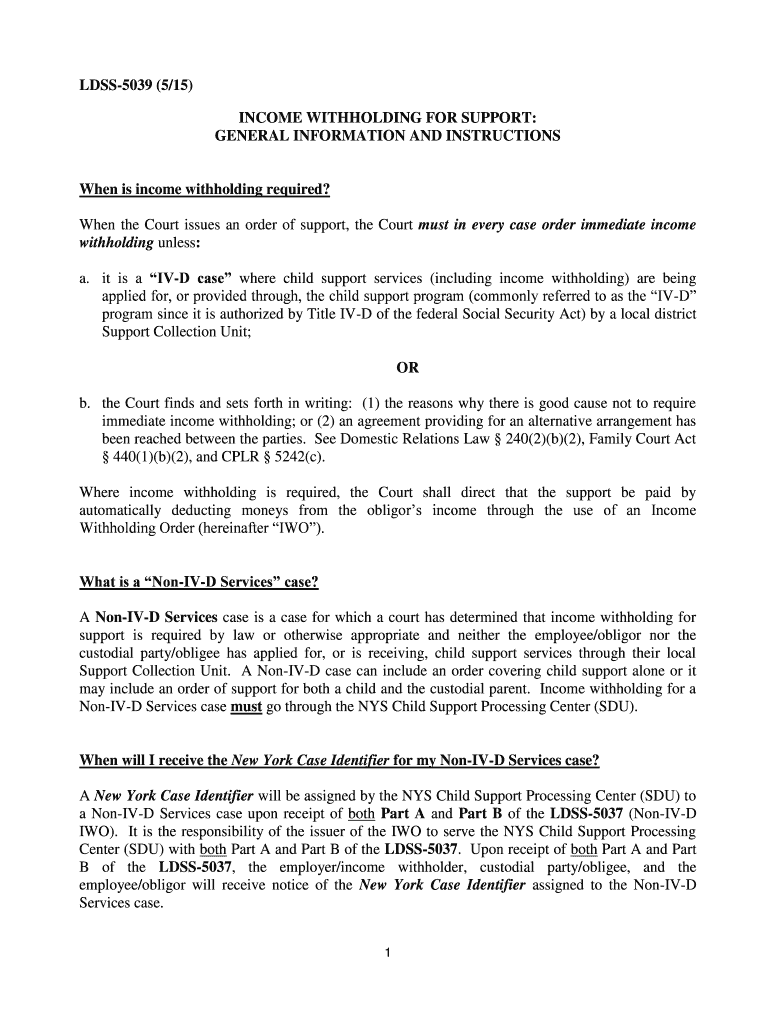
LDSS -5039 ( 5/15 )
INCOME WITHHOLDING FOR SUPPORT:
GENERAL INFORMATION AND INSTRUCTIONS
When is income withholding r equired?
When the Court issues an order of support, the Court must in every case order immediate income
withholding unless :
a. it is a “IV -D case” where child support services (including income withholding) are being
applied for, or provided through, the child support program (commonly referred to as the “IV -D”
program since it is authorized by Title IV -D of the federal Social Security Act) by a loc al district
Support Collection Unit;
OR
b. the Court finds and sets forth in writing: (1) the reasons why there is good cause not to require
immediate income withholding; or (2) an agreement providing for an alternative arrangement has
been reached between the parties. See Domestic Relations Law § 240(2)(b)(2), Family Court Act
§ 440(1)(b)(2), and CPLR § 5242(c).
Where income withholding is required, the Court shall direct that the support be paid by
automatically deducting moneys from the obligo r’s income through the use of an Income
Withholding Order (hereinafter “IWO”).
What is a “Non -IV -D Services” case?
A Non -IV -D Services case is a case for which a court has determined that income withholding for
support is required by law or otherwise a ppropriate and neither the employee/obligor nor the
custodial party/obligee has applied for, or is receiving, child support services through their local
Support Collection Unit. A Non -IV -D case can include an order covering child support alone or it
may i nclude an order of support for both a child and the custodial parent. Income withholding for a
Non -IV -D Services case must go through the NYS Child Support Processing Center (SDU).
When will I receive the New York Case Identifier for my Non -IV -D Service s case?
A New York Case Identifier will be assigned by the NYS Child Support Processing Center (SDU) to
a Non -IV -D Services case upon receipt of both Part A and Part B of the LDSS -5037 (Non -IV -D
IWO). It is the responsibility of the issuer of the IWO to serve the NYS Child Support Processing
Center (SDU) with both Part A and Part B of the LDSS -5037 . Upon receipt of both Part A and Part
B of the LDSS -5037 , the employer/income withholder , custodial party/obligee, and the
employee/obligor will receive notice of the New York Case Identifier assigned to the Non -IV -D
Services case.
2
What is a “Spousal Support Only” case?
A Spousal Support Only case is a case that has no child support ordered.
How do I complete the IWO?
Follow the field -by -field instructions below to properly complete the LDSS -5037 (Non -IV -D IWO)
and the LDSS -5038 (Spousal Support Only IWO). Use the instructions with the Numbered
Referen ce Tool s found on Pages 8 - 19. The person making the payment is the employee/obligor (or
debtor). The person receiving the payment is the custodial party/obligee (or creditor).
Note: If you wish to apply for child support services at this time, or y ou are already receiving
services, DO NOT fill out this IWO; an IWO will be prepared and sent by the Support Collection
Unit on your behalf.
Part A:
Field 1: Check the appropriate box to indicate the court that issued the underlying support
order to which this IWO relates. Provide the name of the county in which that court is
located.
Field 2: Provide the Index number of your Supreme Court divorce action or the Docket
number of your Family Court case.
Field 3: Provide the employee’s/obligor’s name (last, first, middle ).
Field 4: Provide the mailing address of the em ployee/obligor including the street, PO Box, city,
state, and zip code.
Note : This field is not applicable to Spousal Support Only IWOs and has been
omitted from Part A of the LDSS -5038.
Field 5: Provide the Social Security number or other taxpayer identification number of the
employee/obligor.
Field 6: Provide the birth date for the employee/obligor.
Field 7: Provide the custodial party/obligee’s name ( last, first, middle ).
Field 8: Provide the mailing address of the custodial party/obligee includi ng the street, PO
Box, city, state, and zip code.
Field 9: Provide the Social Security number or other taxpayer identification number of the
custodial party/obligee.
Note : This field is not applicable to Spousal Support Only IWOs and has been
omitted from Part A of the LDSS -5038.
Field 10: Provide the birth date for the custodial party/obligee.
Note : This field is not applicable to Spousal Support Only IWOs and has been
omitted from Part A of the LDSS -5038.
3
Part B:
Fields 1a -1d: Check the applicable box, depending on your situation.
Note : If you check box 1d “Termination of IWO” enter $0 in field 12a “Total Amount
to Withhold.”
Field 1e: Leave this field blank. The Court will fill in the date when the IWO is signed.
Field 1f: Check the appropriate box to indicate who is issuing the IWO. If you are giving this
form to a court or clerk of the court for signature, select “Court.” If the IWO will be
issued by a private attorney select “Attorney.” If the IWO will be issued by a s heriff,
select “Private Individual/Entity .”
Field 1g: Write in “New York.”
Field 1h: Provide the Index number of the Supreme Court divorce action or the Docket
number of the Family Court case in which the court issued the support order to which
this IWO relates.
Field 1i: Provide the name of the county where the divorce action or Family Court support case
referenced in Field 1h was filed.
Field 1j: Provide the Index number of your Supreme Court divorce action or the Docket
Number of the Family Court case in which the court issued the suppor t order to which
this IWO relates.
Field 1k: If “Private Individual/Entity” was selected for Field 1f (above), provide the name of
the sheriff issuing the IWO.
Field 1l : If this is an Original IWO or One -Time (Lump Sum) IWO establishing the income
withhold ing for support, leave this field blank. Once a copy of the completed IWO is
received by the NYS Child Support Processing Center (SDU), a New York Case
Identifier will be assigned for proper identification of remittances. For all other
actions regarding the IWO (i.e. amending or terminating) provide the New York Case
Identifier previously assigned.
Note : This field is not applicable to a Spousal Support Only IWO.
Field 2a: Provide the name of the employer/income withholder to whom the IWO will be sent
and who will be directed to withhold income.
Field 2b: Provide the mailing address of the employer/income withh older including the street,
PO Box, city, state, and zip code. (This may differ from the employee/obligor’s
worksite .) If the employer/income withholder is a federal government agency, provide
the address listed under Federal Agenc y Income Withholding Contacts - Addresses for
Income Withholding at www.acf.hhs.gov/programs/css/resource/federal -agency -
income -withholding -contact -information .
Field 2c: Provide the employer /income withholder ’s nine (9) digit Federal Employer
Identification Number (FEIN) if available.
Field 3a: Provide the employee’s/obligor’s name (last, first, middle ).
Field 3b: Provide the Social Security number or other taxpaye r identification number of the
employee/obligor.
Field 3c: Provide the name (last, first, middle) of the custodial party/ oblige e.
4
Field 3d: Provide the child(ren)’s name(s) ( last, first, middle). Note if there are more than six
children, you may attach an additional page. (Or you may utilize the blank space
above the lines provided for the first 6 children.)
Note : This field is not ap plicable to a Spousal Support Only IWO.
Field 3e: Provide the birth date for each child named.
Note : This field is not applicable to a Spousal Support Only IWO.
Field 3f: If the underlying support obligation to which this IWO relates was determined in a
divorce action in Supreme Court, write in the box: “Supreme Court of
_________County.” Then fill in the county where the divorce action was filed. If the
underlying support obligation to which this IWO relates is a Family Court order of
support, write in the box: “Family Court of _______ County.” Then fill in the county
where the petition was filed.
Field 4: This field has been pre -filled to make completion of the IWO easier for you.
Go to Field 5a.
Fill in the dollar amounts to be withheld for the specific time period as specified in the
applicable order of support. Copy this information from the applicable order of
support. For Field 6c, check the appropriate box to indicate whether arrears have
accrued for more than 12 weeks .
Note : Fields 5a, 5b, 6a, 6b, 7a, 7b, 8a and 8b are not applicable for Spousal Support
Only orders.
Field 12a: Enter the total of the amounts in Fields 5a -11a on Line 12a. This is the total
amount to withhold for the corresponding time period.
Note : For termination of an IWO, enter $0 in this field.
Field 12b: Enter the time period (e.g. week, month) specified in the underlying order for the
obligations contained in fields 5a - 11a.
If you are certain of the employer’s/inc ome withholder’s pay cycle, enter the value of
the obligation in the appropriate field. Only one field need be filled in.
If you are not certain of the employer’s/income withholder’s pay cycle, you must enter
a value in each of these fields. To do this, follow these instructions:
First calculate the amount of the obligation on a yearly basis (i.e., if the amount of
the obligation is weekly, multiply it by 52; if biweekly, multiply it by 26; if
semimonthly multiply it by 24; or if monthly, mu ltiply it by 12); then take the
yearly amount and divide it by the appropriate pay cycle (i.e., if weekly, by 52; if
biweekly, by 26; if semimonthly, by 24; and if monthly, by 12). Then enter the
recalculated amount in the proper field.
o Example 1: Assume t he support obligation is $100.00 biweekly. You know
that the employer’s/income withholder’s pay cycle is monthly. Then you
should multiply $100.00 by 26 to get the yearly obligation ($2,600.00). Then
divide that by 12 to get the monthly obligation ($216 .67). You would then
enter that value in field 13d.
o Example 2: Maybe you’re not sure of the employer’s/income withholder’s pay
cycle. Then you should again multiply $100.00 by 26 to get the yearly
obligation ($2,600.00). Then divide $2,600.00 by 52 to get the value for the
weekly value ($50.00); divide $ 2,600.00 by 26 to get the biweekly value
($100.00.); divide $2,600.00 by 24 to get the semimonthly value ($108.33);
Fields
5a -11c:
Fields
13 a-13d :
5
and divide $2,600.00 by 12 to get the monthly value ($216.67). You should
enter thes e values in fields 13a - 13d.
Field 13a: If the employer’s/income withholder’s pay cycle does not correspond with Field 12b,
enter the total amount the employer/income withholder should withhold if the
employee/obligor is paid weekly .
Field 13b: If the em ployer’s/income withholder’s pay cycle does not correspond with Field 12b,
enter the total amount the employer should withhold if the employee is paid twice a
month .
Field 13c: If the employer’s/income withholder’s pay cycle does not correspond with Field 12b,
enter the total amount the employer should withhold if the employee is paid every two
weeks.
Field 13d: If the employer’s/income withholder’s pay cycle does not correspond with Field 12b,
enter the total amount the employer should withhold if the empl oyee is paid once a
month.
Field 14: Complete if 1c (above) has been selected.
Fields 15 -20: These fields have been pre -filled to make completion of the IWO easier for you.
Go to Field 21.
Field 21: If you are submitting the IWO to a Court or Clerk of Court for issuance, leave this
field blank. If the IWO is issued by a private attorney or sheriff, the issuer may use
this space to note its own tracking identifier. This is optional .
Fields 22 -24: Th ese fields have been pre -filled to make completion of the IWO easier for you.
Go to Field 25.
Field 25: Do not check this box. It is for employer/income withholder use only, if applicable.
Fields 26 -29: If you are giving the IWO to a Court or C lerk o f Court for issuance, leave these spaces
blank. The Court will fill in this information when the IWO is signed by the Judge or
Clerk of Court. If the IWO is issued by a private attorney or sheriff, these fields
should be completed by the issuer.
Field 30: If the employee works in a state different from New York, check this box.
Fields 31 -33: These fields have been pre -filled to make completion of the IWO easier for you.
Note : The information included in Field 33 for service of Part A and Part B of the
IWO will vary depending upon the type of IWO served, i.e. whether it is a Non -IV -D
IWO processed through the NYS Child Support Processing Center (SDU) or whether
it is a Spousal Support Only IWO which is remitted/payable to the obligee.
Go to Field 34a.
Leave this section blank. It is for the employer/income withholder’s use only if
applicable.
Fields 42 -50: If you are submitting the IWO to a Court or Clerk of Court for issuance, leave this
field blank; it will filled in by the Court. If the IWO is issued by a private attorney or
sheriff, the issuer must fill in these blanks.
Copy the information from Fields 2a, 2c, 3a, 3b , and 1j into the corresponding fields at
the top of the 2nd, 3 rd, and 4 th pages of Part B ( pages 1 1-13 and 1 7-19 ). Leave the New
York Case Identifier field blank as instructed for Field 1l.
Fields
34 a-41 :
Top of
2nd – 4th
Pages,
Part B:
6
Where do I s erve the IWO?
For a Non -IV -D Services case, serve the completed LDSS -5037 as follows :
Part A: serve only upon the NYS Child Support Processing Center (SDU), PO Box 15363,
Albany, NY 12212 -5363.
Part B: serve upon all of the following:
1. employer/income withholder;
2. employee/obligor;
3. custodial party/obligee; and
4. NYS Child Support Processing Center (SDU)
PO Box 15363, Albany, NY 12212 -5363.
For a Spousal Support Only case, serve the completed LDSS -5038 as follows :
Part A: serve only upon the employer/income withholder.
Part B: serve upon all of the following:
1. employer/income withholder;
2. employee/oblig or; and
3. obligee.
What method of service do I use to s end the IWO?
You may use regular mail but it is suggested that you file an Affidavit of Service of the IWO with the
Clerk of the Court.
Do I need to send a copy of the underlying order of support with the IWO?
The Federal Office of Child Support Enforcement states that if the IWO is issued by a Court, a copy
of the underlying support order need not be attached to the IWO even in instances where the IWO is
served by a litigant or his/her representative acting on the Court’s instructions. See Field 1(f), Fields
26 -29, and Fields 42 -50 on the IWO for information about the Issuer.
If you have continuing questions about this instruction, you may contact the Child Support Helpline
toll free at 888 -208 -4485 (TTY: 866 -875 -9975) , Monday through Friday from 8:00 AM to 7:00
PM. (For Video Relay Service visit www.fcc.gov/encyclopedia/trs -providers ).
7
How do I r emit (send) payments for a Non -IV -D Services c ase?
You must include the following information with the payment:
o Remittance I D (once assigned, the New York Case Identifier will replace this);
o Pay date; and
o A notation of “Non -IV -D Services.”
Make the payment payable to the NYS Child Support Processing Center (SDU)
Mail the payment to:
NYS Child Support Processing Center (SDU)
PO Box 15363
Albany N Y 12212 -5363.
How do I r emit (send) payments f or a Spousal Support Only case?
You must follow the instructions contained in the IWO. If the LDSS -5038 was used by the
issuer, you must include the following information with the payment:
o Remittance ID;
o Pay date; and
o Employee/Obligor’s name.
Make the payment payable to the Obligee .
Mail the payment to the Obligee at the address provided on Part A of the LDSS -5038 .
How do I t erminate an IWO?
When terminating an IWO, basic information must be provided to enable proper identification by the
employer/income payor of the subject IWO. At a minimum, the following information must be
provided on Part B of the IWO to terminate a previously issued Original, Amended, or One -Time
(L ump Sum) IWO:
Field 1d – IWO Category (check the box marked “Termination of IWO”)
Field 1e – Date
Field 1f – Issuer Category
Field 1h – Remittance ID
Field 1l – New York Case Identifier (applicable to a Non -IV -D Case only)
Field 2a – Employer/Income Withholder’s Name
Field 2b – Employer/Income Withholder’s Address
Field 3a – Employee/Obligor’s Name
Field 3b – Employee/Obligor’s Social Security Number
Field 3c – Custodial Party/Obligee’s Name
Field 12a – Total Amount to Withhold (enter $0.00)
Fields 26 -29 – Judge/Issuing Official Identification box
Fields 42 -45 – Issuer Contact Information
Part A of the LDSS -5037 or LDSS -5038 need not be completed when terminating an IWO .
Note that a Termination of IWO must be served upon the employ er/income withholder,
employee/obligor, custodial party/obligee, and for a Non -IV -D Services case, also mailed to the NYS
Child Support Processing Center (SDU).
8
LDSS -5037 (5/15)
NUMBERED REFERENCE TOOL
Imp ortant N otice
INCOME WITHHOLDING ORDER
Court Information
1
□ Family Court: _________________ C ounty
□ Supreme Court: _________________ C ounty
2
Order ID (Index/ Docket Number )
Employee/Obligor Information
3
Name (Last, First , M iddle )
4
Mailing Address
5
Social Security Number - -
6
Date of Birth (MM/DD/YYYY) / /
Custodial Party/Obligee Information
7
Name ( Last, First , Middle)
8
Mailing Address
9
Social Security Number - -
10
Date of Birth (MM/DD/YYYY) / /
Part
A
Important Notice
If you are issuing a Non -IV -D Income Withholding Order for child support or combined
child and spousal support, you must serve the completed LDSS -5037 as follows:
Part A : serve only upon the NYS Child Support Processing Center (SDU), PO
Box 15363, Albany, NY 12212 -5363.
Part B: serve upon all of the following:
1. employer/income withholder;
2. employee/obligor;
3. custodial party/obligee; and
4. NYS Child Support Processing Center (SDU)
PO Box 15363, Albany, NY 12212 -5363.
9
Page intentionally left blank.
10
LDSS -5037 (5/15 )
NUMBERED REFERENCE TOOL
INCOME WITHHOLDING FOR SUPPORT
1a ORIGINAL INCOME WITHHOLDING ORDER/NOTICE FOR SUPPORT (IWO)
1b AMENDED IWO
1c ONE -TIME ORDER/NOTICE FOR LUMP SUM PAYMENT
1d TERMINATION OF IWO Date: ________ 1e _______________
1f Child Support Enforcement (CSE) Agency Court Attorney Private Individual/Entity (Check One)
NOTE: This IWO must be regular on its face. Under certain circumstances you must reject this IWO and return it to the sender (see
IWO instructi ons www. acf.hhs.gov/programs/css /resource/income -withholding -for -support -instructions ). If you receive this
document from someone other than a state or tribal CSE agency or a court, a copy of the underlying order must be attached.
State/Tribe/Territory _________ 1g ___________ Remittance ID (include w/payment) _____ ______ __1h _________
City/County/Dist./Tribe _________ 1i___________ Order ID_____ _______________ ______________ 1j__________
Private Individual/Entity ________ 1k ____________ New York Case ID__________________ ____ ____ 1l___ ____ ___
2a ________________________________ ___________ RE: 3a ________________________________ ___________
Employer/Income Withholder’s Name Employee/Obligor’s Name (Last, First, Middle)
2b ________________________________ ___________ 3b ________________________________ ___________
Employer/Income Withholder’s Address Employee/Obligor’s Social Security Number
________________________________ _____________ 3c ________________________________ ___________
Custodial Party/Obligee’s Name (Last, First, Middle)
________________________________ _____________
Employer/Income Withholder’s FEIN _______________ 2c
Child(ren)’s Name(s) (Last, First, Middle) Child(ren)’s Birth Date(s)
______________________________ ___________________
3d ____________________________ 3e _________________
______________________________ ___________________
______________________________ ___________________
______________________________ ___________________
______________________________ ___________________
ORDER INFORMATION : This document is based on the support or withholding order from New York State. 4
You are required by law to deduct these amounts from the employee/obligor’s income until further notice.
$ ____ 5a _____ Per ____ 5b _______ current child support
$ ____ 6a _____ Per ____ 6b _______ past -due child support – 6c Arrears greater than 12 weeks? Yes No
$ ____ 7a _____ Per ____ 7b _______ current cash medical support
$ ____ 8a _____ Per ____ 8b _______ past -due cash medical support
$ ____ 9a _____ Per ____ 9b _______ current spousal support
$ ___ 10a _____ Per ___ 10b _______ past -due spousal support
$ ___ 11a _____ Per ___ 11b _______ other (must specify)______ 11c ________________________________ _____ .
for a Total Amount to Withhold of $_____ 12a ______ per ____ 12b __________ .
AMOUNTS TO WITHHOLD: You do not have to vary your pay cycle to be in compliance with the Order Information . If
your pay cycle does not match the ordered payment cycle, withhold one of the following amounts:
$ ____ 13a __ per weekly pay period $___ 13b ____ per semimonthly pay pe riod (twice a month)
$ ____ 13c __ per biweekly pay period (every two weeks) $___ 13d ____ per monthly pay period
$_____ 14 ___ Lump Sum Payment: Do not stop any existing IWO unless you receive a termination order.
Document Tracking I D___________ 21 _______________ OMB 0970 -0154 1
Part
B
3f
Employer’s Name: ______________ 2a__________ Employer FEIN: __________ 2c___________
Employee/Obligor’s Name : _______3a____________________ SSN:_______________3b________
New York Case Identifier : _______1l___________ Order Identifier:____________1j___________
11
REMITTANCE INFORMATION : If the employee/obligor’s principal place of employment is New York State, you must
begin withholding no later than the first pay period that occurs 14 days after the date of service of this notice. Send
payment within 7 working days of the pay date. If you cannot withhold the full amount of support for any or all orders for
this employee/obligor, see Withholding Limits on page 3. If the obligor is a non -employee, obtain withholding lim its f rom
Supplemental Information on page 3. If the employee/obligor’s principal place of employment is not New York State,
obtain withholding limitations, time requirements, and any allowable employer fees at
www. acf.hhs.gov/programs/css/resource/ state -income -withholding -contacts -and -program -informa tion for the
employee/obligor’s principal place of employment.
For electronic payment requirements and centralized payment collection and disbursement facility information (State
Disbursement Unit (SDU)), contact the SDU at 888 -208 -4485 or see
www. acf.h hs.gov/programs/css/ employers /electronic -payments .
Include the Remittance ID (until a N ew York Case Identifier is received) , pay date , and write “Non -IV-D Services ” on the
payment.
Remit payment to: NYS Child Support Processing Center (SDU)
at PO Box 1536 3, Albany, NY 12212 -536 3
25 Return to Sender [Completed by Employer/Income Withholder]. Payment must be directed to an SDU in
accordance with 42 USC §666(b)(5) and (b)(6) or Tribal Payee (see Payments to SDU below). If payment is not directed
to an SDU/Tribal Payee or this IWO is not regular on its face, you must check this box and return the IWO to the sender.
Signature of J udge/Issuing Official (if required by State or Tribal Law):_____________ 26 __________________________
Print Name of Judge/Issuing Official: ________ 27 ________________________________ _________________________
Title of Judge/Issuing Official: ____________ 28 ________________________________ ___________________________
Date of Signature: ___________________ 29 ________________________________ ____________________________
If the employee/obligor works in a state or for a tribe that is different from the state or tribe that issued this order, a copy of
this IWO must be provided to the employee/obligor.
30 If checked, the employer/income withholder must provide a copy of this form to the employee/obligor . ADDITIONAL INFORMATION FOR EMPLOYERS/INCOME WITHHOLDERS
State -specific contact and withholding information can be found on the Federal Employer Services website located at:
www. acf.hhs.gov/programs/css/resource/ state -income -withholding -contacts -and -program -information . Priority: W ithholding for support has priority over any other legal process under State law against the same income ( 42
USC §6 66(b)(7)) . If a federal tax levy is in effect, please notify the sender. Combining Payment s: When remitting payments to an SDU or tribal CSE agency, you may combine withheld amounts
from more than one employee/obligor’s income in a single payment. You must, however, separately identify each
employee/obligor’s portion of the payment. Payments To SDU: You must send child support payments payable by income withholding to the appropriate SDU or to
a tribal CSE agency. If this IWO instructs you to send a payment to an entity other than an SDU (e.g., payable to the
custodial party, court, or attorney), you must check the box above and return this not ice to the sender. Exception: I f this
IWO was sent by a court, attorney, or private individual/ entity and the initial order was entered before January 1, 1994 or
the order was issued by a tribal CSE agency, you must follow the “Remit payment to” instructions on this form. Reporting the Pay Date: You must report the pay date when sending the payment. The pay date is the date on which
the amount was withheld from the employee/obligor’s wages. You must comply with the law of the state (or tribal law if
applicable) of the employee/obligor’s principal place of employment regarding time periods within whic h you must
implement the withholding and forward the support payments. Multiple IWOs: If there is more than one IWO against this employee/obligor and you are unable to fully honor all IWOs
due to federal, state, or tribal withholding limits, you must hon or all IWOs to the greatest extent possible, giving priority to
current support before payment of any past -due support. Follow the state or tribal law/procedure of the
employee/obligor’s principal place of employment to determine the appropriate allocatio n method.
OMB Expiration Date – 07/31/2017 . The OMB Expiration Date has no bearing on the termination date of the IWO; it
identifies the version of the form currently in use. 2
15
17 16
18
20
19
22
23 24
Employer’s Name: ______________ 2a__________ Employer FEIN: __________ 2c___________
Employee/Obligor’s Name : _______3a____________________ SSN:_______________3b________
New York Case Identifier : _______1l___________ Order Identifier:____________1j___________
12
Lump Sum Payments: You may be required to notify a state or tribal CSE agency of upcoming lump sum payments to
this employee/obligor such as bonuses, commissions, or severance pay. Contact the sender to determine if you are
required to report and/or withhold lump sum payments.
31 Liability: If you have any doubts about the validity of this IWO, contact the sender. If you fail to withhold income from the
employee/obligor’s income as the IWO directs, you are liable for both the accumulated amount you should have withheld
and any pe nalties set by state or tribal law/procedure , together with interest and reasonable attorney’s fees. If you comply
with this IWO you will not be subject to civil liability to any individual or agency for conduct in compliance with this IWO. In
New York S tate, pursuant to Civil Practice Law and Rules (CPLR) §5241 upon a finding by the Family Court that you
failed to withhold or remit withholdings as directed in this IWO, the Court shall issue an order directing your compliance
and may direct the payment of a civil penalty not to exceed $500 for the first instance and $1,000 per instance for the
second and subsequent instances of noncompliance.
32 Anti -discrimination: You are subject to a fine determined under state or tribal law for discharging an employee/obligor
from employment, refusing to employ, or taking disciplinary action against an employee/obligor because of this IWO. In
New York State, pursuant to CPLR §5252, the court may direct a civil penalty not to excee d $500 for the first instance and
$1,000 per instance for the second and subsequent instances of such discrimination.
Withholding Limits: You may not withhold more than the lesser of: 1) the amounts allowed by the Federal Consume r
Cre dit Protection Act (CCPA) (15 USC §1673(b)) ; or 2) the amounts allowed by the state of the employee/obligor’s
principal place of employment or tribal law if a tribal order (see Remittance Information ). Disposable income is the net
income after mandatory deductions such as: state, federal, local taxes; Social Security taxes; statutory pension
contributions; and Medicare taxes. The federal limit is 50% of the disposable income if the obligor is supporting another
family and 60% of the disposable income if the obligor is not supporting another family. However, those limits increase
5% - - to 55% and 65% - - if the arrears are greater than 12 weeks. If permitted by the state or tribe, you may deduct a
fee for administrative costs. The combined support amount and fee may not exceed the limit indicated in this section.
For tribal orders, you may not withhold more than the amounts allowe d under the law of the issuing t ribe. For tribal
employers/income withholders who receive a state IWO, you may not withhold more than the limit set by tribal law .
Depending upon applicable state or tribal law, you may need to consider amounts paid for health care premiums in
determining disposable income and applying appropriate withholding limi ts.
Arrears greater than 12 weeks? If the Order Information does not indicate that the arrears are greater than 12 weeks,
then the employer should calculate the CCPA limit using the lower percentage.
33 Supplemental Information: (1) PART A of this form contains sensitive information and must be served only upon the
NYS Child Support Processing Center (SDU) ; PART B , which consists of 4 pages, must be served upon the SDU,
employer/income withholder, employee/obligor, and custodial party/obligee. (2) Priority of wit hholding pursuant to CPLR
§5241 (h) is current support, followed by health insurance premiums, and then arrears payments. (3 ) If there are multiple
IWOs against this employee/obligor, withhold the maximum amount permitted under the CCPA (see Withholding Limits ,
above) and pay to each creditor the proportion ther eof which such creditor’s claim bea rs to the combined total. (4) Where
the income is compensation that is not paid or payable to the obligor for personal services, there is no limit to the amount
you must withhold . (5) I f the employee/obligor is reinstated or re employed within 90 days after terminatio n, this IWO is
stil l in effect.
IMPORTANT: The person completing this form is advised that the information may be shared with the employee/obligor.
3
Employer’s Name: ______________ 2a__________ Employer FEIN: __________ 2c___________
Employee/Obligor’s Name : _______3a____________________ SSN:_______________3b________
New York Case Identifier : _______1l___________ Order Identifier:____________1j___________
13
NOTIFICATION OF EMPLOYMENT TERMINATION OR INCOME STATUS: If this employee/obligor never worked for
you or you are no longer withholding income for this employee/obligor, you must promptly notify the CSE agency and/or
the sender by returning this form to the address listed in the Contact Information below:
34a This person has never worked for this employer nor received periodic income.
34b This person no longer works for this employer nor receives periodic income .
Please provide the following information for the employee/obligor: Termination date:_______ 35 ____________________________ Last known phone number: _________ 36 __________
Last known address: ____ 37 ________________________________ ________________________________ _________
________________________________ ________________________________ ________________________________ _
Final payment date to SDU/ tribal payee: ______ 38 _________ Final payment amount: _________ 39 ____________
New employer’s name:____________ 40 ________________________________ ________________________________
New employer’s address:__________ 41 ________________________________ ________________________________ _
________________________________ ________________________________ ________________________________ _ CONTACT INFORMATION:
To Employer/Income Withholder: If you have questions , contact ____ 42 ______________________ ___ (issuer name)
by phone: _______ 43 ______ ,by fax : ______ 44 ___ _____, by e -mail or website: _______ __ ____ 45 ____________ ___ __.
Send termination/income status notice and other correspondence to :_____________ 46 ___________________________
___________________________________________________________________________________ ( issuer address).
To Employee/Obligor: If the employee/obligor has questions , contact _________ 47 ________________ ( issuer name)
by phone : _____ 48 ________, by fax : ______ 49 ________, by e -mail or website : _____________ 50 __________ ____ ___.
The Paperwork Reduction Act of 1995
This information collection and associated responses are conducted in accordance with 45 CFR 303.100 of the Child
Support Enforcement Program. This form is designed to provide uniformity and standardization. Public reporting burden
for this collection of inform ation is estimated to average 5 minutes per response for Non -IV-D CPs; 2 minutes per
response for employers; 3 seconds for e -IWO employers, including the time for reviewing instructions, gathering and
maintaining the data needed, and reviewing the collecti on of information.
An agency may not conduct or sponsor, and a person is not required to respond to, a collection of information unless it
displays a currently valid OMB control number.
4
14
LDSS -5038 ( 5/15 )
NUMBERED REFERENCE TOOL
INCOME WITHHOLDING ORDER
Court Information
1
□ Family Court: _________________ County
□ Supreme Court: _________________ County
2
Order ID (Index/Docket Number)
Employee/Obligor Information
3
Name (Last, First, Middle)
5
Social Security Number - -
6
Date of Birth (MM/DD/YYYY) / /
Obligee Information
7
Name ( Last, First , Middle)
8
Mailing Address
Part
A
Important N otice
If you are issuing a Spousal Support Only Income Withholding
Order, yo u must serve the completed LDSS -5038 as follows:
Part A: serve only upon the employer/income withholder.
Part B: serve upon all of the following:
1. employer/income withholder;
2. employee/obligor; and
3. obligee.
15
Page intentionally left blank.
16
LDSS -5038 (5/15)
NUMBERED REFERENCE TOOL
INCOME WITHHOLDING FOR SUPPORT
1a ORIGINAL INCOME WITHHOLDING ORDER/NOTICE FOR SUPPORT (IWO)
1b AMENDED IWO
1c ONE -TIME ORDER/NOTICE FOR LUMP SUM PAYMENT
1d TERMINATION OF IWO Date: ________1e_______________
1f Child Support Enforcement (CSE) Agency Court Attorney Private Individual/Entity (Check One)
NOTE: This IWO must be regular on its face. Under certain circumstances you must reject this IWO and return it to the sender (see
IWO instructions www. acf.hhs.gov/progra ms/css/resource/income -withholding -for -support -instructio ns ). If you receive this
document from someone other than a state or tribal CSE agency or a court, a copy of the underlying order must be attached.
State/Tribe/Territory _________ 1g ___________ Remittance ID (include w/payment)_____ __ _____ _1h __ __ __ ___ __
City/County/Dist./Tribe _________ 1i___________ Order ID____________________________ _____ _1j_____ ___ __ __
Private Individual/Entity ________ 1k ____________ New York Case I D________________ ___ ___ __ __ 1l______ ___ ___
2a ________________________________ ___________ RE: 3a ________________________________ ___________
Employer/Income Withholder’s Name Employee/Obligor’s Name (Last, First, Middle)
2b ________________________________ ___________ 3b ________________________________ ___________
Employer/Income Withholder’s Address Employee/Obligor’s Social Security Number
________________________________ _____________ 3c ________________________________ ___________
Custodial Party/ Obligee’s Name (Last, First, Middle)
________________________________ _____________
Em ployer/Income Withholder’s FEIN _______________ 2c ________________________________ _____________
Child(ren)’s Name(s) (Last, First, Middle) Child(ren)’s Birth Date(s)
______________________________ ___________________
3d ____________________________ 3e _________________
______________________________ ___________________
______________________________ ___________________
______________________________ ___________________
______________________________ ___________________
ORDER INFORMATION : This document is based on the support or withholding order from New York State. You are 4
required by law to deduct these amounts from the employee/obligor’s income until further notice.
$____5a_______ Per ______ 5b______ current child support
$ ___ 6a_______ Per ______ 6b______ past -due child support - 6c Arrears greater than 12 weeks? Yes No
$ ___ 7a_______ Per ______ 7b______ current cash medical support
$ ___ 8a_______ Per ______ 8b______ past -due cash medical support
$____ 9a ______ Per ____ _9b _____ current spousal support
$___ 10a ______ Per ___ _10b _____ past -due spousal support
$___ 11a ______ Per ___ _11b _____ other (must specify)______ 11c ________________________________ _____ .
for a Total Amount to Withhold of $_____ 12a ______ per ____ 12b _________ ..
AMOUNTS TO WITHHOLD: You do not have to vary your pay cycle to be in compliance with the Order Information . If
your pay cycle does not match the ordered payment cycle, withhold one of the following amounts:
$ ____ 13a __ per weekly pay period $___ 13b ____ per semimonthly pay period (twice a month)
$ ____ 13c __ per biweekly pay period (every two weeks) $___ 13d ____ per monthly pay period
$_____ 14 ___ Lump Sum Payment: Do not stop any existing IWO unless you receive a termination order.
Document Tracking I D___________ 21 _____________ OMB 0970 -0154
1
3f
Part
B
Employer’s Name: ______________ 2a__________ Employer FEIN: __________ 2c___________
Employee/Obligor’s Name: _______3a____________________ SSN:________ ____3b_____ ___ __ _
New York Case Identifier : _______1l___________ Order Identifier:____________1j___________
17
REMITTANCE INFORMATION : If the employee/obligor’s principal place of employment is New York State, you must
begin withholding no later than the first pay period that occurs 14 days after the date of service of this n otice . Send
payment within 7 working days of the pay date. If you cannot withhold the full amount of support for any or all orders for
this employee/obligor, see Withholding Limits on page 3. If the obligor is a non -employee, obtain withholding limits from
Supplemental Information on page 3. If the employee/obligor’s principal place of employment is not New York State,
obtain withholding limitations, time requirements, and any allowable employer fees at
www. acf.hhs.gov/programs/css/resource/ state -income -withholding -contacts -and -program -informa tion for the
employee/obligor’s principal place of employment.
Include the Remittance ID , pay date and employee/obligor’s name on the payment.
Make payments payable in the name of the obligee identified on PART A.
Remit payment to obligee’s address identified on PART A.
Return to Sender [Completed by Employer/Income Withholder]. Payment must be directed to an SDU in accordance
with 42 USC §666(b)(5) and (b)(6) or Tribal Payee (see Payments to SDU below). If payment is not directed to an
SDU/Tribal Payee or this IWO is not regular on its face, you must check this box and return the IWO to the sender.
Signature of Judge/Issuing Official (if required by State or Tribal Law):_____________ 26 __________________________
Print Name of Judge/Issuing Official: ________ 27 ________________________________ _________________________
Title of Judge/Issuing Official: ____________ 28 ________________________________ ___________________________
Date of Signature: ___________________ 29 ________________________________ ____________________________
If the employee/obligor works in a state or for a tribe that is different from the state or tribe that issued this order, a copy of
this IWO must be provided to the employee/obligor.
30 If checked, the employer/income withholder must provide a copy of this form to the employee/obligor. ADDITIONAL INFORMATION FOR EMPLOYERS/INCOME WITHHOLDERS
State -specific contact and withholding information can be found on the Federal Employer Services website located at:
www. acf.hhs.gov/programs/css/resource/ state -income -withholding -contacts -and -program -information .
Priority: W ithholding for support has priority over any other legal process under State law against the same income (42
USC §666(b)(7 )). If a federal tax levy is in effect, please notify the sender.
Combining Payments: When remitting payments to an SDU or tribal CSE agency, you may combine withheld amounts
from more than one employee/obligor’s income in a single payment. You must, however, separately identify each
employee/obligor’s portion of the payment . Payments To SDU: You must send child support payments payable by income wit hholding to the appropriate SDU or to
a tribal CSE agency. If this IWO instructs you to send a payment to an entity other than an SDU (e.g., payable to the
custodial party, court, or attorney), you must check the box above and return this notice to the sen der. Exception: If this
IWO was sent by a court, attorney, or private individual/ entity and the initial order was entered before January 1, 1994 or
the order was issued by a tribal CSE agency, you must follow the “Remit payment to” instructions on this f orm. Reporting the Pay Date: You must report the pay date when sending the payment. The pay date is the date on which
the amount was withheld from the employee/obligor’s wages. You must comply with the law of the state (or tribal law if
applicable) of the employee/obligor’s principal place of employment regarding time periods within which you must
implement the withholding and forward the support payments.
Multiple IWOs: If there is more than one IWO against this employee/obligor and you are unable t o fully honor all IWOs
due to federal, state, or tribal withholding limits, you must honor all IWOs to the greatest extent possible, giving priority to
current support before payment of any past -due support. Follow the state or tribal law/procedure of the
employee/obligor’s principal place of employment to determine the appropriate allocation method.
OMB Expiration Date – 07/31/2017. The OMB Expiration Date has no bearing on the termination date of the IWO; it
identifies the version of the form currently in use. 2
15
16 17
18 19
20
22
23 24
25
Employer’s Name: ______________ 2a__________ Employer FEIN: __________ 2c___________
Employee/Obligor’s Name: _______3a____________________ SSN:________ ____3b_____ ___ __ _
New York Case Identifier : _______1l___________ Order Identifier:____________1j___________
18
Lump Sum Payments: You may be required to notify a state or tribal CSE agency of upcoming lump sum payments to
this employee/obligor such as bonuses, commissions, or severance pay. Contact the sender to determine if you are
required to report and/or withhold lump sum payments.
31 Liability: If you have any doubts about the validity of this IWO, contact the sender. If you fail to withhold income from the
employee/obligor’s income as the IWO directs, you are liable for both the accumulated amount you should have withheld
and any penalties se t by state or tribal law/procedure, together with interest and reasonable attorney’s fees. If you comply
with this IWO you will not be subject to civil liability to any individual or agency for conduct in compliance with this IWO. In
New York State, purs uant to Civil Practice Law and Rules (CPLR) §5241, upon a finding by the Family Court that you
failed to withhold or remit withholdings as directed in this IWO, the Court shall issue an order directing your compliance
and may direct the payment of a civil penalty not to exceed $500 for the first instance and $1,000 per instance for the
second and subsequent instances of noncompliance.
32 Anti -discrimination: You are subject to a fine determined under state or tribal law for discharging an employee/obligor
from employment, refusing to employ, or taking disciplinary action against an employee/obligor because of this IWO. In
New York State, pursuant to CPLR §5252, the court may direct a civil penalty not to exceed $500 for the first instance and
$1,000 per i nstance for the second and subsequent instances of such discrimination.
Withholding Limits: You may not withhold more than the lesser of: 1) the amounts allowed by the Federal Consumer
Credit Protection Act (CCPA) (15 USC §1673(b)); or 2) the amounts al lowed by the state of the employee/obligor’s
principal place of employment or tribal law if a tribal order (see Remittance Information ). Disposable income is the net
income after mandatory deductions such as: state, federal, local taxes; Social Security taxes; statutory pension
contributions; and Medicare taxes. The federal limit is 50% of the disposable income if the obligor is supporting another
family and 60% of the disposable income if the obligor is not supportin g another family. However, those limits increase
5% - - to 55% and 65% - - if the arrears are greater than 12 weeks. If permitted by the state or tribe, you may deduct a
fee for administrative costs. The combined support amount and fee may not exceed th e limit indicated in this section.
For tribal orders, you may not withhold more than the amounts allowed under the law of the issuing tribe. For tribal
employers/income withholders who receive a state IWO, you may not withhold more than the limit set by tribal law.
Depending upon applicable state or tribal law, you may need to consider amounts paid for health care premiums in
determining disposable income and applying appropriate withholding limits.
Arrears greater than 12 weeks? If the Order Information does not indicate that the arrears are greater than 12 weeks,
then the employer should calculate the CCPA limit using the lower percentage.
33 Supplemental Information: (1) PART A of this form contains sensitive information and must be serv ed only upon the
employer/income withholder for purposes of processing the income withholding; PART B, which consists of 4 pages, must
be served upon the employer/income withholder, employee/obligor, and obligee. (2) Priority of wit hholding pursuant to
CP LR §5241 (h) is current support, followed by health insurance premiums, and then arrears payments. (3) If there are
multiple IWOs against this employee/obligor, withhold the maximum amount permitted under the CCPA (see Withholding
Limits, above ) and pay to each creditor the proportion thereof which such creditor’s claim bears to the combined total. (4)
Where the income is compensation that is not paid or payable to the obligor for personal services, there is no limit to the
amount you must with hold . (5) If the employee/obligor is reinstated or reemployed within 90 days after termination, this
IWO is still in effect.
IMPORTANT: The person completing this form is advised that the information may be shared with the employee/obligor .
3
Employer’s Name: ______________ 2a__________ Employer FEIN: __________ 2c___________
Employee/Obligor’s Name: _______3a____________________ SSN:________ ____3b_____ ___ __ _
New York Case Identifier : _______1l___________ Order Identifier:____________1j___________
19
NOTIFICATION OF EMPLOYMENT TERMINATION OR INCOME STATUS: If this employee/obligor never worked for
you or you are no longer withholding income for this employee/obligor, you must promptly notify the CSE agency and/or
the sender by returning this form to the address listed in the Contact Information below :
34a This person has never worked for this employer nor received periodic income.
34b This person no longer works for this employer nor receives periodic income.
Please provide the following information for the employee/obligor:
Termination date: _______ 35 ___________________________ Last known phone number: _________ 36 __________
Last known address: ____ 37 ________________________________ ________________________________ _________
________________________________ ________________________________ ________________________________ _
Final payment date to Obligee/ tribal payee : ______ 38 ___________________ Final payment amount: _________ 39 ___
New employer’s name: ____________ 40 ________________________________ ________________________________
New employer’s address: __________ 41 ________________________________ ________________________________
________________________________ ________________________________ ________________________________ _
CONTACT INFORMATION: To Employer/Income Withholder: If you have questions, contact ____ 42 ______________________ ___ (issuer name)
by phone : _______ 43 ______, by fax : ______ 44 ________, by e -mail or website : ________ __ ___ 45 ____ __ ___________.
Send termination/income status notice and other correspondence to :_____________ 46 __________________ ________
___________________________________________________________________________________ ( issuer address).
To Employee/Obligor: If the employee/obligor has questions, contact _________ 47 ________________ ( issuer name)
by phone : _____ 48 ________, by fax: ______ 49 ________, by e -mail or website : _____________ 50 ______ ____ _______
The Paperwork Reduction Act of 1995
This information collection and associated responses are conducted in accordance with 45 CFR 303.100 of the Child
Support Enforcement Program. This form is designed to provide uniformity and standardization. Public reporting burden
for this collec tion of information is estimated to average 5 minutes per response for Non -IV-D CPs; 2 minutes per
response for employers; 3 seconds for e -IWO employers, including the time for reviewing instructions, gathering and
maintaining the data needed, and reviewin g the collection of information.
An agency may not conduct or sponsor, and a person is not required to respond to, a collection of information unless it
displays a currently valid OMB control number.
4