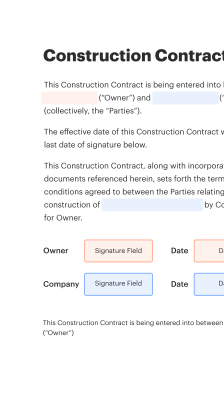
Add Signature Date with SignNow's eSignature Solution
What it means to add signature date
Why capturing the signature date matters
A clear signature date establishes when obligations begin, supports compliance and auditability, and reduces disputes about timing in legal or administrative processes.
Common problems when signature dates are missing
- Unclear contract effective date increases risk of performance disputes and late responsibilities.
- Manual date entry can lead to inconsistent formats and transcription errors across documents.
- Missing timestamps complicate regulatory audits and make it harder to demonstrate timely consent.
- Delayed or post-dated entries raise questions about the authenticity of execution timing.
Representative users and roles
HR Manager
An HR manager uses a required signature date field to ensure offer letters and consent forms show the exact execution date, simplifying onboarding timelines and payroll activation while maintaining a reliable audit trail for personnel records.
Real Estate Broker
A broker requires precise execution dates on agreements to determine contingency timelines and closing schedules, and to provide lenders and title companies with clear documentary evidence of contract formation and acceptance dates.
Who typically needs to add signature date
Legal, HR, sales, and finance teams frequently require consistent signature dates to establish contract timing and compliance.
- Legal teams managing execution and enforcement schedules.
- Human resources for offer letters and policy acknowledgments.
- Sales and account teams for executed agreements and renewals.
Consistent date capture supports internal controls and simplifies downstream processes such as renewals, billing, and compliance tracking.
Choose a better solution
Essential features for reliable signature date capture
Required Date Field
A configurable field that forces entry or auto-population of the signature date, ensuring no document completes without a recorded execution date and reducing manual omissions across workflows.
Auto Timestamp
Automatic server-side timestamping when the final signature is applied, creating a cryptographically verifiable time record distinct from any manually entered date for audit and evidentiary purposes.
Format Validation
Configurable date format enforcement and validation rules to maintain consistency across documents and locales, preventing ambiguous date formats and ensuring alignment with organizational standards.
Audit Trail Linkage
Full linkage between the visible date field and the underlying audit trail entry so administrators and auditors can trace who signed and precisely when the signing event occurred.
How signature date capture works across platforms
-
Signer-entered: Signer types the execution date manually.
-
Auto-populated: System inserts date when signature applied.
-
Audit entry: Timestamp recorded in the transaction log.
-
Format settings: Administrator chooses date format and validation.
Step-by-step: how to add signature date to a document
-
01Upload document: Add the file to your account workspace.
-
02Place date field: Drag a date field near the signature block.
-
03Set field rules: Make the date required or auto-fill.
-
04Send for signature: Route the document to signers with instructions.
Why choose airSlate SignNow
-
Free 7-day trial. Choose the plan you need and try it risk-free.
-
Honest pricing for full-featured plans. airSlate SignNow offers subscription plans with no overages or hidden fees at renewal.
-
Enterprise-grade security. airSlate SignNow helps you comply with global security standards.
Configuring workflows to include signature dates
| Setting Name | Configuration |
|---|---|
| Require signature date field | Enabled by default |
| Date field validation rule | ISO 8601 format |
| Auto-timestamp option | Server-side timestamp |
| Reminder frequency | 48 hours |
| Signature order enforcement | Sequential signing |
Platform and device considerations for adding signature date
Date capture works on web, mobile, and tablet platforms but administrators should confirm specific feature parity and format handling across clients.
- Web browser: Full feature set
- iOS and Android: Core features supported
- Offline signing: Limited or queued timestamps
Verify how auto-populated timestamps are generated on each platform and whether offline or queued signing changes the recorded timestamp so policies match technical behavior and evidentiary needs.
Real-world examples of adding signature date
Case Study 1
A mid-size employer implemented required signature dates on offer letters to ensure consistent onboarding timelines and benefits eligibility verification.
- Required date field enforced during signing.
- Resulted in immediate clarity for HR and new hires about start dates.
Leading to faster payroll setup and fewer eligibility disputes.
Case Study 2
A regional real estate firm standardized execution pages with an auto-populated signature date to remove ambiguity about acceptance times in purchase agreements.
- Date captured automatically when last signature applied.
- Benefit included precise contingency countdowns for inspections and financing.
Resulting in fewer closing delays and clearer communications with lenders and title companies.
Best practices for secure and accurate signature dates
Troubleshooting common issues when adding a signature date
- Date field not appearing on document
Confirm the date field was placed on the correct page and layer, check template permissions to ensure the signer can view and edit the field if configured as signer-entered, and verify that the field is not conditional on another input.
- Auto-timestamp not recorded
Review workflow settings to ensure server-side timestamping is enabled, check for any offline or queued signing states that delay recording, and inspect the transaction log for the signing event to confirm whether a timestamp entry exists.
- Incorrect date format displayed
Adjust the document or template date format validation to the desired locale or ISO 8601 format, update signer locale settings if available, and test by executing a sample signing to confirm the displayed format matches expectations.
- Signer entered a different date than system timestamp
If manual entry is allowed, retain both the visible signer-entered date and the system timestamp in the audit trail; consider switching to auto-populate or make the signer-entered date read-only to prevent discrepancies.
- Missing audit trail entry for execution
Check administrative logs for retention or export settings that may archive older transactions, confirm audit logging remains enabled for the account, and contact the platform's support team if server logs appear incomplete.
- Dispute about when signature occurred
Provide the immutable audit record showing the server timestamp and signer identity, correlate the timestamp with access logs and IP metadata if available, and rely on these linked records to resolve timing disputes.
Feature availability comparison: signature date essentials
| Feature | signNow (Recommended) | DocuSign | Adobe Sign |
|---|---|---|---|
| Bulk Send | |||
| Mobile App Availability | |||
| Audit Trail | |||
| API / SDK Access | REST API | REST API | REST API |
Get legally-binding signatures now!
Risks of incorrect or missing signature dates
Pricing snapshot and plan comparison for signature date features
| Attribute | signNow (Recommended) | DocuSign | Adobe Sign | Dropbox Sign | PandaDoc |
|---|---|---|---|---|---|
| Starting Plan | Business Starter | Personal | Individual | Essentials | Essentials |
| Monthly Price per User | Approximately $8 per user | Approximately $10 per user | Approximately $14.99 per user | Approximately $15 per user | Approximately $19 per user |
| Free Tier Availability | Free trial available | Limited free trial | Free trial available | Limited free tier | Free trial available |
| Advanced Authentication | SMS and knowledge-based options | SMS and ID verification | Federated SSO and ID checks | SMS and SSO | SSO and two-factor |
| Enterprise SLA and Support | Custom SLAs available | Enterprise support packages | Enterprise agreements available | Enterprise support options | Dedicated enterprise support |
Simplify complex workflows
Create, execute, and manage workflows of any complexity, electronically from virtually anywhere. Scalable eSignature capabilities allow you to share documents with the right people in the correct order and define roles for each recipient. Execute document workflows faster and easier than ever before.
Automate document management
Optimize complex signing processes with airSlate SignNow’s powerful features to enhance your business. Control your automated eSignature workflows to ensure they're running at peak performance with instant notifications and reminders.
Optimize in team collaboration
Bring teams together in a secure, shared environment. Manage documents, use form templates and notifications to create more efficient cross-organization collaboration. Free your employees from having to spend time on repetitive activities so that they can focus on valuable, business-critical tasks.
Integrate into your existing systems
Run your projects with industry-leading integration. Collect Salesforce, Microsoft Teams, and SharePoint all in one business flow. Connect your software to a single system for endless possibilities and more productiveness.
Stay compliant with best-in-class data security
Feel confident understanding that your information is protected by the latest in encryption security. airSlate SignNow is GDPR and eIDAS compliant and gives you awareness into your signing process with court-admissible audit trails. Set up user access permissions and roles to control who has access to what.