CPQ Tools for Efficient Document Management

airSlate SignNow simplifies eSigning with an intuitive interface, making it cost-effective and efficient for businesses to manage their documents.

Award-winning eSignature solution

What CPQ tools are and how they fit into sales operations

CPQ tools (Configure, Price, Quote) automate the creation of accurate sales quotes by combining product configuration, pricing logic, and proposal generation. They reduce manual errors, accelerate quote cycles, and enforce approved discounts and contract language. Deployed alongside CRM and document systems, CPQ tools centralize pricing rules, track versioning, and output standardized proposals ready for approvals and signature. Organizations typically use CPQ to manage complex product bundles, dynamic pricing, multi-tier discounts, and to produce compliant documents for downstream workflows and audit reporting.

Why organizations adopt CPQ tools

CPQ tools improve quote accuracy, shorten sales cycles, and ensure consistent pricing and contract language across teams while integrating with CRM and signature systems for end-to-end automation.

Why organizations adopt CPQ tools

Common adoption and operational challenges

  • Complex product catalogs require careful data modeling and ongoing maintenance to reflect real SKUs and options.
  • Inconsistent pricing rules across regions create disputes and require centralized governance to resolve quickly.
  • Integration gaps between CPQ, CRM, and document signing can cause manual handoffs and delays.
  • Change management for sales teams is necessary to ensure templates and approvals are used correctly.

Representative user profiles for CPQ deployments

Sales Operations

A Sales Operations Manager configures product bundles, maintains pricing logic, and manages approval workflows. They coordinate with finance to ensure discounts are within policy and work with IT to integrate CPQ with CRM and eSignature systems for a seamless quote-to-cash process.

CPQ Administrator

A CPQ Administrator models product rules, creates templates, and applies version control. They troubleshoot configuration issues, run test scenarios for edge cases, and train sales staff on correct usage to prevent pricing and quoting errors.

Typical users and teams that rely on CPQ tools

CPQ tools are used by a mix of commercial and operations teams that need accurate quotes fast.

  • Sales representatives who need fast, compliant quotes for customer conversations.
  • Sales operations and pricing analysts who maintain rules and approvals.
  • Channel managers and partners generating quotes across distributors or resellers.

Adoption succeeds when sales, finance, and product teams collaborate on rules, templates, and user training to keep quotes accurate and compliant.

Core CPQ capabilities to evaluate

These capabilities influence speed, accuracy, and compliance when selecting or evaluating CPQ tools for your organization.

Product rules

Rule engines enforce valid product combinations, prerequisites, and exclusions to prevent invalid quotes and production issues, reducing returns and rework associated with incorrect orders.


Dynamic pricing

Support for list, tiered, usage, and discount schedules ensures accurate pricing under complex commercial models and adapts to promotions or temporary price changes with auditability.

Approval workflows

Configurable approval chains route high-risk or high-discount quotes to finance or management, embedding controls that help limit unauthorized pricing decisions and maintain governance.

Proposal generation

Automated document assembly builds customer-facing proposals and contracts with populated fields, line-item tables, and terms tailored to the agreed configuration, improving consistency.

Version control

Tracking versions for templates and generated proposals preserves historical records for audits and dispute resolution while enabling rollbacks to previous approved templates.

Analytics and reporting

Sales and operations dashboards provide visibility into pipeline conversion, discounting trends, and quote turnaround times to inform commercial decisions.

be ready to get more

Choose a better solution

Integration touchpoints and document features

Effective CPQ setups connect to core document and storage systems to keep quotes current, track versions, and manage signatures.

CRM Integration

Bi-directional CRM links sync account, opportunity, and product data so quotes automatically reflect current customer context and deal stage; this reduces rekeying and ensures consistent records across systems.

Cloud document sync

Connectors to Google Drive, Dropbox, or OneDrive keep proposal files synchronized and accessible for collaboration, ensuring the most recent templates and attachments are used in every quote.

Template library

Centralized templates standardize contract clauses, pricing tables, and commercial terms across teams so generated proposals comply with company-approved language and formatting standards.

eSignature integration

Linking CPQ output to an eSignature provider creates a seamless path to signature and execution while preserving audit trails and signed document storage within the workflow.
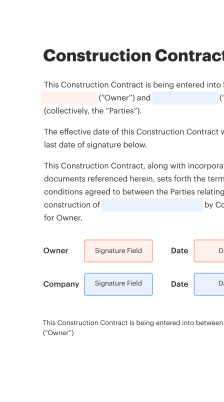
How to create and manage CPQ quotes online

A typical online CPQ flow assembles configuration, calculates price, applies approvals, and outputs a signed-ready document.

  • Configure: Select products and options
  • Price: Apply pricing logic and discounts
  • Approve: Route for required approvals
  • Deliver: Generate proposal for signature
Collect signatures
24x
faster
Reduce costs by
$30
per document
Save up to
40h
per employee / month

Quick setup steps to start using CPQ tools

Follow these core steps to configure a basic CPQ process that integrates with CRM and document signing.

  • 01
    Model products: Define SKUs and options
  • 02
    Set pricing: Implement rules and discounts
  • 03
    Create templates: Build quote and proposal templates
  • 04
    Connect systems: Integrate CRM and signing tools

Managing audit trails and signed documents

Maintain clear audit trails and document records to support compliance, dispute resolution, and financial controls in quote and contract lifecycles.

01

Enable logging:

Capture all events
02

Store signed copies:

Immutable storage
03

Timestamping:

Secure UTC timestamps
04

User identity:

Record signer details
05

Export capability:

Downloadable audit reports
06

Retention policy:

Policy-driven retention
be ready to get more

Why choose airSlate SignNow

  • Free 7-day trial. Choose the plan you need and try it risk-free.
  • Honest pricing for full-featured plans. airSlate SignNow offers subscription plans with no overages or hidden fees at renewal.
  • Enterprise-grade security. airSlate SignNow helps you comply with global security standards.
illustrations signature

Typical workflow configuration settings for CPQ

Below are standard workflow settings and recommended configuration values to establish consistent quote generation and approval behavior.

Feature Configuration
Approval Threshold Discount percent
Reminder Frequency 48 hours
Document Retention 7 years
Template Versioning Policy Automatic
API Rate Limit 500 requests/min

Supported platforms and device considerations

CPQ tools should support modern web browsers and mobile access to serve field sales and remote teams effectively.

  • Web browsers: Chrome, Edge, Safari
  • Mobile OS: iOS and Android
  • Integrations: SAML SSO and APIs

Ensure supported browsers, mobile operating systems, and device performance requirements are validated during pilot testing; check compatibility with single sign-on providers, and confirm that offline or mobile-limited scenarios are handled gracefully for field quoting.

Security and authentication features to expect

Encryption at rest: AES-256 or equivalent
Encryption in transit: TLS 1.2+ for data
Multi-factor authentication: Optional MFA support
Single sign-on: SAML and OAuth
Access logging: Detailed access logs
Role-based access: Scoped permissions

Industry examples showing CPQ impact

Concrete use cases illustrate how CPQ tools streamline quoting for diverse industries and transaction types.

Manufacturing Configure-to-Quote

A manufacturer replaces manual spreadsheets with a CPQ engine to enforce BOM rules and lead-time checks.

  • Product variant rules and material constraints are applied automatically.
  • Quote accuracy improves and order rework falls.

Resulting in reduced lead times and fewer production errors.

SaaS Tiered Pricing

A SaaS vendor implements CPQ to manage subscription tiers, usage-based add-ons, and volume discounts.

  • Billing triggers and trial-to-paid transitions are embedded in templates.
  • Sales cycles shorten and billing aligns with quoted terms.

Leading to faster revenue recognition and reduced invoicing disputes.

Best practices for secure and accurate CPQ workflows

Adhering to a few core practices reduces errors and keeps CPQ output compliant and auditable in production environments.

Centralize pricing and product rules
Maintain a single source of truth for pricing, discounts, and product configurations to avoid divergent calculations and ensure consistent customer-facing quotes across channels.
Implement approval and audit controls
Configure automated approvals for high-risk quotes, log all changes, and require documented justification for manual overrides to preserve governance and support audits.
Validate integrations and data flows
Regularly test CRM, billing, and eSignature integrations to ensure data mapping, status updates, and document handoffs function correctly and to prevent manual reconciliation work.
Train users and maintain documentation
Provide role-based training, publish clear process guides, and update documentation for template and rule changes to keep sales teams aligned with current policies.

Frequently asked questions about CPQ tools

Common questions address setup, integrations, compliance, and everyday troubleshooting for CPQ and document workflows.

Feature availability: signNow compared to DocuSign

A focused feature comparison highlights whether core capabilities are available or the specific implementation details for signNow and DocuSign.

Criteria signNow (Recommended) DocuSign
HIPAA compliance
Bulk Send
Embedded signing
SAML SSO
be ready to get more

Get legally-binding signatures now!

Document retention and review schedule

Set clear retention and review timelines to meet compliance obligations and operational requirements for quotes, contracts, and related records.

Template review cadence:

Quarterly reviews

Audit log retention:

7 years

Signed document storage:

Permanent archival

Pricing rule review:

Biannual checks

Access rights review:

Annual audit

Operational risks and compliance penalties

Pricing errors: Lost revenue
Unauthorized discounts: Margin erosion
Data exposure: Regulatory fines
Contract disputes: Legal costs
Audit failures: Compliance breaches
Integration failures: Transaction delays

Pricing and plan comparisons across eSignature providers

Compare common pricing and plan attributes for signNow and other widely used eSignature providers to understand cost and features at a glance.

Providers signNow (Recommended) DocuSign Adobe Sign HelloSign PandaDoc
Starting Price (per user/month) From $8/user/month From $10/user/month From $14.99/user/month From $15/user/month From $19/user/month
Bulk Send Included Yes, included Add-on or plan dependent Add-on or plan dependent Yes, limited Plan dependent
API Access Available with plans Available with plans Available with plans Available with plans Available with plans
Enterprise features Advanced roles and SSO Advanced admin and SSO Enterprise identity and integrations Team controls and SSO CRM-focused enterprise
Document retention and storage Cloud storage options Cloud or local Adobe Document Cloud Dropbox integration Cloud storage and archiving
walmart logo
exonMobil logo
apple logo
comcast logo
facebook logo
FedEx logo
be ready to get more

Get legally-binding signatures now!