Templates
Bibliothèque de modèles personnalisables pour créer rapidement des propositions cohérentes avec champs dynamiques et clauses verrouillées.



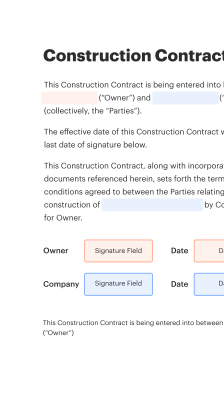
Un modèle signé numériquement réduit les délais, standardise les conditions et fournit une trace légale claire pour chaque proposition.

Le directeur des ventes crée et personnalise des modèles de proposition pour l'équipe, vérifie les clauses standard et suit les signatures en temps réel afin d'optimiser le taux de conversion et réduire les délais de conclusion.
Le chef de compte prépare des propositions client avec tarifs et annexes, envoie pour signature électronique et utilise la piste d'audit pour documenter les approbations et les modifications contractuelles.
Équipes commerciales, agences publicitaires et responsables marketing utilisent ces modèles pour standardiser offres et contrats.
Dans chaque cas, l'objectif est d'améliorer vitesse, traçabilité et sécurité sans complexifier le processus pour le signataire.
Bibliothèque de modèles personnalisables pour créer rapidement des propositions cohérentes avec champs dynamiques et clauses verrouillées.
Envoi simultané de documents individualisés à plusieurs destinataires avec suivi séparé et gestion des relances automatiques.
API REST pour intégrer envoi, suivi et stockage des documents dans des CRM et systèmes internes.
Expérience de signature optimisée pour smartphone et tablette avec conservation de la piste d'audit.
Journal complet horodaté avec adresses IP et actions pour garantir l'intégrité juridique des transactions.
Connecteurs vers CRM, stockage cloud et outils de productivité pour automatiser préremplissage et archivage.
Enregistrer propositions standardisées avec champs variables, conditions et pièces jointes pour accélérer la génération de documents et réduire les erreurs manuelles sur chaque envoi.
Envoyer simultanément une même proposition personnalisée à plusieurs destinataires, avec suivi individuel des statuts et relances automatiques pour améliorer le taux de réponse.
Synchroniser données clients et statuts de signature avec CRM pour éviter double saisie, maintenir l'historique commercial et déclencher actions post-signature.
Conserver journal horodaté des actions (ouverture, modification, signature) pour fournir une preuve admissible en cas de contestation contractuelle.
| Setting Name | Configuration |
|---|---|
| Paramètre: ordre de signature séquentiel | Séquentiel |
| Paramètre: fréquence des rappels automatiques | 48 heures |
| Paramètre: méthode d'authentification des signataires | SMS OTP |
| Paramètre: période de conservation des documents | 7 ans |
Vérifiez compatibilité et conditions minimales avant d'envoyer des propositions pour signature depuis différents appareils.
Assurez-vous aussi que les destinataires disposent d'un accès Internet, d'un navigateur à jour et, le cas échéant, d'une appli mobile compatible pour une expérience de signature fluide.
Une agence utilise un modèle standard pour offres publicitaires, incluant tarifs et annexes légales
Conduisant à une clôture de contrats plus rapide et une meilleure traçabilité des accords.
L'équipe commerciale déploie un modèle intégré au CRM pour propositions personnalisées
Conduisant à une diminution notable des délais de signature et une visibilité complète pour la direction.
| Criteria | signNow | Paper-Based |
|---|---|---|
| Légalité | Conforme ESIGN/UETA | Peut nécessiter notarisation |
| Vitesse | Minutes à heures | Jours à semaines |
| Traçabilité | Piste d'audit numérique | Preuves limitées |
| Coût opérationnel | Faible coûts récurrents | Coûts d'impression et d'envoi |
| Criteria | signNow | DocuSign | Adobe Sign | HelloSign | PandaDoc |
|---|---|---|---|---|---|
| Plans proposés | Business, Enterprise | Personal, Standard, Business Pro | Individual, Business | Essentials, Business | Essentials, Business |
| Accès API | Oui, API REST disponible | Oui, API complète | Oui, API Adobe | Oui, API Dropbox Sign | Oui, API disponible |
| Support HIPAA | Options de conformité disponibles | Options entreprise disponibles | Options entreprise disponibles | Non standard, vérifiez offres | Options entreprise disponibles |
| Fonction Bulk Send | Oui, pour envois en masse | Oui, fonctionnalités avancées | Oui, via intégration | Oui, fonctionnalités de base | Oui, en fonction du plan |
| Statut fournisseur | Recommended | Solution rentable et conforme | Large adoption | Intégré au stockage Dropbox | Orienté ventes et documents |
Prepare, perform, and control workflows of any complexity, digitally from almost anywhere. Scalable eSignature functionality enable you to exchange papers with the right users the right way and set up roles for each signee. Perform document workflows faster and simpler than ever before.
Improve intricate signing processes with airSlate SignNow�s effective tools to enhance your operation. Manage your automated signature workflows to guarantee they're running at maximum functionality with quick notices and reminders.
Get teams together in a safe, shared workspace. Manage documents, use form templates and notices to produce more effective cross-company interaction. Free your workers from having to spend time on repetitive activities so that they can give attention to beneficial, business-critical projects.
Manage your projects with market-leading integration. Assemble Salesforce, Microsoft Teams, and SharePoint all in one business thread. Link up your software to a single unit for unlimited opportunities and more productiveness.
Feel safe understanding that your information is protected by the newest in encryption security. airSlate SignNow is GDPR and eIDAS certified and offers you visibility into your signing experience with court-admissible audit trails. Set up user authorization and rights to manage who has access to what.