Template Library
Centralized repository for insertion order templates with versioning and access controls to ensure teams use approved document formats.




A standardized email signature insertion order template reduces errors, enforces required fields, and speeds approvals by eliminating repetitive formatting tasks while maintaining consistent signature placement and metadata capture.

Marketing managers create and reuse insertion order templates to ensure every campaign contract contains required signature blocks, advertiser details, and campaign dates. They reduce time to launch by predefining fields and reminders so stakeholders sign in the correct sequence without manual adjustments.
Legal counsel configures required clauses and signature acceptance logic within templates, verifies that audit trails meet evidentiary standards, and enforces retention policies to ensure insertion orders comply with corporate and regulatory requirements.
Advertising operations, procurement, and account teams commonly use email signature insertion order templates to accelerate campaign onboarding and vendor acceptance.
Templates reduce coordination friction across these groups by centralizing form logic, routing, and signature requirements in one reusable asset.
Centralized repository for insertion order templates with versioning and access controls to ensure teams use approved document formats.
Variables and conditional logic that prefill advertiser, campaign, and billing data to eliminate manual entry and enforce required inputs.
Ability to send the same insertion order to multiple recipients or accounts in a single operation to scale recurring announcements or vendor agreements.
Routing rules that change signing order based on role, contract value, or other field values to match internal approval policies.
Complete event log capturing signer IP, timestamps, and field-level changes to support evidentiary needs and internal reviews.
Additional signer authentication options such as SMS or knowledge-based checks for higher-assurance transactions.
Create and import insertion orders directly from Google Docs, preserving formatting and enabling template variables for client data to reduce copy/paste work and maintain consistent document structure.
Connect templates to CRM records to populate advertiser and campaign fields automatically, attach signed insertion orders to account records, and trigger follow-up workflows based on signature events.
Save completed insertion orders automatically to cloud storage providers such as Dropbox or Google Drive to centralize records, support retention policies, and simplify access for billing and compliance teams.
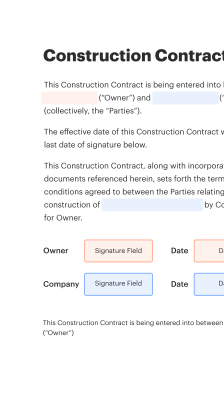
Define reusable insertion order templates with conditional fields and preset signing sequences so teams can generate contract-ready documents quickly while enforcing required content.
| Primary Workflow Setting Name Header | Default configuration value used by templates |
|---|---|
| Reminder Frequency for Signatories (hours) | 48 hours |
| Template Expiration Window for Documents (days) | 30 days |
| Signature Authentication Level for Signers | Email + optional SMS |
| Retention Policy for Completed Insertion Orders | 7 years |
| Bulk Send Batch Size Limit per Operation | 500 documents |
Insertion order templates should be accessible across modern browsers and on common mobile devices to accommodate signers in the field.
Confirm browser versions and PDF compatibility for your team; test signature flows on representative devices to verify field placement, rendering, and signing behavior before wide deployment.
A publisher uses a standard insertion order template to capture advertiser details and signature blocks for each campaign
Resulting in faster campaign launches and a clear audit trail for billing reconciliation.
An agency attaches an insertion order template to addenda for multiple clients
Leading to consistent contract records and reduced legal review time across recurring engagements.
| Feature Criteria and Provider Columns | signNow (Recommended) | DocuSign | Adobe Acrobat Sign |
|---|---|---|---|
| Supported Signature Methods and Formats | ESIGN/UETA compliant | ESIGN/UETA compliant | ESIGN/UETA compliant |
| Bulk Send and Batch Delivery | |||
| API Template Management | REST API available | REST API available | REST API available |
| HIPAA and Higher-Assurance Options | Supported | Supported | Supported |
| Provider Plan Header Comparison | signNow (Featured) | DocuSign | Adobe Acrobat Sign | HelloSign | PandaDoc |
|---|---|---|---|---|---|
| Starting Monthly Price | From $8/month | From $10/month | From $15/month | From $15/month | From $19/month |
| Free Tier or Trial Availability | Trial available | Trial available | Trial available | Trial available | Trial available |
| Included Template Functionality | Template library and API | Template library and API | Template and workflows | Templates and API | Templates and content library |
| Bulk Send or Batch Capacity | Included, tier limits | Included, tier limits | Extra cost tiers | Included, limited | Included, tier limits |
| Enterprise Security Add‑ons | MFA, SSO, retention controls | MFA, SSO, advanced KBA | MFA, SSO, advanced controls | SSO, basic MFA | SSO, enterprise controls |
Generate, execute, and control workflows of any difficulty, electronically from almost anywhere. Scalable eSignature functionality enable you to share documents with the right users the right way and set up roles for each signee. Complete document workflows faster and simpler than ever before.
Enhance complex signing procedures with airSlate SignNow�s effective tools to improve your company. Control your automatic signature workflows to ensure they're running at maximum efficiency with fast notices and alerts.
Get teams together in a protected, shared workplace. Manage documents, use form templates and notifications to create more efficient cross-organization communication. Free your workers from having to hang out on recurring actions to enable them to center on beneficial, business-essential duties.
Manage your tasks with industry-leading integration. Assemble Salesforce, Microsoft Teams, and SharePoint all in one business stream. Link up your applications to a single environment for limitless possibilities and higher productiveness.
Feel safe knowing that your data is protected by the most up-to-date in encryption security. airSlate SignNow is GDPR and eIDAS compliant and gives you transparence into your eSigning procedure with court-admissible audit trails. Configure user access permissions and roles to regulate who has access to what.