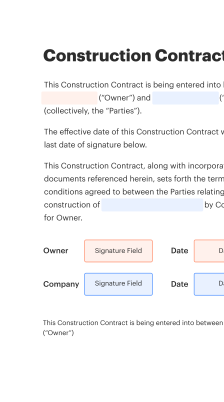
eSigning Contract with SignNow's Secure Solution

Remove paper and automate document management for higher efficiency and limitless possibilities. Discover a greater way of doing business with airSlate SignNow.

Award-winning eSignature solution

What esigning contract means and how it works

An esigning contract replaces ink-and-paper signatures with electronic methods that capture agreement intent and identity. It typically combines a digital representation of a document, a designated signature field, signer authentication, and a verifiable audit trail that records timestamps and IP addresses. In the United States, properly executed electronic signatures meeting ESIGN and UETA requirements create enforceable agreements when the parties consent and the record is retained. Platforms such as signNow provide a secure environment for preparing, sending, signing, and storing these contracts while preserving the metadata needed for later verification.

Why use an esigning contract solution

Using an esigning contract reduces turnaround time, lowers paper handling costs, and standardizes signature capture while maintaining legal validity under U.S. law when implemented correctly.

Why use an esigning contract solution

Common challenges when implementing esigning contract

  • Ensuring each signer’s identity meets legal and internal policy requirements across different jurisdictions and transaction types.
  • Configuring document workflows so required fields, approvals, and conditional routing are applied consistently for all contracts.
  • Managing retention, backups, and secure access controls while meeting industry-specific privacy regulations like HIPAA and FERPA.
  • Integrating eSignature processes with existing systems such as CRM, HRIS, and document storage without disrupting operations.

Representative user profiles for esigning contract

Legal Counsel

In-house counsel uses esigning contract to ensure signature workflows meet statutory requirements, maintain chain-of-custody records, and store enforceable documents. They typically review access controls, retention policies, and audit trails to minimize litigation risk and ensure compliance with ESIGN and UETA.

Sales Manager

Sales managers deploy esigning contract to shorten sales cycles and reduce manual back-and-forth. They focus on template consistency, Bulk Send use cases, and CRM integration to automatically log signed agreements and update deal stages.

Teams and roles that commonly rely on esigning contract

Legal, sales, HR, procurement, and finance teams frequently use esigning contract to speed approvals and maintain auditable records.

  • Legal departments use esigning contract to track version history and ensure enforceability during negotiations.
  • Sales teams use esigning contract for faster deal closures and improved customer experience.
  • HR and operations use esigning contract for onboarding and policy acknowledgements with consistent workflows.

Small businesses and large enterprises alike adopt esigning contract for efficiency; implementation details vary by scale, security needs, and integrations.

Essential capabilities to look for when using esigning contract

Core capabilities support secure signature capture, automated workflows, integrations, and compliance tracking for efficient contract lifecycle management.

Template Management

Template Management centralizes reusable documents and preconfigured fields, enabling consistent document creation, reducing error rates, and allowing teams to apply role-based field visibility and conditional logic across common contract types.

Bulk Send

Bulk Send allows sending a single document to many recipients with individualized fields, streamlining mass acknowledgements, standardized offers, and widespread policy acceptance while tracking each recipient’s status separately.

Advanced Authentication

Advanced Authentication supports multi-factor methods, government ID checks, or phone verification to align signer identity assurance with transaction risk and compliance requirements for sensitive agreements.

Audit Trail

An immutable Audit Trail records signer activity, timestamps, IP addresses, and document events to provide clear evidence of execution and defend against disputes or challenges to validity.

API and Integrations

Comprehensive APIs and prebuilt connectors integrate esigning contract into CRM, HR, and storage systems, enabling automated document generation, status updates, and centralized storage for enterprise workflows.

Document Security Controls

Document Security Controls include encryption, granular access permissions, watermarking, and download restrictions to protect confidential information during and after the signing process.

be ready to get more

Choose a better solution

Common integrative features that support esigning contract

Integration features allow esigning contract platforms to connect with daily tools, enabling seamless document generation, storage, and process automation across business systems.

CRM connectors

Pre-built CRM integrations sync contact data and store signed agreements alongside opportunities, allowing sales teams to trigger signature workflows directly from the CRM and maintain a single source of truth for contract status.

Cloud storage sync

Automatic routing of completed documents to cloud storage providers ensures signed contracts are archived in the organization’s chosen repository and simplifies backup and retrieval for audits or compliance reviews.

API access

RESTful APIs enable embedding esigning contract capabilities in custom apps, automating document creation, sending, and status checks to support high-volume or bespoke workflows without manual steps.

Template libraries

Centralized templates standardize frequently used contract structures, reduce preparation errors, and speed sending through reusable fields, conditional logic, and role mappings for common transaction types.

How an esigning contract transaction flows

Electronic signing follows a predictable flow: document preparation, signer authentication, signature capture, and audit trail generation; understanding each step helps maintain compliance.

  • Document assembly: Upload file and apply template fields.
  • Signer identification: Select authentication method per signer.
  • Signature capture: Signer affixes e-signature via web or mobile.
  • Record retention: System stores signed copy plus audit metadata.
Collect signatures
24x
faster
Reduce costs by
$30
per document
Save up to
40h
per employee / month

Step-by-step: preparing an esigning contract for signature

A clear sequence reduces errors when you prepare a document for electronic signature: prepare content, assign roles, set fields, and track completion.

  • 01
    Prepare document: Finalize content and remove hidden metadata.
  • 02
    Define signers: Assign names, emails, and signing order.
  • 03
    Place fields: Add signature, date, and data fields.
  • 04
    Send and monitor: Dispatch envelope and follow status updates.

How to complete an esigning contract: user checklist

A concise checklist helps signers and senders complete esigning contract steps correctly and reliably.

01

Open document link:

Review content carefully
02

Verify identity:

Complete selected authentication
03

Fill required fields:

Enter dates and data
04

Apply signature:

Use typed or drawn signature
05

Confirm completion:

Accept and finalize document
06

Download executed copy:

Save local copy for records
be ready to get more

Why choose airSlate SignNow

  • Free 7-day trial. Choose the plan you need and try it risk-free.
  • Honest pricing for full-featured plans. airSlate SignNow offers subscription plans with no overages or hidden fees at renewal.
  • Enterprise-grade security. airSlate SignNow helps you comply with global security standards.
illustrations signature

Recommended workflow configuration for esigning contract

A baseline workflow configuration helps standardize behavior for sending, reminders, retention, and access control across teams using esigning contract.

Workflow Feature Settings and Configuration Values Default configuration values currently in use
Reminder Frequency for Pending Signatures 48 hours then weekly
Signature Order and Routing Rules Sequential with conditional steps
Document Retention and Archival Policy 7 years, immutable archive
Authentication Method Selection Email + optional MFA
Notification and Audit Logging Enabled with detailed logs

Supported platforms and device considerations for esigning contract

Most esigning contract platforms support modern browsers and native mobile apps, but specific feature parity can vary by platform and version.

  • Web browsers: Chrome, Edge, Safari
  • Mobile apps: iOS and Android
  • Offline support: Limited or app-dependent

For consistent signer experience, confirm browser version requirements, test mobile app behaviors for signature capture and attachments, and provide simple instructions for recipients using older devices or restricted environments.

Key security controls for esigning contract platforms

Encryption in transit: TLS 1.2 or higher
Encryption at rest: AES-256 encryption
Access controls: Role-based access
Authentication options: Multi-factor support
Audit logging: Immutable audit trail
Data residency: Configurable storage regions

Real-world examples of esigning contract in action

These brief case examples show how esigning contract solves specific business needs across common workflows.

Sales Agreement Execution

A mid-market software vendor reduced signature turnaround times for sales agreements by automating contract delivery and reminders

  • Bulk Send distributed standardized proposals to regional reps
  • Automated status updates synchronized with CRM records

Resulting in shorter sales cycles and clearer audit trails that supported predictable revenue recognition and faster contract processing.

Employee Onboarding Forms

A healthcare provider replaced paper onboarding with digital packets that included sensitive attestations

  • Role-based templates ensured consistent form completion
  • Conditional routing sent background checks to HR automatically

Resulting in faster new-hire processing, stronger record retention controls, and reduced risk around HIPAA-related data handling.

Best practices for secure and accurate esigning contract

Adopting consistent controls and clear processes reduces risk and improves signer experience when using esigning contract solutions.

Standardize templates with required fields
Create vetted templates that include mandatory signature, date, and data fields. This minimizes missed fields, preserves contract integrity, and ensures every executed document contains the essential elements needed for enforceability and recordkeeping.
Choose appropriate authentication levels
Match signer authentication to transaction risk: simple email for low-risk forms, knowledge-based or government ID verification for high-value contracts. Document the chosen method for audit purposes and regulatory compliance.
Maintain clear retention policies
Define retention and deletion schedules that comply with legal and industry requirements. Ensure signed contracts and related audit logs are stored in immutable formats and backed up according to organizational policy.
Train users and monitor usage
Provide role-specific training on preparing, sending, and reviewing esigning contract documents. Regularly audit templates and access logs to detect misconfigurations or unusual activity before they become compliance issues.

FAQs and troubleshooting for esigning contract

This FAQ covers common questions and practical troubleshooting steps for esigning contract workflows used by administrators and end users.

Feature comparison for esigning contract providers

Compare core availability and capabilities across leading eSignature providers to evaluate suitability for specific esigning contract needs.

Feature and Compliance Criteria Table signNow (Recommended) DocuSign Adobe Sign
Legal validity under U.S. law
Bulk Send capability
Native CRM integrations
Advanced authentication options MFA & ID check MFA & ID check MFA & ID check
be ready to get more

Get legally-binding signatures now!

Operational steps and timelines for signing campaigns

A planned sequence for signing campaigns reduces delays and improves completion rates for high-volume esigning contract activities.

01

Day 0: Prepare campaign

Assemble templates and recipient lists

02

Day 1: Send batch

Dispatch envelopes to recipients

03

Day 3: First reminder

Automated reminder sent

04

Day 7: Second reminder

Escalate to manager or alternate contact

05

Day 14: Final notice

Mark as expired if no response

06

Day 15: Archive incomplete

Move expired envelopes to archive

07

Month 1: Review metrics

Assess completion rates and issues

08

Quarterly: Process improvements

Update templates and automation rules

Key timing considerations for esigning contract

Timelines matter for signature validity, reminders, and retention; set policies that reflect operational needs and legal obligations.

01

Signature expiration windows

Set deadlines per agreement terms.

02

Reminder cadence

Automate reminders at set intervals.

03

Retention schedule

Store records for the required period.

04

Archival checkpoints

Periodic verification of backups and archives.

Typical retention and action timelines for esigning contract

Establishing concrete timelines helps teams manage follow-ups, retention, and audits for esigning contract records.

Immediate actions after signing:

Send final copy to signers within 24 hours.

Reminder schedule for pending signatures:

Send first reminder after 48 hours, then weekly.

Short-term retention for active deals:

Keep records accessible for 1–3 years.

Long-term legal retention:

Retain executed contracts for 6–7 years or per law.

Periodic audit reviews:

Conduct audits annually to verify compliance.

Risks and compliance penalties to consider

Noncompliance fines: Regulatory penalties
Contract disputes: Enforceability issues
Data breaches: Notification costs
Retention failures: Legal exposure
Unauthorized access: Operational risk
Integration errors: Workflow breakdowns

Pricing comparison for common esigning contract plans

Base pricing and plan features vary; the table shows common entry-level per-user or per-seat starting points for popular eSignature providers.

Pricing Comparison Across Providers signNow (Recommended) DocuSign Adobe Sign Dropbox Sign PandaDoc
Monthly starting price (approx.) $8/user $10–15/user $14.99/user $15/user $19/user
Bulk send included Yes in business plans Add-on or mid plans Business plans include Available in paid plans Available in paid plans
API access Included in business APIs Included in business plans Included via Adobe APIs Available in paid plans Included in business plans
Advanced authentication MFA and ID options Wide auth options Government ID verification Phone and email OTP MFA options
Storage and retention Configurable retention Configurable retention Configurable retention Configurable retention Configurable retention

Make simpler complex workflows

Create, deliver, and maintain workflows of any complexness, electronically from virtually anywhere. Scalable electronic signature capabilities let you exchange papers with the right people in the right sequence and determine roles for every receiver. Execute document workflows faster and simpler than ever before.

Automate document managing

Improve intricate signing processes with airSlate SignNow�s powerful capabilities to enhance your operation. Manage your automated signature workflows to ensure they're operating at peak efficiency with instant notifications and alerts.

Enhance in team communication

Bring teammates together in a protected, shared workspace. Handle paperwork, use form templates and notices to create more efficient cross-company collaboration. Free your workers from having to spend time on repetitive activities so that they can center on valuable, business-crucial tasks.

Integrate into your existing network

Run your jobs with industry-leading integration. Capture Salesforce, Microsoft Teams, and SharePoint all in one business thread. Link up your applications to a single environment for endless opportunities and higher performance.

Stay compliant with market-leading data security

Feel safe with the knowledge that your data is protected by the newest in encryption security. airSlate SignNow is GDPR and eIDAS compliant and offers you transparence into your signing procedure with court-admissible audit trails. Set up user access permissions and rights to manage who has access to what.


walmart logo
exonMobil logo
apple logo
comcast logo
facebook logo
FedEx logo
be ready to get more

Get legally-binding signatures now!