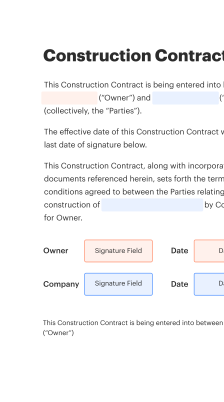
Group Email Signature for Secure Communication
What a group email signature means for teams
Why standardize your group email signature
Standardizing a group email signature improves consistency, simplifies team onboarding, and reduces manual errors when sending documents. It also supports clearer audit trails and aligns signer identity with organizational policies and regulatory expectations.
Common challenges when adopting a group email signature
- Managing access to a shared address can create ambiguity about which individual executed a signature without strict audit practices in place.
- Inconsistent signature blocks across users lead to brand and compliance gaps when signatures include titles, contact data, or disclaimers.
- Misconfigured authentication for group addresses may increase the risk of unauthorized signing if multi-factor protections are not applied.
- Retaining clear records for legal or regulatory review becomes harder when group signatures are not linked to individual user actions.
Representative user roles for group email signature management
IT Administrator
An IT Administrator configures shared mailbox access, integrates signNow with corporate identity providers, and enforces authentication and single sign-on policies to ensure only authorized accounts can sign using a group address.
Business Owner
A Business Owner defines the signature format, legal disclaimers, and retention policies, and approves template usage so that group email signatures remain consistent and compliant across departmental documents.
Teams and roles that commonly use group email signatures
Shared signatures are most useful for teams that send standardized documents or operate shared mailboxes such as billing, HR, or procurement.
- Customer support departments sending standardized service agreements and confirmations.
- Finance and billing teams issuing invoices or payment authorizations from a centralized email.
- Human resources departments distributing offer letters and onboarding paperwork.
Assigning clear roles, logging individual approvers, and using platform-level authentication ensures the group signature supports both operational needs and compliance obligations.
Choose a better solution
Core features to look for in group email signature management
Template library
A centralized template library enforces consistent signature blocks, legal language, and branding across all documents sent from a group address, reducing manual edits and compliance risk while speeding up routine sends.
Role permissions
Granular role and permission settings let administrators restrict who can send, who can sign on behalf of the group, and who can view audit logs, ensuring accountability and minimizing unauthorized actions.
Audit trail
Complete, tamper-evident audit trails record each sending and signing action tied to individual user authentication, preserving evidence needed for disputes and regulatory reviews while supporting internal controls.
Identity integrations
Integrations with SSO and directory services allow group email signing to respect corporate authentication policies and automate user provisioning and deprovisioning tied to employment changes.
How group email signature workflows typically operate
-
Template creation: Create reusable documents and signature blocks.
-
Authorization: Ensure sending users authenticate before sending.
-
Signing: Recipient signs; platform records signer identity.
-
Storage: Signed documents saved with audit metadata.
Quick steps to set up a group email signature
-
01Create template: Design a standardized signature block and document template.
-
02Assign mailbox: Map the shared email address to a team account or alias.
-
03Set permissions: Grant role-based signing and send privileges to users.
-
04Enable audit: Turn on detailed logging and authentication requirements.
Why choose airSlate SignNow
-
Free 7-day trial. Choose the plan you need and try it risk-free.
-
Honest pricing for full-featured plans. airSlate SignNow offers subscription plans with no overages or hidden fees at renewal.
-
Enterprise-grade security. airSlate SignNow helps you comply with global security standards.
Recommended workflow settings for group email signature
| Setting Name | Configuration |
|---|---|
| Signer Order | Sequential or parallel |
| Group Email Mapping | Shared mailbox alias |
| Reminder Frequency | 48 hours |
| Authentication Method | SSO with MFA |
| Template Assignment | Department-based |
Platform and device considerations for group email signature
Ensure the eSignature platform you choose supports shared mailbox workflows, SSO, MFA, and comprehensive audit logging across desktop and mobile environments.
- Desktop compatibility: Modern browsers
- Mobile support: iOS and Android apps
- Browser requirements: Latest TLS support
Confirm that the vendor provides up-to-date mobile applications and browser compatibility, and validate that identity integrations and logging work consistently on each platform you deploy to avoid gaps in signer attribution or audit data.
Practical examples of group email signature use
Finance: centralized invoicing
A billing team uses a single group email signature for outgoing invoices to maintain brand consistency and streamline approvals
- Templates route invoices to a designated approver
- Centralized signing reduces turnaround and prevents duplicate sends
Resulting in faster collections and clearer audit trails for accounting reviews.
HR: offer letter distribution
An HR department issues offer letters from a shared mailbox to present a uniform company identity
- Template fields populate candidate name and role automatically
- Individual HR specialists authenticate before sending and record signer details
Leading to consistent candidate experience and preserved compliance records for hiring audits.
Best practices for secure and compliant group email signatures
FAQs About group email signature
- Why does my audit trail not show the individual signer?
If users send documents from a shared mailbox without authenticating as themselves, the audit record may reference the group address only. Require individual authentication (SSO or MFA) for senders and confirm platform settings link each action to the authenticated user to preserve individual accountability.
- Can multiple people sign using the same group email address?
Yes, multiple authorized users can send and sign from a shared address, but best practice is to require each person to authenticate individually and to log their identity in the audit trail so signatures remain attributable to individuals for compliance and dispute resolution.
- How do I restrict who can send with the group signature?
Use role-based permissions and group membership controls in your eSignature platform and directory service. Limit send privileges to a defined list, enforce MFA for those accounts, and routinely review access rights to remove users who no longer need sending capability.
- Are group email signatures acceptable under ESIGN and UETA?
Yes, electronic signatures from a properly authenticated individual or authorized representative meet ESIGN and UETA requirements. Ensure the platform records intent, consent, and a reliable audit trail linking the action to an authenticated user to support legal validity.
- What authentication methods work best for shared addresses?
SSO with multi-factor authentication is recommended so each sender proves identity before sending. Consider additional controls like access approvals, IP restrictions, and periodic credential reviews for higher-risk documents and regulated workflows.
- How should we handle document retention and discovery for group-signed files?
Set retention policies that capture signed documents and full audit logs for the required period under your regulatory regime. Ensure exports include signer identity, timestamps, and IP or authentication metadata to support legal discovery and compliance audits.
Feature availability for group email signature across vendors
| Feature | signNow (Recommended) | DocuSign | Adobe Sign |
|---|---|---|---|
| Shared mailbox sending | |||
| Per-sender audit linking | |||
| SSO integration | |||
| Bulk send from group address | Limited |
Get legally-binding signatures now!
Legal and operational risks of poorly managed group signatures
High-level feature availability across popular eSignature vendors
| Feature | signNow (Recommended) | DocuSign | Adobe Sign | HelloSign | PandaDoc |
|---|---|---|---|---|---|
| Free plan available | Yes | No | No | Yes | Yes |
| API access | Yes | Yes | Yes | Yes | Yes |
| Bulk Send functionality | Yes | Yes | Yes | Limited | Yes |
| SSO / Enterprise SSO | Yes | Yes | Yes | Available | Yes |
| HIPAA compliance option | Available | Available | Available | No | Available |
Simplify complex workflows
Create, execute, and manage workflows of any complexity, electronically from virtually anywhere. Scalable eSignature capabilities allow you to share documents with the right people in the correct order and define roles for each recipient. Execute document workflows faster and easier than ever before.
Automate document management
Optimize complex signing processes with airSlate SignNow’s powerful features to enhance your business. Control your automated eSignature workflows to ensure they're running at peak performance with instant notifications and reminders.
Optimize in team collaboration
Bring teams together in a secure, shared environment. Manage documents, use form templates and notifications to create more efficient cross-organization collaboration. Free your employees from having to spend time on repetitive activities so that they can focus on valuable, business-critical tasks.
Integrate into your existing systems
Run your projects with industry-leading integration. Collect Salesforce, Microsoft Teams, and SharePoint all in one business flow. Connect your software to a single system for endless possibilities and more productiveness.
Stay compliant with industry-leading data protection
Feel confident understanding that your information remains secure by the latest in encryption security. airSlate SignNow is GDPR and eIDAS compliant and offers you visibility into your signing process with court-admissible audit trails. Configure user access permissions and rights to manage who has access to what.