Mark Hardship Letter with SignNow's eSignature Solution

Remove paper and improve digital document processing for increased productivity and unlimited opportunities. Explore a greater way of doing business with airSlate SignNow.

Award-winning eSignature solution

What a mark hardship letter is and when to use it

A mark hardship letter is a written request that documents a party's financial or situational difficulty and asks for relief, modification, or temporary accommodation. Common contexts include mortgage or loan forbearance, rent deferral, student loan deferment, and utility relief; the letter explains circumstances, relevant dates, income changes, and the specific remedy sought. Using a digital workflow for a mark hardship letter lets organizations maintain a clear record, control access, and apply consistent templates while preserving legal validity under U.S. electronic signature laws.

Why formalize mark hardship letters in a digital workflow

Digitizing mark hardship letters standardizes requests, improves tracking, and reduces processing time while maintaining an auditable record for compliance and internal review.

Why formalize mark hardship letters in a digital workflow

Common challenges when handling hardship letters

  • Incomplete documentation from requestors delays review and can lead to repeated follow-ups and processing bottlenecks.
  • Managing physical signatures and paper copies increases storage overhead and risks loss or unauthorized access.
  • Inconsistent decision-making across teams without a standardized template leads to compliance gaps and unequal outcomes.
  • Tracking deadlines and communications manually raises the chance of missed responses or late relief decisions.

Representative roles interacting with mark hardship letters

Loan Officer

Loan officers review hardship letters to determine eligibility for relief programs. They verify income documentation, evaluate requested accommodations, and record decisions in servicing systems, coordinating with compliance and risk teams to ensure decisions follow program rules and regulatory requirements.

Tenant Advocate

Tenant advocates intake hardship letters for renters seeking temporary relief. They collect supporting documents, communicate with property managers, and track application status to ensure timely responses and to protect tenant rights under lease and local housing regulations.

Typical users and teams that handle mark hardship letters

  • Loan servicing teams that evaluate payment modification and forbearance requests.
  • Property management and landlord teams that manage rent relief and accommodation requests.
  • Nonprofit intake staff and benefits administrators who document financial hardship for assistance programs.

Centralizing requests in a digital system supports consistent documentation, clearer reviewer assignments, and faster decision cycles.

Key tools to manage mark hardship letters efficiently

A focused set of features speeds intake, preserves evidence, and enforces consistent decision-making for hardship requests.

Templates

Reusable hardship letter templates ensure completeness and consistency, reducing errors from freeform submissions while speeding reviewer throughput and making record-keeping simpler for audits and downstream processing.


Conditional fields

Conditional form fields show or hide inputs based on the request type, enabling tailored data capture for mortgage, rent, or student requests without separate templates for each scenario.

Role routing

Automated routing assigns requests to the correct reviewer or department based on criteria, cutting manual handoffs and ensuring appropriate approvals are captured and recorded.

Secure file uploads

Encrypted uploads let applicants add pay stubs or medical records directly to the request while access controls prevent unauthorized downloads or sharing.

Audit trail

Comprehensive logs capture each action, timestamp, and IP for the hardship letter, supporting regulatory compliance and internal governance reviews with verifiable evidence.

Reminders

Automated reminders nudge applicants and reviewers about missing documents or pending approvals, reducing delays and improving overall resolution times without manual follow-up.

be ready to get more

Choose a better solution

Integrations and templates that streamline hardship letter processing

Connecting eSignature workflows to other systems accelerates data entry and centralizes document storage and decisions.

Google Workspace

Two-way integration with Google Docs and Drive lets teams draft letters in Docs, populate fields automatically, and store final signed PDFs in Drive for centralized access and retention policies.

CRM connectivity

CRM integrations auto-fill requester records, attach hardship letters to customer profiles, and synchronize status updates so caseworkers see approvals directly in the client record.

Cloud storage

Direct sync to Dropbox or enterprise storage providers ensures signed letters are archived under established backup and retention rules while preserving metadata and audit logs.

Prebuilt templates

Library templates for common hardship scenarios reduce drafting time, enforce required fields, and provide consistent language for compliance and review purposes.
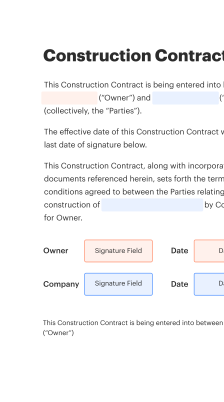
How to create and use a mark hardship letter online

An online workflow organizes document creation, evidence collection, signature capture, and reviewer assignment for efficient processing.

  • Create template: Author a reusable hardship letter template with placeholders.
  • Populate fields: Auto-fill requester data from CRM or intake forms.
  • Collect attachments: Request supporting documents via secure upload links.
  • Route for approval: Assign reviewers and capture eSignatures with audit trail.
Collect signatures
24x
faster
Reduce costs by
$30
per document
Save up to
40h
per employee / month

Step-by-step: preparing and submitting a mark hardship letter

Follow these core steps to create a clear, compliant mark hardship letter and submit it through a controlled e-signature workflow.

  • 01
    Gather details: Collect dates, income changes, and supporting documents.
  • 02
    Write request: State hardship cause, timeline, and specific relief sought.
  • 03
    Attach evidence: Include pay stubs, termination letters, or medical notes.
  • 04
    Send securely: Use an eSignature workflow with role-based access and audit logging.

Audit trail and recordkeeping steps for mark hardship letters

Maintain a clear, tamper-evident record by capturing key events and metadata throughout the hardship review lifecycle.

01

Capture timestamp:

Log submission and signature times
02

Record actor identity:

Store signer email and authentication method
03

Preserve IP addresses:

Associate actions with network origin
04

Store document versioning:

Keep original and final signed copies
05

Exportable audit reports:

Generate PDF or CSV logs for audits
06

Tamper evidence:

Digital seals indicate post-signature changes
be ready to get more

Why choose airSlate SignNow

  • Free 7-day trial. Choose the plan you need and try it risk-free.
  • Honest pricing for full-featured plans. airSlate SignNow offers subscription plans with no overages or hidden fees at renewal.
  • Enterprise-grade security. airSlate SignNow helps you comply with global security standards.
illustrations signature

Typical workflow settings for mark hardship letter automation

Configure these settings to automate intake, reminders, routing, and retention for hardship letter workflows.

Setting Name Configuration
Default reminder frequency for signature requests 48 hours with two follow-up reminders
Automatic routing based on request category Route to loan or housing team
Required attachments for submission ID proof and income documentation mandatory
Retention period for signed letters Seven years with secure archival
Reviewer escalation timeline and alerts Escalate after five business days

Device and platform considerations for mark hardship letter workflows

  • Desktop browsers: Full editing and administrative controls
  • Mobile apps: Signing and quick uploads on the go
  • Tablet support: Good balance of mobility and screen space

Ensure devices use updated browsers or vendor apps, enable secure Wi-Fi or VPN access, and enforce authentication policies so that submission, signature, and review steps remain secure and compliant across platforms.

Security controls relevant to mark hardship letter workflows

Access controls: Role-based permissions limit who views or edits letters
Encryption: TLS in transit and AES at rest protect documents
Audit logging: Complete event trails record actions and timestamps
Two-factor authentication: Adds identity verification for sensitive accounts
Document redaction: Masks sensitive fields before sharing externally
Secure access links: Time-limited links prevent unauthorized retrieval

Real-world examples of mark hardship letter usage

Two representative scenarios show how hardship letters are used and documented across organizations.

Mortgage Forbearance Request

A borrower documents sudden income loss and requests temporary payment relief.

  • The submission includes income statements and a brief explanation of hardship.
  • The servicer applies a standardized template and routes the packet for underwriting review.

Resulting in faster eligibility determination and a clear record of the relief term and conditions.

Student Loan Deferment Application

A student provides a hardship letter citing unemployment and medical bills.

  • The university financial aid office attaches supporting documents and verifies enrollment status.
  • Staff evaluate against deferment criteria and record the decision in student records.

Leading to an approved deferment with documented start and end dates and audit-ready trails.

Best practices for secure, compliant mark hardship letters

Adopt clear procedures and technical controls to protect applicants and support defensible decisions.

Use standardized templates with required field validation
Standardize hardship letter wording and required fields to ensure consistent intake. Include clear prompts for dates, supporting documents, and the specific relief sought. Validate fields so submissions cannot proceed without critical attachments, reducing back-and-forth and ensuring reviewers have the information needed to make timely decisions.
Apply role-based access and segmented permissions
Restrict access to hardship letters and attached evidence based on job function. Limit export and download privileges to necessary staff, and regularly review permission assignments. Segmented permissions reduce risk of unauthorized exposure and support compliance with data protection requirements.
Capture comprehensive audit trails and versioning
Enable immutable audit logs that record submissions, edits, signature events, and reviewer actions. Store original and signed versions to demonstrate chain of custody for decisions and to support internal or regulatory audits when questions arise about handling or disposition.
Retain records according to policy and law
Implement retention schedules aligned to regulatory and internal requirements, ensuring signed hardship letters are archived securely for the appropriate period. Define destruction procedures and maintain records of disposal to support compliance and reduce long-term exposure.

FAQs and troubleshooting for mark hardship letter workflows

Answers to common questions about creating, sending, and processing mark hardship letters in an electronic workflow.

Digital signing versus paper-based hardship letters

A concise feature comparison highlights practical differences between electronic and paper processes for hardship letters.

Criteria signNow (Recommended) DocuSign Adobe Sign
Legally binding under ESIGN and UETA
Audit trail and tamper evidence
Mobile signing support
Bulk send for batch requests
be ready to get more

Get legally-binding signatures now!

Retention and key dates for mark hardship letters

Define clear timelines for applicant response, reviewer action, and record retention to ensure timely processing and compliance.

Applicant submission window:

30 days from hardship onset recommended

Reviewer decision SLA:

Ten business days for initial determination

Appeal or follow-up deadline:

Fifteen business days after initial decision

Retention period for signed letters:

Seven years per typical financial records policy

Document disposal schedule:

Secure deletion after retention term expires

Regulatory and compliance risks to monitor

Data breach exposure: Potential fines and notification obligations
Noncompliance with ESIGN: May invalidate electronic acceptance
HIPAA violations: Risk when health information is present
FERPA concerns: Applies for student records disclosures
Record retention lapses: Leads to audit findings or penalties
Inconsistent approvals: Creates legal exposure for discrimination claims

Vendor feature snapshot for hardship letter processing

High-level plan and capability notes across common eSignature providers to inform operational comparisons.

Plan Features signNow (Recommended) DocuSign Adobe Sign HelloSign PandaDoc
Free trial and basic access Free trial available; limited free tier Free trial available; no permanent free tier Free trial available; limited free tier Free trial available; free plan available Free trial available; limited free features
API and developer support REST API with SDKs and documentation REST API with broad platform support REST API integrated with Adobe Cloud REST API with webhooks REST API and developer portal
Document templates and library Template library with reusable fields Template management and bulk use Template creation in Adobe Document Cloud Template support for standard forms Template library with variables
Mobile app capabilities Full-featured mobile apps for signing and admin Mobile apps for signing and limited admin Mobile apps integrated with Adobe account Mobile apps focused on signing Mobile apps with signing and tracking
Enterprise and compliance options Enterprise plans with HIPAA and SOC options Enterprise plans with compliance add-ons Enterprise agreements and FedRAMP options Business and enterprise compliance controls Enterprise and custom compliance support

Simplify complicated workflows

Create, deliver, and manage workflows of any complexness, digitally from almost anywhere. Scalable electronic signature capabilities enable you to exchange contracts with the right people in the proper way and determine roles for each receiver. Execute document workflows faster and simpler than ever before.

Automate document flow

Optimize intricate signing tasks with airSlate SignNow�s highly effective features to enhance your business. Take control of your automated signature workflows to make sure they're running at maximum efficiency with immediate notices and reminders.

Enhance in team communication

Join teammates together in a protected, shared workplace. Handle documents, use form templates and notifications to produce better cross-company communication. Relieve your workers from having to hang out on repetitive routines to enable them to focus on valuable, business-vital projects.

Integrate into your current systems

Work your tasks with industry-leading integration. Capture Salesforce, Microsoft Teams, and SharePoint in multi functional business flow. Hook up your applications to a single unit for endless possibilities and more efficiency.

Remain compliant with market-leading data safety

Feel safe with the knowledge that your information is protected by the newest in encryption security. airSlate SignNow is GDPR and eIDAS certified and provides you visibility into your eSigning experience with court-admissible audit trails. Configure user access permissions and roles to regulate who has access to what.


walmart logo
exonMobil logo
apple logo
comcast logo
facebook logo
FedEx logo
be ready to get more

Get legally-binding signatures now!