Bulk Merge
Process multiple sets of documents in parallel, producing individual merged files for different recipients or accounts to speed high-volume distribution.




Combining documents into a single file reduces administrative overhead, prevents missing pages during signing, and creates a single definitive record for compliance and auditing purposes.

In-house counsel prepares combined agreements and verifies that exhibits and attachments are included and in correct order prior to execution. They rely on merged documents to maintain legal integrity and a single signed record for disputes or audits.
HR managers assemble onboarding packets containing multiple forms and policy documents, ensuring employees receive and sign one consolidated document set, which simplifies recordkeeping and compliance with retention policies.
Legal, HR, sales, and operations teams frequently merge documents to produce complete contractual packets and reduce handling errors.
Consolidation supports a single audit trail and simplifies storage, retrieval, and downstream integrations with CRMs and document management systems.
Process multiple sets of documents in parallel, producing individual merged files for different recipients or accounts to speed high-volume distribution.
Include or exclude specific pages or clauses during merge based on recipient data or workflow rules to keep packets relevant and concise.
Inject known data into form fields across the merged document before sending to reduce signer effort and errors.
Append consistent legal notices, versioning, or retention stamps automatically to every merged output for compliance.
Convert scanned pages into searchable text during merge to support indexing and later text-based searches.
Track source file versions used in each merged output to support audits and reproducibility.
Create reusable merged templates that predefine file order, form fields, and recipient roles so packet assembly is consistent across similar transactions.
Automatically map data fields across merged files so values populate consistently throughout the consolidated document during preparation or via integrations.
Link merged documents to CRM records to attach the single consolidated agreement to the correct contact, opportunity, or account.
Pull source files from cloud storage providers to merge without manual downloads, preserving version metadata where supported.

| Setting Name | Configuration |
|---|---|
| Default merge method | Sequential concatenation |
| Reminder frequency | 48 hours |
| Retention policy | 7 years |
| Approval step | Optional manager sign-off |
| Audit logging level | Full event capture |
Merging multiple documents is available on modern desktop browsers, mobile browsers, and native apps, though performance varies by device.
For large or OCR-heavy merges, recommend using a desktop environment with a stable connection to reduce processing time and to access advanced settings like page reordering and bulk merges.
A clinic combines intake forms, consent forms, and treatment notices to create a single patient packet for signature
Resulting in a complete, auditable record that supports HIPAA-compliant retention and review
A property manager merges lease, addenda, and property rules into one agreement file for tenants
Leading to a single enforceable record stored under the tenant's profile for future reference
| Criteria | signNow (Recommended) | DocuSign | Adobe Sign |
|---|---|---|---|
| Merge multiple files | |||
| API merge endpoint | |||
| Bulk merge capability | Limited | ||
| HIPAA-ready options | Limited | Limited |
| Plan / Vendor | signNow (Recommended) | DocuSign | Adobe Sign | HelloSign | PandaDoc |
|---|---|---|---|---|---|
| Entry-level plan | Individual plan available | Personal plan available | Acrobat subscription required | Free tier with limits | Free trial then paid |
| API access | Available on paid tiers | Available on business tiers | Available with enterprise | Limited API options | Available on higher plans |
| Bulk processing support | Included on certain plans | Available at enterprise | Available with add-on | Limited features | Available with team plans |
| Document retention & compliance | Retention controls included | Compliance add-ons | Integrated with Adobe Document Cloud | Basic retention options | Retention via integrations |
| Typical target customer | SMBs needing cost-effective eSignature | Large enterprises and legal teams | Enterprises with Adobe ecosystem | Small teams and freelancers | Sales and proposal teams |
All you need to do is select files for merging and arrange their order. Merging files can make it easier for you and your signers to process documents and signature requests.
Click the More button next to the document you want to merge and then select Merge Document With from the dropdown.
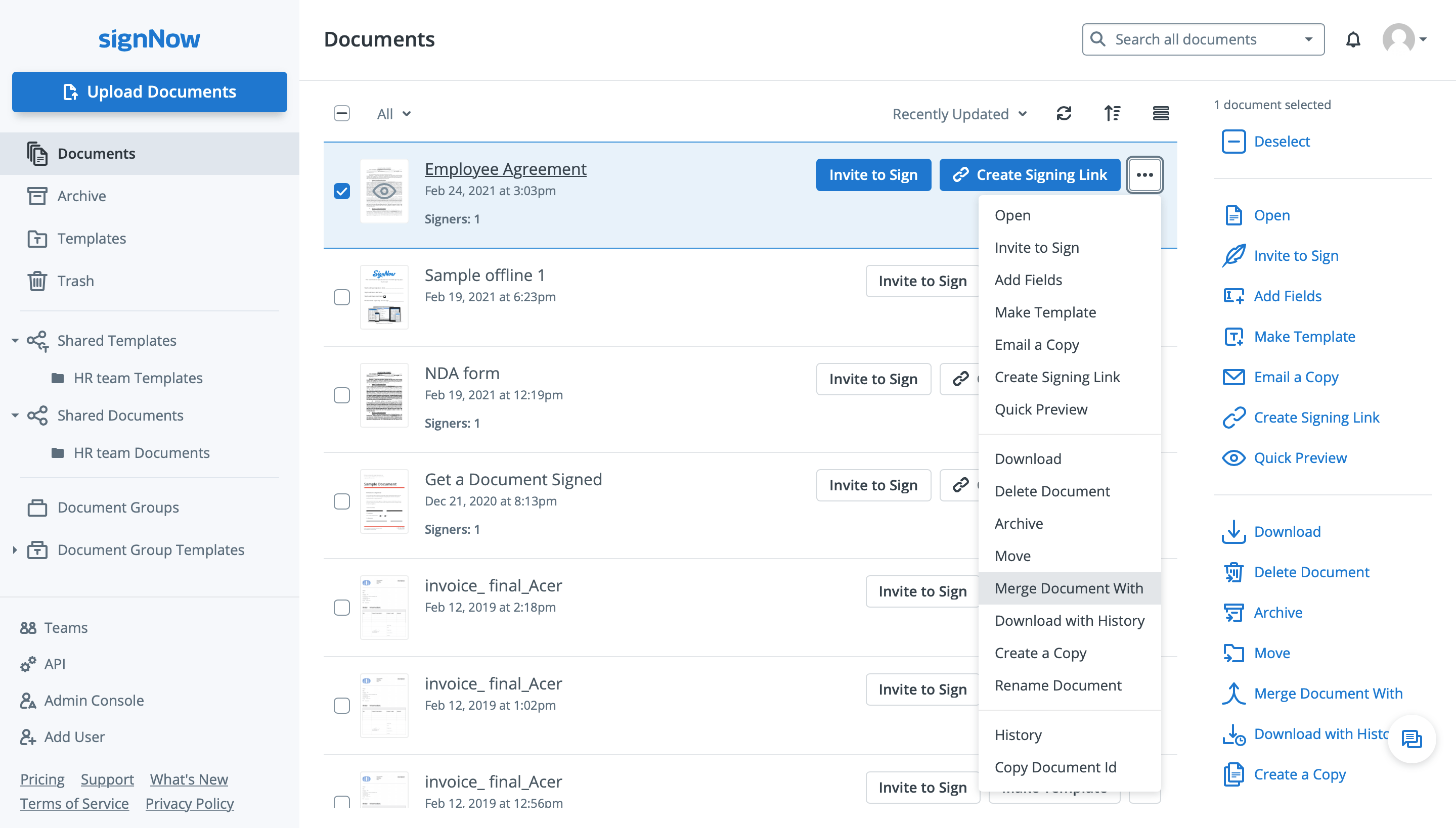
Choose the files you intend to merge from the list and click Next. You can switch between folders to find the documents you need. The folder selection menu appears on the left. You can also view all your selected files by switching to the Selected documents tab.
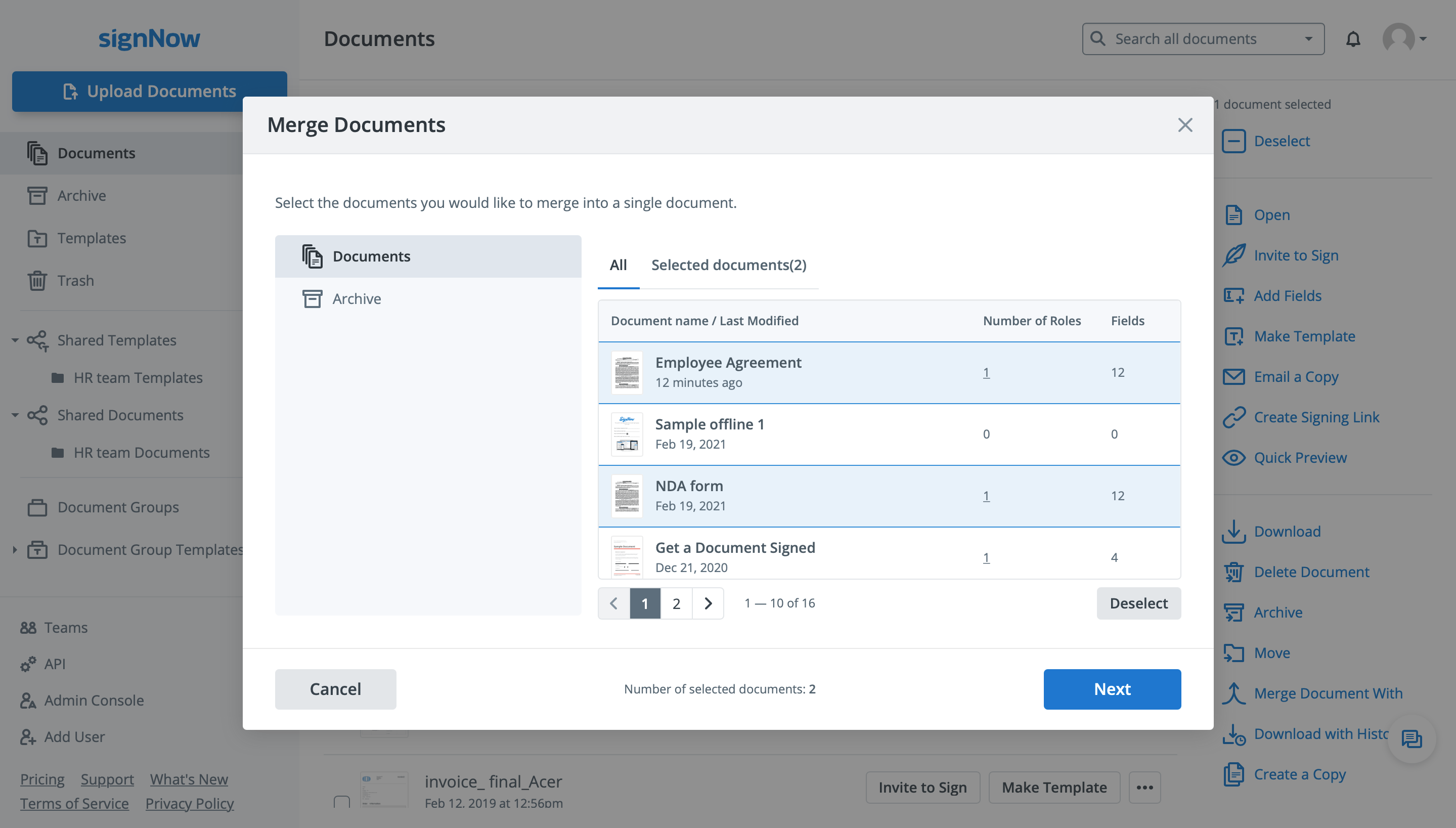
Drag and drop the documents to set the order in which they will appear in the merged file. Then, fill in the Name of New Document field and click the Merge button.
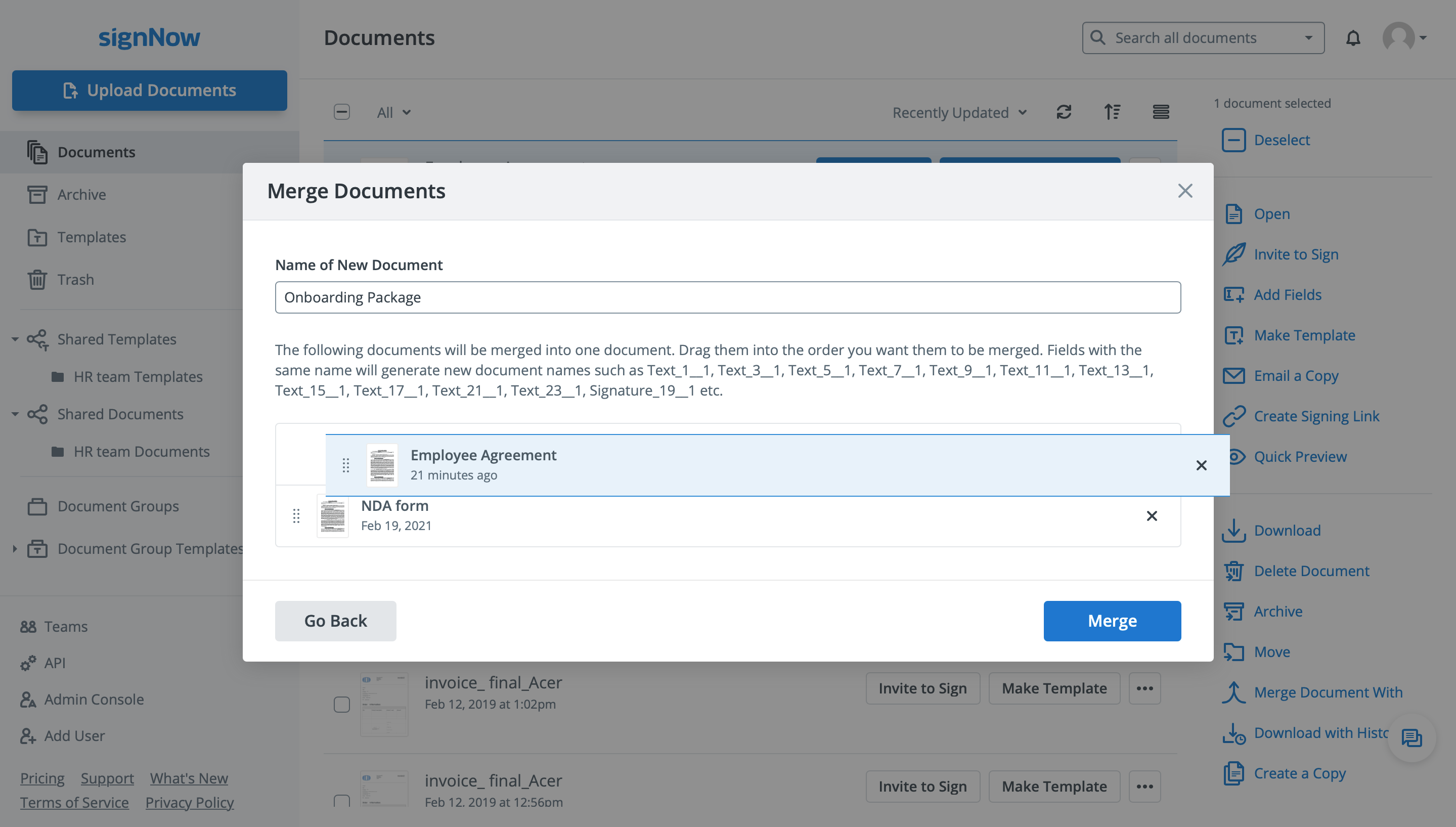
Your merged PDF will appear at the top of the document list. The files you used to create the document will not be affected and will remain in their former directories.











