Print Signatory Solutions with SignNow

Get rid of paperwork and optimize document processing for more efficiency and endless possibilities. Discover a better way of running your business with airSlate SignNow.

Award-winning eSignature solution

What print signatory means and where it fits

A print signatory denotes the printed identification of a signing party on a document, typically the printed name block or legible representation that accompanies a signature. In hybrid and digital workflows it often refers to a field or stamp added to electronic documents so that when a page is printed the signer’s printed name, role, and signing date appear clearly. This clarifies who signed, supports internal recordkeeping, and complements electronic audit trails when organizations produce physical copies for filing or compliance reviews.

Why including a print signatory matters

Including a print signatory improves clarity on printed copies, helps satisfy document retention rules, and provides an easy reference for reviewers who rely on physical records during audits or legal processes.

Why including a print signatory matters

Common challenges when using print signatory fields

  • Ensuring the printed name matches the electronic signature audit trail without introducing duplicate or contradictory information.
  • Managing version control so the printed signatory corresponds to the final signed PDF rather than an earlier draft.
  • Maintaining chain-of-custody and proving authenticity for printed pages derived from digital signatures.
  • Formatting printable fields to avoid truncation, illegibility, or placement that obscures other required elements.

Typical user roles and responsibilities

Compliance Officer

A Compliance Officer evaluates regulatory requirements and verifies that printed signatory details align with legal policies such as ESIGN and UETA, and ensures printed records meet audit and retention standards for regulators or internal review.

Field Agent

Field Agents complete forms outside the office and rely on clear print signatory fields to create legible, verifiable hardcopy records that match the electronic signing event and include identifying details for downstream processing.

Primary users and internal stakeholders

Organizations that combine digital signing with physical records commonly adopt print signatory fields to bridge electronic and paper archives.

  • Legal and compliance teams that must reconcile printed exhibits with electronic audit trails.
  • Records and archives staff responsible for long-term physical storage of signed documents.
  • Field personnel and visiting agents who need clear printed signer details on hardcopy forms.

Teams that handle regulatory documents, contracts, or patient and student records typically require clear printed signatory data to support audits and compliance checks.

Additional capabilities that support printed signatory workflows

Extended features that address enterprise needs for printing, security, and large-scale distribution of signed documents.

Bulk Print Support

Enables generation of print-ready PDFs for many signed documents at once, with configurable headers and per-document printed signatory fields to streamline mailings and batch archival processes.


Role-Based Visibility

Controls which fields are populated in printed output depending on signer role, ensuring restricted information is excluded from hardcopies when required by policy.

Custom Watermarking

Applies print-specific watermarks such as 'Copy' or controlled distribution notes so paper copies are clearly labeled and their intended use is evident.

Secure Print Logs

Records actions related to print generation and export, capturing user, timestamp, and document ID to maintain an evidentiary chain for printed outputs.

Offline Signing Compatibility

Support for signing events captured offline and synchronized later so printed signatory fields reflect the correct signer identity and timestamp once reconnected.

Template Locking

Prevents unauthorized edits to print layout and signatory positions, ensuring consistent printed appearance across distributed teams and locations.

be ready to get more

Choose a better solution

Four useful features for reliable print signatory output

Key features improve reliability and legibility of printed signatory details across documents and workflow contexts.

Printed-Name Field

A configurable field that inserts the signer’s full printed name and, optionally, title and date in a consistent position so printed pages clearly identify the signatory without ambiguity.

Audit Stamp

A visible audit stamp placed near the printed signatory that includes a signing timestamp and event identifier to link the hardcopy with the electronic audit trail for compliance purposes.

Print Formatting Controls

Settings to control font size, line wrapping, and page margins for printed signatory fields to prevent truncation and ensure consistent appearance across printers and devices.

PDF Flattening

An option to flatten dynamic fields into static content so printed copies remain a faithful, tamper-evident snapshot of the signed document.
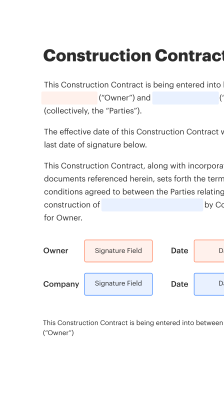
How print signatory works in an electronic workflow

Overview of the typical flow from document setup through printing once signatures are complete.

  • Template Setup: Define printed-name placement and format.
  • Signature Capture: Signer completes electronic signature fields.
  • Audit Linkage: System embeds audit metadata with the document.
  • Print Output: Generate a print-ready file showing printed signs.
Collect signatures
24x
faster
Reduce costs by
$30
per document
Save up to
40h
per employee / month

Quick steps to add a print signatory to a document

A concise four-step workflow for preparing a document with a print signatory field that will appear on printed copies after signing.

  • 01
    Prepare Document: Convert final version to PDF or supported format.
  • 02
    Add Print Field: Place a designated printed-name block on the page.
  • 03
    Assign Signer: Set signer role and required fields before sending.
  • 04
    Finalize Print: Complete signing, then export print-ready PDF.
be ready to get more

Why choose airSlate SignNow

  • Free 7-day trial. Choose the plan you need and try it risk-free.
  • Honest pricing for full-featured plans. airSlate SignNow offers subscription plans with no overages or hidden fees at renewal.
  • Enterprise-grade security. airSlate SignNow helps you comply with global security standards.
illustrations signature

Technical settings and recommended workflow configuration

Configuration items to enable reliable print signatory behavior in an enterprise signing workflow.

Configuration Setting Name and Value Header Configuration
Reminder Frequency 48 hours
Default Signer Role Signer
Print Template Selection Standard print layout
Audit Trail Retention 7 years
PDF Flattening on Export Enabled

Security controls related to print signatory

Data Encryption: At-rest and in-transit
Access Controls: Role-based restrictions
Audit Logging: Comprehensive event logs
Redaction Tools: Mask sensitive fields
Document Watermarking: Print-specific watermark
Signature Validation: Tamper-evident checks

Practical examples where print signatory is used

Real-world scenarios highlight how printed signatory fields support compliance and operational needs across regulated industries.

Higher Education Records

An administrator needs signed consent forms for student activities and also must provide physical copies for departmental files

  • Use of a print signatory field ensures the student’s printed name and signing timestamp are visible on any paper copy
  • This preserves a clear link between the electronic signature and the physical document

Resulting in auditable, FERPA-compliant records that simplify internal review and external audits.

Clinical Intake Forms

A clinic collects patient intake consents that must be stored in both EHR and paper chart folders

  • The print signatory field places the clinician’s printed name, role, and date on printed pages
  • That printed detail reduces ambiguity for staff retrieving paper charts and supports HIPAA-compliant recordkeeping

Leading to consistent clinical documentation and clearer evidence in medical-legal reviews.

Best practices for accurate and compliant print signatory usage

Adopt standards and policies to ensure printed signatory fields are reliable, consistent, and defensible for audits and recordkeeping.

Include a distinct printed-name field near each signature block
Place a dedicated printed-name field immediately adjacent to each signature to remove ambiguity about signer identity; include role and date where applicable to support internal and regulatory review.
Link printed output to the electronic audit trail
Ensure printed documents include an audit identifier or timestamp that maps back to the electronic signing event, enabling verification without exposing unnecessary metadata on the page.
Standardize font and layout to avoid truncation
Use preset font sizes and margin rules for printed signatory fields across templates so names do not wrap unpredictably or overlap other content when printed on different devices.
Restrict printed PHI and PII according to policy
Limit what appears on printed copies to the minimum required; redact or exclude protected health or student information unless authorized under HIPAA or FERPA policies.

FAQs about print signatory

Common questions and concise answers to help teams implement and troubleshoot print signatory workflows in compliant environments.

Feature availability: signNow versus leading providers

A concise feature comparison showing common print signatory and related capabilities across major eSignature platforms.

Feature or Criteria to Compare signNow (Recommended) DocuSign Adobe Sign
Printable Name Field Availability
Audit Trail Linked to Print
HIPAA-Ready Options
Bulk Print/Export
be ready to get more

Get legally-binding signatures now!

Retention and timing guidelines for printed signatory records

Suggested retention intervals and timing steps to align physical printed records with regulatory and organizational requirements.

Retention schedule for printed signatory records:

Follow industry-specific retention, commonly 3 to 7 years for contracts and up to 7 years for healthcare records.

Timing to produce certified printed copies:

Generate certified physical copies soon after final signature to minimize risk of later edits.

Periodic audits of printed archives:

Perform annual checks to verify printed copies match electronic originals and audit logs.

Secure offsite storage and retrieval timelines:

Store printed archives in controlled facilities with documented retrieval procedures.

Disposition schedule for obsolete printed files:

Securely destroy or de-identify paper records after retention period expires.

Risks and compliance implications

Noncompliance penalties: Regulatory fines
Evidence disputes: Admissibility issues
Data exposure: Unauthorized disclosure
Integrity loss: Altered pages
Operational delays: Rework and audits
Record mismatch: Inconsistent archives

Pricing and plan characteristics across platforms

High-level plan characteristics to help compare cost structure and availability of enterprise features relevant to printed signatory workflows.

Plan or Feature signNow (Recommended) DocuSign Adobe Sign Dropbox Sign PandaDoc
Entry-level offering Paid monthly plans with basic eSign Personal and Standard tiers Included with Acrobat subscriptions Free tier available Free trial and paid plans
Free tier availability Limited free trial only Free trial only No free eSign tier Limited free tier Free trial only
API access API with paid plans and enterprise options API available with Business plans API via Adobe Document Cloud API on paid tiers API included on business tiers
Enterprise support options Enterprise SLAs and onboarding available Enterprise-grade support and compliance Enterprise agreements and support Business and enterprise support Enterprise-focused customer success
Typical use case fit Mid-market to enterprise digital + print workflows Large enterprise and regulated industries Organizations with Adobe ecosystems Teams using Dropbox ecosystems Sales teams needing templates and proposals

Simplify complicated workflows

Create, deliver, and control workflows of any intricacy, electronically from virtually anywhere. Scalable eSignature functionality allow you to exchange documents with the right users the proper way and set up roles for each receiver. Perform document workflows faster and easier than ever before.

Automate document flow

Optimize complicated signing procedures with airSlate SignNow�s powerful capabilities to boost your operation. Take control of your automatic signature workflows to make sure they're running at maximum efficiency with quick notices and alerts.

Optimize in team communication

Get teammates together in a safe, shared workspace. Manage paperwork, use form templates and notices to create more efficient cross-company communication. Free your staff from having to spend time on repeating actions so that they can focus on valuable, business-vital projects.

Integrate into your existing network

Run your jobs with industry-leading integration. Capture Salesforce, Microsoft Teams, and SharePoint all in one business flow. Hook up your software to a single unit for endless opportunities and higher productivity.

Stay compliant with best-in-class data protection

Feel confident knowing that your information remains secure by the newest in encryption security. airSlate SignNow is GDPR and eIDAS compliant and provides you visibility into your signing process with court-admissible audit trails. Set up user access permissions and rights to manage who has access to what.


walmart logo
exonMobil logo
apple logo
comcast logo
facebook logo
FedEx logo
be ready to get more

Get legally-binding signatures now!