Print Signer Required: Secure eSignature Solutions

Get rid of paper and automate digital document processing for more performance and countless opportunities. Sign anything from your home, quick and professional. Explore the perfect manner of running your business with airSlate SignNow.

Award-winning eSignature solution

What print signer required means in eSignature workflows

print signer required is a configuration that marks a signer as needing to provide a wet ink, printed signature in addition to or instead of an electronic signature. This setting is used when documents must be physically signed for regulatory, institutional, or archival reasons while still being tracked digitally. Implementing print signer required lets organizations combine paper signing with an electronic workflow by flagging documents and signers, recording steps, and preserving an audit trail that documents when a printed copy was created, mailed, or returned.

When organizations use a print signer required flag

Use print signer required to meet legal or institutional requirements that still demand physical signatures while keeping centralized tracking and compliance records in the digital workflow.

When organizations use a print signer required flag

Common challenges when enforcing print signer required

  • Coordinating physical return of signed paper can create delays and add postal or courier costs that extend cycle time considerably.
  • Reconciling a returned wet ink signature with the digital record requires careful matching and may need manual verification steps.
  • Maintaining chain-of-custody for physical documents is more complex than purely electronic workflows and increases administrative overhead.
  • Ensuring the printed document exactly matches the digital copy requires standardized templates and version control to avoid disputes.

Typical user personas interacting with print signer required

HR Manager

An HR Manager uses print signer required for onboarding packets or benefits forms that demand original signatures. They configure workflows to flag required documents, instruct new hires on printing and returning pages, and track receipt dates in the digital record to maintain compliance with employment policies and record retention rules.

Compliance Officer

A Compliance Officer enforces print signer required where regulators insist on wet ink signatures. They review document templates, set authentication controls, and verify that returned paper copies match digital versions, preserving audit logs and filing records to satisfy audits and internal governance.

Roles and teams that commonly require print signer required

Organizations with legal, real estate, healthcare, education, and financial workflows often adopt print signer required where wet ink signatures remain necessary.

  • Legal departments that must retain hard-copy signed contracts for court or regulatory recordkeeping.
  • Real estate teams handling deeds, escrow documents, and notarized paper that require physical signatures.
  • Educational institutions processing student records or transcript releases that demand original signatures.

Teams implement print signer required selectively to balance legal obligations with digital tracking and to reduce unnecessary physical handling.

Extended capabilities that support print signer required workflows

Beyond the core controls, these capabilities help large or regulated organizations govern printed signature requirements at scale while preserving compliance and efficiency.

Template locking

Lock document templates to prevent edits after approval, ensuring every printed copy is generated from a controlled source. This reduces version mismatch risk and supports consistent evidence for audits and legal review.


Advanced routing

Route envelopes conditionally based on print requirements, jurisdiction, or document type so additional notarization, witness, or courier steps activate automatically when needed.

Bulk issuance

Send the same print-required packet to many recipients while tracking individual return status and enabling batch reconciliation of scanned returns for administrative efficiency.

API automation

Use API calls to programmatically flag print signer required, upload scanned returns, and integrate status updates with external systems like CRMs and document repositories.

Custom retention rules

Define retention schedules for scanned originals and physical copies by document type to meet regulatory or internal recordkeeping policies with automated archival.

Compliance reporting

Generate reports that combine digital audit logs and scanned return metadata to prove adherence to procedures for audits and regulatory reviews.

be ready to get more

Choose a better solution

Core controls to manage print signer required efficiently

These four features help organizations manage required printed signatures while preserving digital oversight, security, and compliance.

Print requirement flag

A per-signer toggle that designates a signer must print, sign, and return an original paper copy; the workflow records the requirement and prevents completion until verification is logged.

Scan-and-attach

A mechanism to upload scanned wet ink pages directly into the envelope or record, with metadata capture to link the scanned file to the signer and timestamp for audit purposes.

Conditional routing

Automated rules that route documents differently when print signer required is enabled, such as adding delivery or verification steps to ensure the physical copy is notarized or witnessed when necessary.

Audit reporting

Comprehensive logs that record issuance, print requirement settings, scanned returns, verification steps, and timestamps to support compliance reviews and record retention obligations.
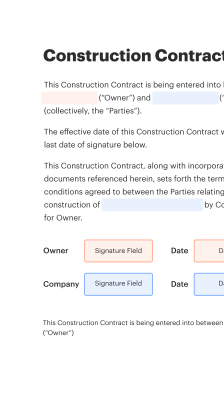
How the print signer required flow operates end to end

This sequence outlines how documents move from digital issue to physical signing and back into the secure record.

  • Issue: Sender flags document and notifies signer.
  • Print: Signer prints exact document copy locally.
  • Sign: Signer applies wet ink signature on paper.
  • Return: Scanned copy uploaded and matched to record.
Collect signatures
24x
faster
Reduce costs by
$30
per document
Save up to
40h
per employee / month

Quick setup: enable print signer required in a workflow

Follow these four basic steps to add a print signer required flag and document the process within an eSignature workflow.

  • 01
    Create template: Upload document and save a reusable template.
  • 02
    Add signer role: Define recipient role and contact details.
  • 03
    Set print requirement: Enable print signer required for that role.
  • 04
    Track return: Log scanned copy and update audit status.

Manage the audit trail for printed signatures

Track each stage of the printed signature lifecycle and ensure records are complete and searchable for compliance or legal review.

01

Issue ID:

Assign a unique envelope identifier for tracing
02

Signer metadata:

Capture signer name, email, and role
03

Print timestamp:

Record when the printer instruction was issued
04

Scan receipt:

Log uploaded scanned file and uploader
05

Verification note:

Record manual checks and matching steps
06

Retention entry:

Store retention deadline and archival location
be ready to get more

Why choose airSlate SignNow

  • Free 7-day trial. Choose the plan you need and try it risk-free.
  • Honest pricing for full-featured plans. airSlate SignNow offers subscription plans with no overages or hidden fees at renewal.
  • Enterprise-grade security. airSlate SignNow helps you comply with global security standards.
illustrations signature

Recommended workflow settings for print signer required

Use these configuration settings to standardize how print signer required works across templates and deployments.

Setting Name Configuration
Default reminder frequency for signers Reminders sent at 48 hours and 24 hours before due date
Signer print requirement enforcement Flag set to require printed signature and scanned return
Required verification on scanned returns Manual verification with metadata match and timestamp
Notarization and witness routing rules Conditional routing to notary or witness when enabled
Retention and archival configuration Retain scanned originals for configured retention period

Device and platform guidance for print signer required

Verify that signers have access to a printer, a reliable scanner or camera, and a modern browser or mobile device capable of uploading scanned images.

  • Desktop and laptop: Windows or macOS with modern browser
  • Mobile devices: iOS or Android with camera upload capability
  • Scanning apps: Reliable scanner or smartphone scanning app

Provide clear upload instructions and recommended file formats to ensure scanned images are legible and easily matched to the digital record for verification.

Security and protection elements relevant to print signer required

Encryption at rest: AES-256 encryption applied
Encryption in transit: TLS-secured document transfer
Access controls: Role-based signer access
Audit logging: Immutable event records
Document watermarking: Visible proof-of-origin marks
Data retention: Configurable retention periods

How print signer required is used in real workflows

Two concise examples show how combining digital tracking with required printed signatures supports compliance and operational needs.

Healthcare consent forms

Patient admits to procedure and must sign a paper consent form before treatment begins.

  • Workflow flags consent with print signer required and provides patient instructions for printing and signing.
  • The front desk scans the returned wet ink copy and attaches it to the digital record for secure storage.

Resulting in retained legal proof while keeping a searchable, auditable electronic index of the signed form.

Real estate closing packets

A buyer and seller must provide original signatures on deed transfers before recording.

  • The closing agent issues documents with print signer required and tracks each signer’s status in the workflow.
  • After signing, paper originals are notarized, scanned, and matched to the digital copy to complete the file.

Leading to compliant recording with an audit trail linking physical documents to their digital workflow entries.

Operational best practices for reliable print signer required workflows

Adopt consistent procedures and documentation standards to reduce errors, speed processing, and maintain defensible records when physical signatures are needed.

Standardize document templates and versions
Use locked templates and strict version control so the printed copy always matches the digital master. Enforce template checks before issuing a print signer required envelope to avoid mismatches and disputes.
Provide clear signer instructions and return options
Include simple printing, signing, notarization, and return instructions directly in the notification and on the document itself. Offer multiple secure return channels such as secure upload, mail, or in-person drop-off to minimize delays.
Validate returned paper with digital metadata
When a scanned copy is uploaded, capture signer name, date, and a reference identifier. Compare details to the digital envelope and log verification steps to maintain an auditable evidence chain.
Limit physical handling and centralize storage
Establish secure procedures for transporting, storing, and disposing of original paper documents. Assign custody roles and maintain a physical chain-of-custody log to reduce loss or unauthorized access.

FAQs and troubleshooting for print signer required

Answers to common questions and guidance to resolve typical issues when requiring printed signatures alongside electronic workflows.

Comparing print signer required across leading eSignature vendors

This concise comparison highlights whether major providers support print signer required workflows and related features for physical signature handling.

Feature comparison across leading eSignature vendors signNow (Recommended) DocuSign Adobe Acrobat Sign
Print signer required option
Scan-and-attach returned pages
Conditional notarization routing Limited
Per-signer requirement toggle
be ready to get more

Get legally-binding signatures now!

Operational risks and compliance penalties to consider

Regulatory fines: Penalties for noncompliance
Contract disputes: Invalid signatures lead
Data breaches: Exposure of personal data
Record loss: Missing physical documents
Audit failures: Insufficient proof trails
Operational delays: Late execution impacts

Pricing and plan differences for managing printed signature workflows

Pricing often varies by feature set, API access, and enterprise support; this table summarizes starter plan differences and notable paid capabilities.

Pricing comparison across vendors signNow (Recommended) DocuSign Adobe Acrobat Sign Dropbox Sign PandaDoc
Starting monthly price for small teams Affordable entry-level monthly per user with basic features and limited templates Higher starting price per user with broad enterprise features Moderate price with strong PDF tools and integrations Competitive small-team pricing with Dropbox integration Mid-range pricing with document generation features
Free tier availability and limits Free or trial tier with limited sends and templates Limited trial and developer sandbox Trial with reduced functionality Free limited tier for Dropbox users Free trial available with document limits
API access and developer options API included in paid plans with clear documentation and SDKs Mature API with extensive features and enterprise support Robust API with strong PDF handling API available with Dropbox Sign developer resources API access with template automation support
User seats and team management Flexible seat licensing and team roles suitable for SMBs Enterprise seat tiers and advanced admin controls User and admin roles with policy settings Team management tied to Dropbox accounts Team roles plus sales workflow features
Enterprise support and SLAs Available enterprise support and contractual SLAs for compliance customers Comprehensive enterprise support and onboarding services Enterprise support with Adobe care plans Enterprise support available through Dropbox enterprise Priority support and onboarding for enterprise customers

Simplify complex workflows

Create, execute, and manage workflows of any complexity, electronically from virtually anywhere. Scalable eSignature capabilities allow you to share documents with the right people in the correct order and define roles for each recipient. Execute document workflows faster and easier than ever before.

Automate document management

Optimize complex signing processes with airSlate SignNow’s powerful features to enhance your business. Control your automated eSignature workflows to ensure they're running at peak performance with instant notifications and reminders.

Optimize in team collaboration

Bring teams together in a secure, shared environment. Manage documents, use form templates and notifications to create more efficient cross-organization collaboration. Free your employees from having to spend time on repetitive activities so that they can focus on valuable, business-critical tasks.

Integrate into your existing systems

Run your projects with industry-leading integration. Collect Salesforce, Microsoft Teams, and SharePoint all in one business flow. Connect your software to a single system for endless possibilities and more productiveness.

Stay compliant with best-in-class data protection

Feel safe understanding that your information remains secure by the latest in encryption security. airSlate SignNow is GDPR and eIDAS compliant and gives you exposure into your signing procedure with court-admissible audit trails. Set up user authorization and rights to control who has access to what.


walmart logo
exonMobil logo
apple logo
comcast logo
facebook logo
FedEx logo
be ready to get more

Get legally-binding signatures now!