



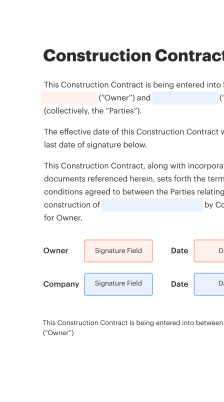
Product Invoice Template for Technology Industry

Streamline your invoicing process with airSlate SignNow. Enjoy easy eSigning and reduce costs while boosting efficiency.

Award-winning eSignature solution

What a product invoice template for technology industry is and why it matters

A product invoice template for technology industry is a standardized billing document tailored to hardware, software, SaaS subscriptions, and professional services common to technology vendors. It includes line items for product SKUs, license terms, subscription periods, usage metrics, taxes, discounts, and recurring billing notes. For tech companies the template should accommodate SKU mapping, support and maintenance fees, multi-currency pricing, and clear license grant language. Using a consistent template reduces billing errors, accelerates approvals, and creates a clear record for accounting, client onboarding, and audit purposes.

When to adopt an industry-specific invoice template

A tech-focused invoice template standardizes complex billing elements like subscriptions, usage tiers, and license renewals, reducing disputes and shortening payment cycles.

When to adopt an industry-specific invoice template

Common invoicing challenges for technology companies

  • Managing recurring charges and prorations across subscriptions with varying start and end dates can create reconciliation complexity.
  • Attributing usage-based fees accurately requires reliable telemetry and integration between billing and product usage systems.
  • Applying correct tax treatment across jurisdictions for software, services, and hardware often needs specialized tax rules and tooling.
  • Coordinating discounts, bundling, and multi-line credits increases the likelihood of manual entry errors and delayed payments.

Typical roles involved in invoice creation and review

Billing Manager

The Billing Manager oversees invoice templates, enforces compliance with accounting policies, and coordinates changes with product and finance teams. They review complex billing scenarios, manage customer-specific pricing, and ensure templates align with ERP and accounting software integrations.

Account Executive

The Account Executive generates quotes and approves final invoices for customers, verifies contract terms and discounts, and communicates line-item clarifications to clients. They often trigger invoice generation during renewals or upgrades.

Who benefits from a tailored invoice template

Finance, billing operations, account managers, and procurement teams all use industry-specific invoice templates to streamline transactions.

  • Finance teams that need consistent GL mappings and auditor-ready records.
  • Account managers issuing renewal invoices and bundled service charges to customers.
  • Procurement and purchasing departments verifying line-item details for corporate clients.

Clear templates reduce disputes, help teams reconcile faster, and improve cash flow predictability across the organization.

be ready to get more

Choose a better solution

Core features to include in your template setup

Design templates with fields and automation suited to technology billing: SKU-level details, subscription dates, prorations, tax handling, and integration hooks for CRM or accounting systems.

SKU and license fields

Include discrete fields for SKU, license type, seat counts, and serial numbers so invoices clearly reflect what was delivered and which license terms apply to each line item.

Subscription controls

Add start/end dates, trial periods, renewal cadence, and proration rules. These fields ensure recurring charges are calculated consistently and communicated clearly to customers.

Tax and jurisdiction

Provide configurable tax code and jurisdiction fields, including nexus indicators and tax-exempt status, enabling accurate tax calculation and reporting for cross-state transactions.

Integration fields

Include mapping fields for customer IDs, PO numbers, and accounting codes so the invoice can be exported to ERP, posted to GL accounts, and reconciled automatically.

How the online template process typically works

A clear online workflow turns template data into an invoice, routes approvals, and delivers signed or acknowledged documents to customers.

  • Create: Populate template with order details.
  • Validate: Run tax and pricing checks.
  • Approve: Route for internal sign-off.
  • Deliver: Send invoice via email or portal.
Collect signatures
24x
faster
Reduce costs by
$30
per document
Save up to
40h
per employee / month

Quick setup: create a product invoice template for technology industry

Follow these four core steps to prepare and deploy a technology-focused invoice template that supports subscriptions, SKUs, and service fees.

  • 01
    Map items: List SKUs, services, and fee types.
  • 02
    Define terms: Add payment terms and renewal rules.
  • 03
    Tax rules: Apply jurisdiction-specific tax codes.
  • 04
    Integrate: Connect to accounting or CRM systems.

Detailed steps to complete a product invoice template

Follow these steps when populating and finalizing an invoice to ensure accuracy, legal validity, and timely delivery to customers.

01

Customer data:

Enter billing and contact details.
02

Purchase order:

Reference customer PO number.
03

Line items:

Add SKUs, quantities, and unit prices.
04

Taxes:

Apply jurisdictional tax rates.
05

Adjustments:

Add discounts or credits if applicable.
06

Finalize:

Route for approval and delivery.
be ready to get more

Why choose airSlate SignNow

  • Free 7-day trial. Choose the plan you need and try it risk-free.
  • Honest pricing for full-featured plans. airSlate SignNow offers subscription plans with no overages or hidden fees at renewal.
  • Enterprise-grade security. airSlate SignNow helps you comply with global security standards.
illustrations signature

Workflow settings for automated invoice routing

Configure workflow rules and automation settings to route invoices for review, apply reminders, and trigger accounting exports when signatures or approvals occur.

Setting Name Configuration
Approval routing sequence Sales → Finance → Legal
Reminder Frequency 48 hours
Auto-send on approval Enabled
Accounting export format CSV or ERP XML
Signature requirement Customer signature optional

Supported platforms and device considerations

Templates should function across web, mobile, and tablet interfaces to support sales, billing, and customer approvals wherever work occurs.

  • Web browser: Modern browsers supported
  • Mobile apps: iOS and Android apps
  • Offline use: Limited offline access

Ensure responsive design for smaller screens, maintain consistent field validation across devices, and test signature and attachment flows on each platform before production roll-out.

Security and data controls for invoice templates

Access control: Role-based permissions
Encryption: TLS and at-rest encryption
Authentication: Multi-factor options
Audit logs: Immutable activity records
Data minimization: Limit PII fields
Retention policy: Configurable retention

Real-world examples for tech invoicing

Two condensed case examples show how a product invoice template for technology industry handles typical scenarios like SaaS billing and hardware-plus-support sales.

SaaS subscription billing

A mid-size SaaS vendor issues monthly invoices with tiered usage and prorated upgrades

  • Usage metering integrated into billing pipeline
  • Reduced disputes and faster collections

Resulting in predictable monthly revenue and simpler reconciliation for finance teams.

Hardware with support plan

A hardware reseller combines device SKUs with annual support contracts on one invoice

  • Line-item SKUs, serial numbers, and warranty terms included
  • Support fees separated from capital sales for tax clarity

Leading to clearer client statements and faster purchase order approvals.

Best practices for secure, accurate tech invoices

Apply consistent controls, versioning, and validation to reduce errors, meet compliance needs, and accelerate payment cycles for technology product invoices.

Use template version control and approvals
Maintain a single source of truth with clear version history and mandated approvals for template changes, reducing inconsistent billing language and accidental rate changes across customers.
Validate pricing with automated checks
Automate price and discount validation against approved pricing lists and contract terms to prevent incorrect charges and post-invoice adjustments that delay collections and complicate accounting.
Standardize tax handling and documentation
Centralize tax rules and capture exemption certificates when needed; retain tax calculations and supporting documentation with each invoice for audits and compliance reviews.
Log audits and maintain immutable records
Ensure every invoice change is logged, store signed copies with audit trails, and use access controls so only authorized users can modify billing templates or issued invoices.

FAQs About product invoice template for technology industry

Common questions address template fields, signature validity, integrations, and resolving billing disputes.

Feature availability comparison: signNow and alternatives

Quick comparison of core capabilities relevant to invoice templates and eSignature workflows across providers commonly used by technology companies.

Criteria signNow (Recommended) DocuSign Adobe Sign
ESIGN and UETA compliance
Mobile signing support
API availability and SDKs REST API and SDKs REST API and SDKs REST API and SDKs
HIPAA-friendly options Limited
be ready to get more

Get legally-binding signatures now!

Risks and compliance considerations

Incorrect taxation: Penalties
Unauthorized access: Data breach
Missing records: Audit fines
Noncompliant signatures: Invalid contracts
Retention violations: Legal exposure
Billing disputes: Delayed payments

Pricing snapshot across common eSignature providers

Representative pricing and plan differences to consider when pairing invoice templates with a signing solution; actual costs may vary by contract and seat count.

Plan / Feature signNow (Recommended) DocuSign Adobe Sign HelloSign PandaDoc
Entry-level plan price From $8 per user monthly billed annually From $10 per user monthly From $9.99 per month individual From $15 per user monthly From $19 per user monthly
Business/team plan price Approximately $15 per user monthly Approximately $25 per user monthly Business plans from $24.99 monthly Team plans start near $25 monthly Business plans around $30 monthly
Enterprise plan availability Yes, custom enterprise pricing Yes, custom enterprise pricing Yes, enterprise agreements Yes, enterprise offers Yes, enterprise plans
Templates and bulk send Included with team plans and templates management Included with advanced plans Template libraries available Templates in higher tiers Template management included
API access and limits API available; usage tiers vary by contract API access included; usage billed separately API included; plan limits apply API available with quotas API access with rate limits
walmart logo
exonMobil logo
apple logo
comcast logo
facebook logo
FedEx logo
be ready to get more

Get legally-binding signatures now!