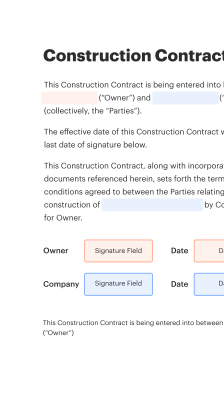
Sign DOC Securely with SignNow

Remove paperwork and automate document management for increased productivity and limitless opportunities. Discover the best way of doing business with airSlate SignNow.

Award-winning eSignature solution

What sign doc means and how it works

sign doc refers to using signNow to apply legally recognized electronic signatures to documents. It combines document upload, field placement, signer assignment, and secure signature capture in a single workflow. In the United States, transactions executed through signNow can be validated under ESIGN and UETA when appropriate identity and intent are recorded. The platform records audit data, supports common authentication methods, and integrates with cloud storage and business systems to streamline approvals and reduce dependency on paper processes.

Why use sign doc with signNow for routine signing

Using sign doc via signNow reduces turnaround time, centralizes records, and provides an auditable signing trail while remaining compatible with U.S. electronic signature law and common privacy controls.

Why use sign doc with signNow for routine signing

Common obstacles when switching to electronic sign doc workflows

  • Managing document formats and field placement can delay initial setup unless templates are prepared in advance.
  • Ensuring signer identity meets contractual or regulatory requirements may require additional authentication steps.
  • Integrating sign doc steps with legacy systems often needs API work or middleware to maintain data consistency.
  • Training staff and external signers on a new signing flow takes time and clear documentation to avoid errors.

Representative user profiles for sign doc workflows

HR Manager

An HR Manager uses sign doc to circulate offer letters and onboarding paperwork to new hires, track signature completion, and ensure documents are stored according to retention policies. They rely on templates and reminders to maintain consistent processing across departments.

Sales Director

A Sales Director uses sign doc to send proposals and contracts to prospects, monitor execution status in the pipeline, and integrate signed agreements into the CRM to trigger order fulfillment and invoicing workflows.

Typical users and teams that rely on sign doc processes

Legal, HR, sales, and operations teams frequently manage recurring signed agreements and approvals using a consistent sign doc process.

  • Sales teams that send quotes, contracts, and renewals to external clients with signature fields.
  • Human resources groups managing offer letters, onboarding forms, and policy acknowledgements.
  • Legal and compliance teams that require auditable execution and retention of signed documents.

Organizations adopt sign doc workflows where auditability, speed, and consistent document handling reduce manual risk and administrative overhead.

Expanded feature set that enhances sign doc workflows

Additional sign doc capabilities help organizations scale processes, enforce policy, and integrate signatures into broader business systems for greater efficiency.

Role fields

Assign multiple signer roles and conditional fields to guide who signs, where they sign, and which fields are required based on role or workflow logic.

Conditional fields

Show or hide fields based on prior responses so forms adapt dynamically to user input and minimize irrelevant data collection during signing.

Expiry settings

Set automatic expiration for signature requests to control outstanding documents and prompt reissuance when necessary.

Single sign-on

Enable SSO to align user access with corporate identity providers and centralize authentication and user lifecycle management.

API access

Programmatic endpoints allow document creation, sending, and retrieval to be automated and embedded within custom business applications.

HIPAA support

Options for BAAs and controls to support protected health information handling where required.

be ready to get more

Choose a better solution

Core sign doc capabilities to look for

These features support efficient, auditable, and repeatable sign doc processes while ensuring the document remains legally defensible and operationally practical.

Templates

Reusable document templates let teams standardize field placement, assist with version control, and reduce preparation time for recurring agreements while preserving consistent metadata for tracking.

Bulk Send

Send the same document to many recipients at once with individualized fields so large mailings and enrollment processes complete faster with consolidated status reporting and error handling.

Audit Trail

Comprehensive execution logs capture signer IPs, timestamps, and event history to support dispute resolution and regulatory review with a clear, time-stamped record of each interaction.

Integrations

Connectors to storage, CRM, and productivity apps allow signed documents and metadata to move into downstream systems for workflow automation and centralized recordkeeping.

How the sign doc lifecycle typically progresses

A sign doc workflow includes document creation, recipient authentication, signature capture, and archival with an audit trail for proof of execution.

  • Create: Prepare a document and add interactive fields.
  • Authenticate: Choose an identity verification method for signers.
  • Sign: Capture electronic signatures and timestamps.
  • Archive: Store the executed file with a complete audit record.
Collect signatures
24x
faster
Reduce costs by
$30
per document
Save up to
40h
per employee / month

Quick steps to create a sign doc in signNow

Follow these core steps to prepare and send a document for signature using signNow, focusing on clarity and required fields.

  • 01
    Upload: Add a PDF, Word, or image file to the platform.
  • 02
    Prepare: Place signature, date, and form fields where needed.
  • 03
    Assign: Enter signer details and set signing order if required.
  • 04
    Send: Dispatch the sign request and monitor completion status.

Detailed signer experience: completing a sign doc

This sequence describes the typical steps a signer encounters when completing a sign doc, from notification to final receipt.

01

Notification:

Signer receives an email or SMS with the signing link.
02

Identity check:

Complete chosen verification, such as code or ID check.
03

Form review:

Read and confirm document content before signing.
04

Sign fields:

Apply signature, initials, and other required inputs.
05

Final confirmation:

Receive a confirmation page with timestamp.
06

Download copy:

Access the executed PDF and audit log.
be ready to get more

Why choose airSlate SignNow

  • Free 7-day trial. Choose the plan you need and try it risk-free.
  • Honest pricing for full-featured plans. airSlate SignNow offers subscription plans with no overages or hidden fees at renewal.
  • Enterprise-grade security. airSlate SignNow helps you comply with global security standards.
illustrations signature

Configuring a sign doc workflow in signNow

Key settings to configure when establishing automated sign doc workflows to ensure predictable behavior and compliance with internal policies.

Setting Name Configuration
Reminder Frequency 48 hours
Signing Order Sequential or parallel
Authentication Level Email, SMS, or ID check
Retention Policy 90 days or custom
Notification Recipients Signer and admin

Device and browser requirements for sign doc access

sign doc via signNow works on modern desktop and mobile browsers and through native apps where available for consistent signer experiences.

  • Desktop browsers: Chrome, Edge, Safari supported
  • Mobile devices: iOS and Android supported
  • Native app availability: Apps for core platforms

For best results, keep browsers and apps updated, enable TLS connections, and verify that PDF rendering plugins or accessibility settings do not alter field placement prior to sending a sign doc.

Security controls relevant to sign doc transactions

Encryption in transit: TLS encrypted connections
Encryption at rest: AES-256 storage encryption
Access controls: Role-based permissions
Authentication options: Password and multi-factor
Audit logging: Detailed signature events
Data isolation: Tenant separation available

Real-world scenarios using sign doc

These examples show common applications of sign doc workflows across different industries and typical outcomes.

Healthcare consent forms

A clinic digitizes patient consent documents to accelerate check-in and maintain secure records

  • Forms prefilled with patient and procedure details
  • Reduced waiting-room time and fewer lost forms

Resulting in faster patient throughput and consistent retention aligned with HIPAA controls.

Sales contract execution

A mid-sized vendor sends contract templates to customers for signature to shorten sales cycles

  • Fields auto-populate from CRM records to reduce data entry errors
  • Completed contracts route automatically to billing systems for immediate invoicing

Leading to faster revenue recognition and clearer audit trails for compliance reviews.

Practical best practices for reliable sign doc outcomes

Adopt consistent habits to reduce errors, maintain compliance, and make sign doc processes predictable for internal teams and external signers.

Build and use standardized templates across departments
Create approved templates with clearly labeled fields, fixed clauses, and consistent metadata. Templates reduce mistakes, speed preparation, and simplify audits by ensuring every executed document follows the same structure and retention rules.
Set clear signer authentication levels based on risk
Choose basic email verification for low-risk forms and stronger identity checks or multi-factor authentication for high-value or regulated agreements to balance security with signer convenience.
Maintain a documented retention policy
Define retention periods for signed documents in accordance with legal, tax, and industry requirements and apply automated archival to enforce consistent deletion and storage practices.
Log and review audit trails regularly
Periodically review execution logs and access records to detect anomalies, support compliance audits, and verify that signer authentication and workflow steps were followed correctly.

FAQs About sign doc

Common questions and practical answers related to creating, sending, and maintaining sign doc transactions using signNow.

Quick capability comparison for sign doc vendors

This table contrasts core capability indicators between signNow and DocuSign for common sign doc requirements in U.S. workflows.

Feature criteria and availability table signNow (Recommended) DocuSign
ESIGN and UETA compliance status
Audit trail detail level Comprehensive Comprehensive
Bulk Send capacity per batch High volume High volume
HIPAA-compliant offering Available Enterprise option
be ready to get more

Get legally-binding signatures now!

Key retention and scheduling items for sign doc management

Track critical dates and retention windows to meet legal and operational obligations for signed documents and to support timely renewals.

Document retention start date:

Date of signature

Minimum retention period:

Follow regulatory or policy timeframes

Review and audit schedule:

Annual or biennial checks

Contract renewal reminders:

Set notifications 30–90 days prior

Secure disposal window:

Define secure deletion after retention

Risks and compliance considerations for sign doc

Noncompliant signatures: Invalid contracts
Weak authentication: Disputed signer identity
Insufficient audit trail: Evidentiary gaps
Poor retention: Regulatory penalties
Insecure storage: Data exposure
Misconfigured access: Unauthorized changes

Pricing and plan feature overview for sign doc solutions

High-level plan and feature distinctions among five common eSignature providers to consider when evaluating sign doc costs and capabilities.

Plan and vendor header row signNow (Recommended) DocuSign Adobe Sign HelloSign PandaDoc
Free trial or free tier availability Free trial only Free trial Free trial Free limited Free limited
Entry-level plan starting point Low-cost per user Mid-range Enterprise-focused Low-cost Mid-range
Bulk Send included with plan Yes with plan Requires higher plan Yes Limited Add-on
API access included Available Available Available Available Available
HIPAA-ready option Available Enterprise option Enterprise option Enterprise option Enterprise option

Make simpler challenging workflows

Generate, perform, and maintain workflows of any difficulty, electronically from almost anywhere. Scalable electronic signature features enable you to share papers with the right people in the proper way and determine roles for every receiver. Stream document workflows faster and simpler than ever before.

Automate document managing

Improve sophisticated signing tasks with airSlate SignNow�s powerful functions to improve your company. Manage your automatic signature workflows to guarantee they're running at peak efficiency with fast notifications and reminders.

Optimize in team collaboration

Bring teammates together in a secure, shared workplace. Handle documents, use form templates and notifications to create more effective cross-organization communication. Relieve your employees from having to spend time on repetitive actions so that they can center on valuable, business-vital duties.

Integrate into your existing framework

Run your tasks with market-leading integration. Assemble Salesforce, Microsoft Teams, and SharePoint in multi functional business flow. Connect your software to a single system for unlimited possibilities and higher performance.

Remain compliant with industry-leading data security

Feel confident understanding that your information remains secure by the latest in encryption security. airSlate SignNow is GDPR and eIDAS compliant and provides you transparence into your signing process with court-admissible audit trails. Configure user access permissions and roles to regulate who has access to what.


walmart logo
exonMobil logo
apple logo
comcast logo
facebook logo
FedEx logo
be ready to get more

Get legally-binding signatures now!