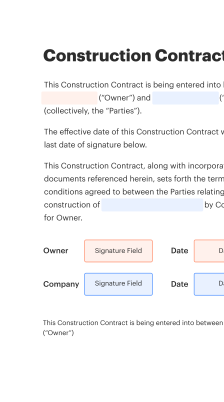
Sign Hardship Letter with SignNow's Secure eSignature
What it means to sign a hardship letter electronically
Why an electronic signature matters for a hardship letter
Using a compliant eSignature for a sign hardship letter ensures the signer’s intent is captured, reduces processing time, and supports admissibility under ESIGN and UETA while maintaining a verifiable audit trail.
Common challenges when preparing or signing hardship letters
- Incomplete documentation: missing income statements, bills, or supporting forms can delay review and decision timelines.
- Signer identity verification: weak authentication increases risk of disputed signatures or requests for re-execution.
- Format inconsistencies: scanned or poorly formatted PDFs make it hard to extract required data for processing.
- Retention and access: unclear storage policies lead to difficulties retrieving letters during audits or appeals.
Representative user profiles for sign hardship letter workflows
Borrower
A consumer experiencing reduced income who needs to submit a hardship letter to request mortgage relief. They typically provide supporting documents, verify identity, and sign the letter electronically to accelerate review and maintain proof of submission.
Loan Officer
A loan officer or servicer representative who collects hardship letters, validates attachments, and manages decision workflows. They use templates, track status, and rely on audit logs to document approvals or denials consistently.
Who typically prepares and signs hardship letters
Borrowers, applicants, and representatives commonly prepare hardship letters to document financial stress and request relief.
- Individual borrowers seeking mortgage or loan forbearance.
- Nonprofit caseworkers submitting appeals on behalf of clients.
- Loan officers and servicers collecting signed statements for review.
Organizations across financial services, healthcare billing, education, and utilities accept signed hardship letters to standardize case handling and document decisions.
Choose a better solution
Key capabilities to look for when you sign hardship letter
Template Library
Templates standardize hardship letter content and required attachments, enabling consistent submissions across cases while reducing drafting errors and ensuring required fields are present before sending to signers.
Bulk Send
Bulk Send enables organizations to distribute identical hardship letter templates to many recipients, streamlining mass collection for programmatic relief or large-scale outreach while tracking individual responses.
Audit Trail
A tamper-evident audit trail records timestamps, IP addresses, and signer actions to provide admissible evidence of intent and completion for regulatory or dispute purposes.
Platform Integrations
Prebuilt integrations with CRMs, document storage, and case management systems let you route signed hardship letters into existing workflows and automate status updates without manual entry.
How electronic signing of a hardship letter works in practice
-
Create: Start from a template or upload a custom letter.
-
Assign: Designate signer roles and add fields.
-
Authenticate: Verify identity with chosen authentication method.
-
Store: Save the signed copy with a complete audit trail.
Step-by-step: how to prepare and sign a hardship letter
-
01Prepare letter: Draft the hardship letter and gather attachments.
-
02Upload: Upload document to the eSignature platform.
-
03Add fields: Place signature, date, and attachment fields.
-
04Sign and send: Authenticate signer, execute signature, and transmit.
Managing audit trails and records for signed hardship letters
Capture events:
Timestamping:
IP logging:
Document hashing:
Certificate issuance:
Export logs:
Why choose airSlate SignNow
-
Free 7-day trial. Choose the plan you need and try it risk-free.
-
Honest pricing for full-featured plans. airSlate SignNow offers subscription plans with no overages or hidden fees at renewal.
-
Enterprise-grade security. airSlate SignNow helps you comply with global security standards.
Typical workflow settings for automated hardship letter handling
| Setting Name | Configuration |
|---|---|
| Reminder Frequency | 48 hours |
| Document Expiration | 30 days |
| Authentication Method | Email + access code |
| Template Automation | Enabled |
| Webhook Destination | Case management URL |
Device and platform requirements for signing a hardship letter
Signing a hardship letter electronically typically works across modern browsers and mobile apps, but confirm minimum versions and connectivity requirements before sending.
- Desktop browsers: Chrome, Edge, Safari
- Mobile apps: iOS and Android supported
- Connectivity needs: Stable internet required
For consistent results, update browsers or apps to current versions, enable cookies and JavaScript, and advise signers to use a private network when uploading sensitive attachments to reduce transmission errors and protect data in transit.
Practical examples of sign hardship letter use
Small Business Appeal
A small business owner documents pandemic-related revenue loss and compiles invoices and bank statements into one hardship letter to submit to a lender
- Template reuse and guided fields reduce omission errors
- Faster validation by the servicer shortens review cycles and reduces back-and-forth
Resulting in quicker case resolution and clearer documentation for potential loan modification.
Student Loan Relief
A borrower preparing a hardship letter for income-driven repayment documents reduced hours and medical expenses in a single digital packet
- Pre-filled fields and attachment prompts ensure completeness
- Auto-tracking of submission status saves follow-up time for counselors
Leading to documented enrollment in a relief program with a verifiable electronic audit trail.
Best practices for secure and accurate sign hardship letter workflows
FAQs about sign hardship letter
- Is an electronic signature legally valid for a hardship letter?
Yes. Electronic signatures executed through a compliant platform are generally enforceable under ESIGN and UETA in the United States, provided the intent to sign and consent to electronic records are captured and the platform preserves an auditable record of the transaction.
- What authentication level is appropriate for hardship letters?
Authentication should match risk. For typical hardship letters, email plus access code is often sufficient; higher-value or contested cases may require multifactor authentication or identity verification services to reduce dispute risk.
- How should attachments be handled with the signed letter?
Attach supporting documents as embedded files or zipped packages, ensure each attachment is labeled, and include a checklist field in the template to confirm required items are included prior to signing to prevent incomplete submissions.
- Can I use templates to standardize hardship letters?
Yes. Templates enforce required fields and streamline collection. Use version control to ensure templates reflect current policy, and include dynamic fields for dates, amounts, and case IDs to reduce manual entry errors.
- How long should signed hardship letters be retained?
Retention periods depend on regulatory and organizational policies; define a schedule that satisfies audit and legal requirements, typically several years for financial records, and ensure secure archival with access controls.
- What if a signer cannot complete the eSignature process?
Offer alternative authentication or assisted signing workflows, verify that browser or app requirements are met, and provide support to upload a wet-signed scanned copy if electronic execution is infeasible while documenting the reason for the alternate process.
Digital signatures versus paper for hardship letters: vendor comparison
| Criteria | signNow (Recommended) | DocuSign | Adobe Sign |
|---|---|---|---|
| ESIGN / UETA support | |||
| Comprehensive audit trail | Detailed | Detailed | Detailed |
| Mobile signing support | Native apps | Native apps | Native apps |
| Advanced workflow rules |
Get legally-binding signatures now!
Legal and operational risks when signatures are deficient
Make simpler challenging workflows
Prepare, deliver, and control workflows of any complexness, electronically from virtually anywhere. Scalable electronic signature capabilities allow you to share contracts with the right people in the proper way and determine roles for every recipient. Execute document workflows faster and easier than ever before.
Automate document management
Improve sophisticated signing processes with airSlate SignNow�s powerful functions to improve your operation. Control your automatic eSignature workflows to make sure they're operating at top functionality with instant notices and alerts.
Optimize in team collaboration
Get teams together in a safe, shared environment. Handle documents, use form templates and notices to produce more efficient cross-company interaction. Free your employees from having to spend time on repeating actions to enable them to center on valuable, business-essential duties.
Integrate into your current systems
Manage your tasks with best-in-class integration. Collect Salesforce, Microsoft Teams, and SharePoint all in one business stream. Link your software to a single system for limitless opportunities and higher efficiency.
Remain compliant with best-in-class data safety
Feel safe with the knowledge that your information remains secure by the most recent in encryption security. airSlate SignNow is GDPR and eIDAS certified and gives you transparence into your eSigning procedure with court-admissible audit trails. Configure user access permissions and roles to regulate who has access to what.