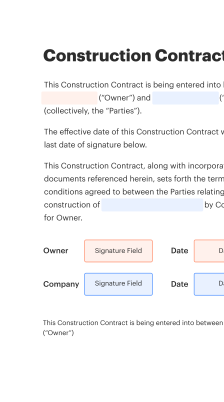
Sign Management Agreement with SignNow
What a sign management agreement is and how it functions
Why a clear sign management agreement matters
A well-defined sign management agreement reduces signing errors, protects legal enforceability, and standardizes security and retention practices across teams and third parties.
Common challenges when managing electronic signing
- Unclear signer roles cause misrouting, delayed approvals, and duplicate signature attempts that slow transactions.
- Insufficient identity verification increases legal risk and may render agreements unenforceable under ESIGN or UETA.
- Poor template control results in inconsistent fields, missing clauses, and increased review cycles for each execution.
- Inadequate retention procedures can create compliance failures and complicate dispute resolution or audits.
Representative user profiles for sign management agreements
Contracts Manager
A Contracts Manager drafts and maintains the sign management agreement, reviews templates for compliance, and administers signing workflows. They coordinate with legal and IT to configure authentication rules, signing order, and retention policies to reduce execution time and legal exposure across departments.
IT Administrator
An IT Administrator implements eSignature platform settings, integrates sign workflows with cloud storage and CRM systems, and enforces security controls. They manage user roles, API credentials, and system logs to ensure technical alignment with the sign management agreement and organizational policies.
Teams and roles that commonly rely on sign management agreements
Legal, operations, HR, sales, and procurement teams typically depend on documented signing processes to ensure consistency and compliance.
- Legal teams: set clause requirements, approve templates, and manage dispute responses.
- HR and payroll: use agreements for onboarding, benefits elections, and employment contracts.
- Sales and procurement: enforce approval chains, pricing terms, and delivery commitments.
Documenting responsibilities and tools in a sign management agreement helps these groups reduce friction and maintain audit-ready records.
Choose a better solution
Integrations commonly used with sign management agreements
Google Docs
Embed signing workflows into Google Docs to prepare and send documents without leaving the editor, preserving formatting and enabling collaborative pre-sign editing while tracking version history for compliance.
CRM Integrations
Connect agreements to CRM systems to auto-populate contact and deal data, trigger signature requests from opportunity workflows, and store completed agreements on the relevant account record to streamline sales processes.
Dropbox
Link cloud storage to automatically save and classify executed agreements in predefined folders, support retention schedules, and reduce duplication by centralizing signed documents.
APIs
Use platform APIs to embed signing into custom applications, automate bulk sends, and retrieve audit logs programmatically for integration with downstream systems and reporting.
How a digital sign management agreement flows through a process
-
Prepare: Configure template, fields, and roles.
-
Authenticate: Verify signer identity per policy.
-
Execute: Collect signatures and timestamps.
-
Archive: Store signed document securely.
Simple steps to complete a sign management agreement
-
01Upload Document: Add the contract file to the eSignature platform.
-
02Assign Roles: Specify signers, approvers, and observers.
-
03Place Fields: Add signature, date, and data fields.
-
04Send and Track: Deliver package and monitor completion.
Audit trail management checklist for sign management agreements
Capture Timestamps:
Record Signer Identity:
Store IP Addresses:
Include Document Versions:
Persist Event Logs:
Exportable Evidence:
Why choose airSlate SignNow
-
Free 7-day trial. Choose the plan you need and try it risk-free.
-
Honest pricing for full-featured plans. airSlate SignNow offers subscription plans with no overages or hidden fees at renewal.
-
Enterprise-grade security. airSlate SignNow helps you comply with global security standards.
Typical workflow settings for sign management agreements
| Feature | Configuration |
|---|---|
| Default Reminder Frequency | 48 hours |
| Signing Order Mode | Sequential |
| Authentication Requirement | Email or SMS |
| Template Enforcement | Locked fields |
| Document Retention Period | 7 years |
Supported platforms and device requirements for sign management agreements
Most modern eSignature platforms support current desktop browsers and recent mobile operating systems for signing and administration.
- Desktop Browsers: Chrome, Edge, Safari supported
- Mobile OS: iOS and Android current versions
- Offline Access: Limited or cached signing
Confirm the specific platform requirements and supported browser versions with your chosen eSignature provider before deployment, and verify mobile app capabilities if signers rely on tablets or smartphones.
Industry examples of sign management agreements in practice
Real Estate Transactions
Broker and buyer use a standardized signing workflow that defines remote and in-person signature procedures
- Template-driven field placement for disclosures
- Reduces closing time and prevents missing signature pages
Resulting in faster closings and clearer audit trails for property records.
Healthcare Consent Forms
A hospital establishes signer identity and consent verification for treatment and data release forms
- Implements multifactor or ID-based authentication for patients
- Ensures records are encrypted and stored under HIPAA-compliant controls
Leading to defensible consent records and streamlined administrative processing.
Best practices for secure and accurate sign management agreements
FAQs and troubleshooting for sign management agreements
- Signature not recognized or validated
If a signature appears unsigned or invalid, verify the platform's authentication method was completed and that the signer used the approved email link. Confirm that timestamps and audit entries show a completed event; if not, resend the signing request with enforced authentication.
- Recipient cannot access document or link
Check that the recipient email is correct and that the message did not go to spam. If access issues persist, generate a new secure link or use an alternate authentication method; confirm the platform's domain is not blocked by corporate filters.
- Authentication failure or mismatch
When authentication fails, verify the method selected (email, SMS, ID check) and that the signer provided matching identity details. Use secondary verification or reissue the request with a different authentication level if necessary for compliance.
- Completed document not visible in archive
Confirm the workflow's post-execution storage settings and check connected cloud folders. Validate retention policy rules and search the platform using signer name, document ID, or timestamps to locate the executed file.
- Audit trail missing events or metadata
If audit data is incomplete, export available logs immediately and contact the provider's support. Preserve any related emails and timestamps; implement stricter logging settings via platform configuration to prevent recurrence.
- Integration or API errors during automation
Review API keys, permissions, and rate limits; confirm endpoints and payloads match the provider's API specification. Check webhook delivery logs and retry failed calls. Ensure the account has API access enabled for the configured plan.
Feature availability: signNow (Recommended) compared with DocuSign
| Criteria | signNow (Recommended) | DocuSign |
|---|---|---|
| ESIGN and UETA Compliance | ||
| Template Library | ||
| API Access | ||
| SMS Authentication |
Get legally-binding signatures now!
Retention and document lifecycle milestones for signed agreements
Initial Retention Review Period:
90 days for quality checks
Standard Retention Duration:
7 years for commercial contracts
Regulated Records Retention:
Per statute and policy
Periodic Compliance Audit:
Annually scheduled review
Disposition or Archive Date:
Defined per document type
Common penalties and operational risks
Comparing common plan characteristics across providers
| Starting Monthly Price (approx.) | signNow (Recommended): $8 | DocuSign: $10 | Adobe Sign: $12.99 | Dropbox Sign: $15 | PandaDoc: $19 |
|---|---|---|---|---|---|
| Free Trial or Tier | Trial available | Trial available | Trial available | Trial available | Trial available |
| API Included | Yes | Yes | Yes | Yes | Yes |
| Template Library Included | Yes | Yes | Yes | Yes | Yes |
| Bulk Send / Batch Signing | Yes | Yes | Yes | Yes | Yes |
| HIPAA Support Option | Available | Available | Available | Available | Available |
Streamline complicated workflows
Prepare, deliver, and manage workflows of any complexness, digitally from almost anywhere. Scalable eSignature features allow you to exchange papers with the right users the right sequence and set up roles for each receiver. Perform document workflows faster and simpler than ever before.
Automate document flow
Improve intricate signing processes with airSlate SignNow�s effective tools to enhance your business. Control your automatic signature workflows to guarantee they're operating at peak functionality with fast notices and alerts.
Enhance in team collaboration
Get teams together in a safe, shared workspace. Handle documents, use form templates and notifications to deliver more efficient cross-company collaboration. Relieve your employees from having to hang out on repetitive routines to enable them to center on beneficial, business-essential activities.
Integrate into your existing systems
Work your projects with industry-leading integration. Assemble Salesforce, Microsoft Teams, and SharePoint in multi functional business flow. Link your software to a single environment for limitless opportunities and more performance.
Stay compliant with industry-leading data protection
Feel safe knowing that your information is protected by the most recent in encryption security. airSlate SignNow is GDPR and eIDAS certified and gives you visibility into your signing process with court-admissible audit trails. Configure user access permissions and roles to control who has access to what.