Signatory Warrant Solutions with SignNow

Remove paperwork and optimize digital document processing for more productivity and endless opportunities. Discover the perfect strategy for running your business with airSlate SignNow.

Award-winning eSignature solution

What a signatory warrant means in eSignature workflows

A signatory warrant is a formal assertion attached to a signed document in which the signer confirms factual statements about authority, identity, or capacity to execute the agreement. In electronic signature contexts, a signatory warrant documents that the signer had the right and legal capacity to sign, and it often appears as an explicit clause, checkbox, or metadata field. Properly recorded, a signatory warrant strengthens evidentiary value for later review and supports compliance with U.S. laws governing electronic records and signatures such as ESIGN and UETA.

Why a clear signatory warrant matters

A concise signatory warrant reduces ambiguity about signer authority and identity, improving enforceability and auditability in digital transactions.

Why a clear signatory warrant matters

Common challenges when implementing signatory warrants

  • Vague wording can leave signer intent or authority open to dispute and weaken evidentiary value.
  • Inconsistent placement across templates makes it harder to automate extraction and audit reporting.
  • Insufficient authentication methods may undermine the warrant if identity cannot be reliably demonstrated.
  • Poor version control or missing metadata can break the chain of custody for the warrant statement.

Typical user roles for signatory warrant workflows

Contract Manager

Contract managers prepare agreements and include signatory warrants to document corporate authority and signatory capacity. They coordinate authentication levels and maintain audit trails to support enforceability and compliance during renewals or disputes.

Compliance Officer

Compliance officers define warrant language and required identity verification methods aligned with ESIGN and UETA. They review retention policies and ensure warrant data is captured in secure logs for regulatory inspections.

Organizations that rely on signatory warrants

Many organizations incorporate signatory warrants to document signer authority, reduce litigation risk, and comply with internal controls.

  • Legal teams verifying contractual authority and sign-off for corporate agreements.
  • HR groups collecting employment acknowledgements that require explicit signer capacity.
  • Healthcare administrators ensuring consent forms reflect patient or authorized representative capacity.

Key platform capabilities that support signatory warrants

Effective warrant workflows rely on an eSignature platform that supports template fields, configurable authentication, audit logging, and secure storage to maintain legal weight and operational efficiency.

Template Fields

Customizable fields let you add warrant language, checkboxes, date stamps, and signer title fields so that warrant text and signer declarations appear consistently across documents.


Authentication Options

Multiple authentication modes such as email verification, SMS one-time passcodes, and identity provider integrations enable matching the warrant's assurance level to transaction risk.

Audit Trail

Comprehensive, time-stamped logs capture each interaction, IP addresses, and authentication events so the warrant is supported by verifiable evidence for later review.

Document Sealing

Tamper-evident sealing and cryptographic hashing lock the finalized document and warrant content, indicating any subsequent modification attempts to preserve integrity.

Role Management

Role-based permissions let administrators control who can edit warrants, send templates, or change authentication settings to protect warrant consistency and compliance.

Retention Controls

Configurable retention and export features help align warrant storage with corporate policies and legal hold requirements, ensuring accessibility for audits.

be ready to get more

Choose a better solution

Integrations that streamline signatory warrant workflows

Connecting eSignature tools with common systems automates population, verification, and storage of warrant details, reducing manual errors and speeding processing.

CRM Integration

Automate pre-filling of company and signer data from CRM records, attach signed documents back to customer records, and trigger compliance checks based on account attributes.

Document Storage

Save signed files and warrant metadata automatically to cloud repositories like Dropbox or Google Drive with consistent naming and folder structures.

Identity Providers

Leverage single sign-on and identity assertion services to corroborate signer identity and map authenticated attributes into the warrant record.

API Access

Use APIs to insert warrant clauses programmatically, capture signed copies, and integrate audit logs into enterprise governance systems.
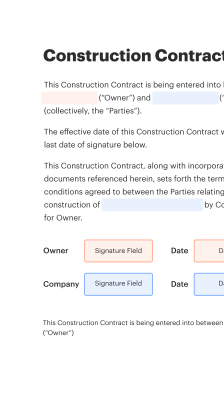
How signatory warrants integrate into eSignature flows

A warrant is typically added during template creation, presented to the signer, and recorded in the final signed document metadata.

  • Template authoring: Add warrant text and required fields.
  • Signer presentation: Show warrant before signing and capture consent.
  • Authentication check: Verify identity per configured method.
  • Record capture: Store warrant and audit trail in the signed file.
Collect signatures
24x
faster
Reduce costs by
$30
per document
Save up to
40h
per employee / month

Quick steps to create a signatory warrant

Follow these steps to add a clear, auditable signatory warrant to an electronic document template.

  • 01
    Draft clause: Write concise warrant language specifying authority and capacity.
  • 02
    Place field: Insert the warrant near signature blocks or checkbox areas.
  • 03
    Set authentication: Choose identity verification required for the signer.
  • 04
    Save template: Apply version control and publish for use.

Managing the audit trail for signatory warrants

A reliable audit trail documents every event related to the warrant and supports dispute resolution and compliance reviews.

01

Event capture:

Log signer actions and timestamps
02

Authentication record:

Store verification method details
03

Document hash:

Compute and record cryptographic hash
04

Signer metadata:

Include name, title, and IP
05

Export options:

PDF and machine-readable logs
06

Retention policy:

Apply legal hold if needed
be ready to get more

Why choose airSlate SignNow

  • Free 7-day trial. Choose the plan you need and try it risk-free.
  • Honest pricing for full-featured plans. airSlate SignNow offers subscription plans with no overages or hidden fees at renewal.
  • Enterprise-grade security. airSlate SignNow helps you comply with global security standards.
illustrations signature

Typical workflow settings for signatory warrant automation

Common configuration items when automating warrant capture ensure consistent presentation, verification, and retention across document types.

Feature Configuration
Warrant Field Placement Adjacent to signature
Default Authentication Level Email or SMS code
Template Versioning Enabled by default
Retention Period 7 years
Audit Log Detail Full event history

Platform and device requirements for signatory warrant workflows

Signatory warrants should be accessible across common devices and supported by platforms that provide secure capture and audit capabilities.

  • Desktop: Modern browsers supported
  • Mobile: iOS and Android apps
  • API: RESTful endpoints available

Security controls relevant to signatory warrants

Authentication: Multi-factor options
Encryption: At-rest and in-transit
Access control: Role-based limits
Audit logs: Detailed event records
Document integrity: Tamper-evident seals
Data isolation: Tenant segregation

Real-world examples of signatory warrant use

The following examples show how different sectors use signatory warrants to clarify signer authority and preserve audit evidence.

Commercial Contract Signing

A procurement team embeds a warrant clause to confirm signers represent their companies

  • Warrant includes printed name and title
  • Confirms internal approval and delegation

Leading to clearer dispute resolution and faster vendor onboarding.

Patient Consent Forms

A healthcare provider adds an explicit warrant for patient or authorized representative capacity

  • Warrant references state consent rules
  • Ensures the signer understood the procedure and authorized treatment

Resulting in stronger evidentiary support for consent and regulatory compliance.

Best practices for drafting and enforcing signatory warrants

Follow structured practices to maximize legal clarity, minimize disputes, and simplify audits when using signatory warrants in digital agreements.

Use concise, unambiguous language
Draft a short warrant that states the signer's capacity, affiliation, and authorization to bind the represented entity. Avoid legalese that obscures intent and ensure the clause directly precedes or is adjacent to signature fields.
Match authentication to transaction risk
Configure identity verification methods that align with the value and sensitivity of the agreement. For low-risk documents, email verification may suffice; for high-value contracts, require multi-factor or ID verification.
Record contextual metadata
Capture IP address, timestamps, authentication events, and signer-entered titles or roles. Storing this metadata with the signed file strengthens the warrant's evidentiary value during audits or disputes.
Maintain versioned templates
Use version control for templates containing warrants and restrict editing to authorized roles. Retain prior template versions for legal review and maintain a change log for governance purposes.

FAQs and troubleshooting for signatory warrant implementation

Common questions about drafting, presenting, and preserving signatory warrants, and practical steps to resolve implementation issues.

Feature availability for signatory warrant support across vendors

Below is a concise feature comparison indicating whether key warrant-related capabilities are available on each vendor platform.

Capability signNow (Recommended) DocuSign Adobe Sign
Template field customization
Audit trail detail Full Full Full
Advanced authentication MFA/IDV MFA/IDV MFA/IDV
API programmatic warrants
be ready to get more

Get legally-binding signatures now!

Document retention and retention schedules for warrants

Retention schedules depend on legal, tax, and industry-specific requirements; define timelines clearly for warrant-bearing documents.

Standard commercial contracts:

Retain for seven years after termination or expiry.

Employment agreements:

Keep for personnel file duration plus statutory period.

Healthcare consents:

Follow state laws and HIPAA retention rules.

Financial agreements:

Retain per SEC and banking regulations.

Records under litigation hold:

Preserve until legal release is granted.

Risks from inadequate signatory warrants

Contract invalidation: Loss of enforceability
Regulatory fines: Compliance penalties
Litigation exposure: Increased legal costs
Operational delays: Renegotiation needs
Reputational harm: Trust erosion
Data breaches: Unauthorized access

Pricing and plan highlights for warrant-capable eSignature platforms

Key plan attributes and availability for warrant-related features across common eSignature vendors; pricing and plan names are subject to change by vendors.

Attribute signNow (Recommended) DocuSign Adobe Sign Dropbox Sign PandaDoc
Entry-level plan name Business Personal Acrobat Standard Essentials Essentials
Typical starting price Approx. $8 per user/month Approx. $10 per user/month Approx. $14.99 per month Approx. $9 per user/month Approx. $19 per user/month
API availability Available on Business plans Available on Business Pro Available with Acrobat Sign APIs Available with Dropbox Sign API Available on Business plan
Advanced authentication options SMS and IDV add-ons SMS, IDV add-ons Government ID and certificate options SMS and OAuth SMS and SSO
Bulk send / templates Included in business plans Included in higher tiers Included in enterprise tiers Available in business plans Template-focused plans

Streamline challenging workflows

Prepare, execute, and control workflows of any complexness, digitally from virtually anywhere. Scalable eSignature functionality ensure you can exchange papers with the right people in the correct way and assign roles for every signee. Complete document workflows faster and simpler than ever before.

Automate document managing

Optimize complex signing procedures with airSlate SignNow�s powerful features to improve your company. Manage your automatic signature workflows to make sure they're running at top functionality with quick notifications and reminders.

Optimize in team communication

Get teammates together in a secure, shared workspace. Handle documents, use form templates and notices to create more effective cross-organization communication. Free your staff from having to hang out on repeating activities so that they can focus on valuable, business-critical activities.

Integrate into your current systems

Manage your projects with market-leading integration. Collect Salesforce, Microsoft Teams, and SharePoint in multi functional business thread. Link up your software to a single system for endless possibilities and more productivity.

Stay compliant with market-leading data protection

Feel safe with the knowledge that your information is protected by the latest in encryption security. airSlate SignNow is GDPR and eIDAS certified and provides you awareness into your eSigning process with court-admissible audit trails. Set up user authorization and roles to regulate who has access to what.


walmart logo
exonMobil logo
apple logo
comcast logo
facebook logo
FedEx logo
be ready to get more

Get legally-binding signatures now!