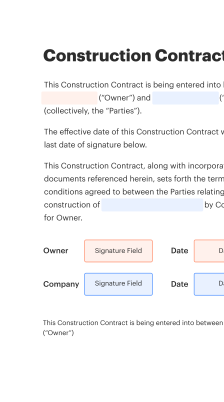
Signature Audit Committee Charter for Effective Governance
What a signature audit committee charter is and why it matters
Why formalizing signature processes matters for audit committees
A clear signature audit committee charter reduces ambiguity, ensures consistent signatory behavior, and documents controls for internal and external reviewers, improving governance and audit readiness.
Common challenges when implementing signature audit committee charters
- Unclear delegation leads to unauthorized approvals and complicates post-transaction verification during audits.
- Inconsistent authentication methods across documents increase compliance risk and reduce confidence in signature validity.
- Poor retention policies make it difficult to produce signed records for regulatory requests or litigation.
- Manual, paper-based signings slow approvals and make it hard to maintain consistent, verifiable audit trails.
Primary roles involved in the charter signing process
Audit Committee Chair
The Audit Committee Chair typically holds primary signing authority for committee resolutions and financial approvals. This role confirms that reviews were completed, that disclosures are accurate, and that required controls are satisfied before executing committee-level signatures.
Corporate Secretary
The Corporate Secretary administers the charter, records authorized signatories, maintains executed documents, and ensures that retention schedules and access controls meet corporate governance and regulatory requirements.
Who typically relies on a signature audit committee charter
Organizations that manage regulated financial reporting, complex transactions, or public company governance need a documented charter to standardize signatory authority and recordkeeping.
- Public company audit committees responsible for SEC filings and financial control attestations.
- Corporate secretaries who maintain governance records and manage delegation of signing power.
- Internal audit and compliance teams that verify controls and document chain of custody.
Defining roles and expectations in the charter helps streamline approvals and supports audits by creating a single source of truth for committee signings.
Choose a better solution
Integration and features to support chartered signings
Template Management
Create and reuse standardized charter templates to ensure consistent fields, signing order, and mandatory authentication steps across committee documents and recurring approvals.
Audit Logs
Maintain immutable, timestamped logs that record each signature action, IP address, and authentication event to satisfy internal and external audit requests.
Identity Verification
Support multiple verification methods such as email, SMS OTP, and knowledge-based verification to meet varying levels of signature assurance defined in the charter.
Secure Storage
Archive executed documents in encrypted storage with role-based access controls and retention policies that align with the charter and regulatory requirements.
How an electronic signature workflow supports the charter
-
Template creation: Create standardized charter-related templates.
-
Signer roles: Assign committee roles and permissions.
-
Authentication step: Require specified verification before signing.
-
Archival: Store signed artifacts with audit logs.
Step-by-step: preparing a signature audit committee charter
-
01Define scope: List document types and approval thresholds.
-
02Assign authorities: Document who can sign and when.
-
03Specify authentication: Select permitted verification methods.
-
04Set retention: Define storage and retention durations.
Managing audit trails for chartered signatures
Capture timestamp:
Record actor:
Log authentication:
Store IP data:
Preserve history:
Export reports:
Why choose airSlate SignNow
-
Free 7-day trial. Choose the plan you need and try it risk-free.
-
Honest pricing for full-featured plans. airSlate SignNow offers subscription plans with no overages or hidden fees at renewal.
-
Enterprise-grade security. airSlate SignNow helps you comply with global security standards.
Recommended workflow settings for chartered approvals
| Setting Name | Configuration |
|---|---|
| Approval Order | Sequential |
| Reminder Frequency | 48 hours |
| Signing Timeout | 14 days |
| Audit Trail Level | Full |
| Identity Verification | Email+SMS |
Platform and device considerations for charter signings
Ensure the chosen eSignature platform supports desktop and mobile access, secure authentication options, and reliable audit logging to comply with the charter.
- Desktop support: Windows and macOS
- Mobile support: iOS and Android
- Browser compatibility: Modern TLS-capable browsers
Verify platform compatibility with corporate IT policies, document retention systems, and any regulatory requirements such as HIPAA or FERPA for protected data; ensure updates and backups are part of the vendor agreement.
Practical examples of chartered signature workflows
Public Company Financial Approval
A mid-cap public company documented the audit committee’s signatory limits in its charter, clarifying that the chair approves quarterly attestations
- The charter required two-factor authentication for committee signatures
- This reduced manual follow-ups and improved traceability
Leading to clearer audit evidence and faster external audit confirmations.
University Grant Oversight
A research university established a charter for grant acceptance signatures to ensure FERPA and sponsor compliance
- The document mandated identity verification and retention for seven years
- Centralized eSignature templates standardized signers and sign-off workflows
Resulting in consistent record production for audits and sponsor reviews.
Best practices for implementing a signature audit committee charter
FAQs and troubleshooting for signature audit committee charters
- How do I verify a signature’s legal validity?
Confirm the signing process meets ESIGN and UETA standards: intent to sign, consent to do business electronically, association of the signature with the record, and preservation of the signed record with an audit trail for evidentiary purposes.
- What authentication level is appropriate?
Determine authentication based on document risk: require multi-factor or government ID verification for material financial approvals, and allow email or SSO for low-risk internal attestations, documenting the choice in the charter.
- How should retention periods be set?
Base retention on regulatory requirements and audit needs; typically retain financial and committee records for at least seven years, and implement legal hold procedures for pending litigation or regulatory inquiries.
- What if a signer loses access to their account?
Use identity re-verification procedures and administrative override controls documented in the charter; maintain an approval log for any administrative changes to preserve accountability during audits.
- How do I present signed records to auditors?
Provide the executed document, associated audit trail (timestamps, IP, authentication events), and any template or workflow configuration that demonstrates the process followed, ensuring traceability for every approval.
- Can paper signatures be mixed with electronic signings?
Yes, but the charter should specify permitted hybrid workflows, how to link paper records to electronic audit trails, and additional verification steps to maintain consistent evidentiary value across formats.
Feature comparison for signature platforms and charter needs
| Feature | signNow (Recommended) | DocuSign | Adobe Sign |
|---|---|---|---|
| ESIGN and UETA compliance | |||
| Audit trail detail | Comprehensive | Comprehensive | Comprehensive |
| Bulk Send capability | |||
| API and integrations | REST API | REST API | REST API |
Get legally-binding signatures now!
Risks and penalties when charter requirements are not followed
Pricing and plan comparison for signature solutions
| Provider | signNow (Recommended) | DocuSign | Adobe Sign | Dropbox Sign | PandaDoc |
|---|---|---|---|---|---|
| Monthly starting price | $8/user | $10/user | $9.99/user | $15/user | $19/user |
| Annual cost per user (billed yearly) | $96/user | $120/user | $119.88/user | $150/user | $228/user |
| API access included | Yes | Yes | Yes | Yes | Yes |
| Business templates and team features | Included | Included | Included | Included | Included |
| Enterprise-level support | Available | Available | Available | Available | Available |
Streamline complicated workflows
Generate, deliver, and control workflows of any complexity, electronically from near any place. Scalable eSignature capabilities enable you to exchange contracts with the right users the proper order and set up roles for every recipient. Complete document workflows faster and easier than ever before.
Automate document flow
Enhance complicated signing tasks with airSlate SignNow�s effective capabilities to boost your business. Control your automated signature workflows to guarantee they're running at peak performance with instant notifications and reminders.
Optimize in team collaboration
Join teams together in a safe, shared workspace. Manage documents, use form templates and notices to produce better cross-organization interaction. Relieve your workers from having to hang out on recurring activities so that they can center on beneficial, business-critical projects.
Integrate into your existing systems
Manage your jobs with market-leading integration. Collect Salesforce, Microsoft Teams, and SharePoint in multi functional business stream. Link your software to a single system for unlimited possibilities and more productiveness.
Stay compliant with market-leading data protection
Feel safe with the knowledge that your data is protected by the newest in encryption security. airSlate SignNow is GDPR and eIDAS certified and gives you visibility into your eSigning procedure with court-admissible audit trails. Configure user access permissions and roles to manage who has access to what.