Signature Test: Secure and Compliant eSignature Solution

Eliminate paper and automate document processing for more productivity and endless opportunities. Explore the best way of doing business with airSlate SignNow.

Award-winning eSignature solution

What a signature test is and when to use it

A signature test is a controlled process used to verify that an electronic signature field, authentication method, and document workflow function as intended before sending a live agreement. It typically checks visual rendering, required fields, signer routing, identity verification methods, and audit logging. Organizations use a signature test to confirm compatibility with internal policies and external compliance requirements such as ESIGN and UETA, to validate integrations with document sources, and to ensure that automated reminders and expiry settings behave correctly under production conditions.

Why run a signature test in your workflow

A signature test reduces downstream errors by verifying form fields, authentication, and integrations before documents reach actual signers, improving accuracy and compliance readiness.

Why run a signature test in your workflow

Common challenges a signature test helps reveal

  • Missing or misaligned signature fields that confuse signers and delay completions.
  • Incorrect signer order or routing that results in incomplete or incorrectly executed documents.
  • Authentication mismatches that break remote identity verification and block signing.
  • Integration failures that prevent documents from saving to the intended cloud storage.

Representative users who run signature tests

Legal Counsel

Corporate and transactional counsel run signature tests to confirm that eSignatures meet statutory requirements, that authentication steps are preserved in the audit trail, and that executed documents are stored per retention policies. They focus on evidentiary integrity and clear signer attribution to reduce legal risk and support dispute resolution.

HR Manager

HR managers use signature tests to validate onboarding flows, signature placement, and required data capture for employment forms. They ensure that role-based permissions and secure storage are in place so personnel records remain compliant and accessible to authorized staff.

Teams and roles that benefit from signature testing

Legal, compliance, HR, sales, and operations teams commonly validate signing workflows to avoid execution errors and meet regulatory needs.

  • Legal and compliance teams verifying enforceability and audit trails for regulated agreements.
  • HR and recruiting ensuring offer letters and onboarding forms are complete and stored correctly.
  • Sales and account teams checking contract templates and automated routing before customer delivery.

Running periodic signature tests supports consistent execution, reduces remediation work, and helps teams document a controlled rollout process.

Features to include in signature tests

When testing, validate functional and security features to ensure signatures are legally defensible and operationally reliable.

Audit Trail

Confirm detailed event logging for each signer, including timestamps, IP addresses, field changes, and verification outcomes to support evidentiary needs.


Bulk Send

Validate mass distribution to multiple recipients, correct field population for each recipient, and proper handling of delivery failures and reporting.

Templates

Ensure templates apply dynamic fields, conditional logic, and correct signer roles so recurring documents generate and route consistently.

Mobile Signing

Test signing from iOS and Android devices to confirm UI rendering, touch signature capture, and identity verification workflows work on small screens.

API Access

Verify API endpoints for envelope creation, status callbacks, and document retrieval to ensure integrations perform reliably at scale.

Conditional Fields

Check that show/hide logic and validation rules trigger correctly based on input values to avoid incomplete submissions.

be ready to get more

Choose a better solution

Common integration points to validate during a signature test

Integrations connect signing workflows to other systems; testing each integration prevents data loss and ensures consistent document lifecycle tracking.

Google Docs

Validate that documents sent from Google Docs preserve formatting, that field placement behaves consistently, and that completed files return to the correct Drive folder with expected metadata and permissions.

CRM systems

Confirm that signed agreements push status updates and attachments back to contact and opportunity records, that field mappings are correct, and that automated triggers execute on signature completion.

Dropbox

Test that completed documents save to the intended Dropbox path, that folder permissions remain correct, and that version history reflects the signed version for audit purposes.

Document templates

Ensure templates populate dynamically with CRM or HR data, that conditional fields render correctly, and that template updates do not break existing signing sequences.
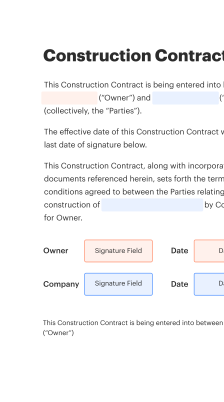
How a signature test flows in typical software

A signature test moves through preparation, delivery, signing, verification, and archival; each stage should be validated individually to ensure end-to-end integrity.

  • Document setup: Upload and tag fields.
  • Authentication selection: Assign identity method.
  • Delivery: Send to test signers.
  • Verification: Confirm audit trail and storage.
Collect signatures
24x
faster
Reduce costs by
$30
per document
Save up to
40h
per employee / month

Quick step-by-step signature test

Follow these steps to run a concise signature test that verifies fields, routing, authentication, and storage.

  • 01
    Prepare document: Insert signature and required fields.
  • 02
    Set routing: Define signer order and roles.
  • 03
    Choose authentication: Select email, SMS, or ID check.
  • 04
    Execute test run: Send to internal test accounts.

Audit trail check: step grid for a signature test

Use this grid to verify audit trail completeness for each test signature event and related metadata.

01

Initiation:

Record who created the envelope.
02

Delivery:

Log timestamp and delivery method.
03

Authentication:

Capture verification method details.
04

Signature capture:

Save signature image and metadata.
05

Completion:

Note finalization timestamp.
06

Storage:

Confirm archival location.
be ready to get more

Why choose airSlate SignNow

  • Free 7-day trial. Choose the plan you need and try it risk-free.
  • Honest pricing for full-featured plans. airSlate SignNow offers subscription plans with no overages or hidden fees at renewal.
  • Enterprise-grade security. airSlate SignNow helps you comply with global security standards.
illustrations signature

Typical workflow settings to configure for a signature test

Configure and validate these technical settings during a signature test to ensure expected behavior for reminders, expirations, and storage.

Setting Name Configuration
Reminder Frequency 48 hours
Expiration Period 30 days
Signer Order Mode Sequential
Archive Location Secure cloud folder
Callback Webhook POST to endpoint

Supported devices and technical requirements

Signature tests should confirm compatibility across desktop browsers, mobile browsers, and native apps to reflect real signer environments.

  • Desktop browsers: Chrome, Edge, Safari
  • Mobile devices: iOS and Android
  • Network needs: Stable HTTPS connection

Verify rendering, authentication flows, and file uploads on each platform and maintain minimum browser and OS versions as defined by your eSignature provider and organizational IT policy.

Core security controls validated by a signature test

Encryption in transit: TLS protected channels
Encryption at rest: AES-256 storage
Access controls: Role-based policies
Authentication methods: Multi-factor options
Audit logging: Immutable activity logs
Document integrity: Tamper-evident seals

Industry scenarios where signature testing matters

Signature tests are useful across industries. The following scenarios describe how testing prevents common failures and supports compliance.

Real estate closings

A broker runs a signature test on closing packages to confirm field placement and signer sequencing for buyers and sellers

  • Checks notarization and identity verification steps
  • Verifies document storage and delivery to title agents

Resulting in fewer re-signs and faster closings with preserved audit evidence.

Education authorizations

An administrator tests parental consent forms delivered via an LMS to ensure signers can authenticate and complete forms on mobile devices

  • Confirms FERPA considerations and restricted data fields are protected
  • Validates automated delivery to student records systems

Ensures records are retained according to policy and available for audits.

Best practices for accurate signature testing

Adopt a repeatable testing routine focused on fields, authentication, routing, and storage to reduce execution errors and support compliance.

Maintain a controlled test account set
Use designated internal accounts that mirror real user roles and permissions. Keep separate test external addresses for vendor or partner signers so that tests do not mix with production data.
Document test scenarios and expected outcomes
Create a simple checklist for each workflow including field placement, authentication type, signer order, reminder cadence, and storage location. Record actual outcomes to track regressions after changes.
Run tests after changes and on a schedule
Execute tests after template updates, integration changes, or security configuration modifications. Periodic validation helps catch issues introduced by platform updates or configuration drift.
Preserve audit logs and test artifacts
Keep copies of test agreements and audit trails to demonstrate validation activities for compliance reviews and to simplify troubleshooting if a production issue arises.

FAQs About signature test

Common questions about running and troubleshooting signature tests, focusing on technical and compliance concerns for U.S. organizations.

Feature availability comparison

A quick feature checklist comparing signNow with other leading vendors on commonly tested capabilities.

eSignature Provider Comparison signNow (Recommended) DocuSign Adobe Sign
Audit Trail
Bulk Send Limited
API Access Available Available Available
HIPAA-support Available Available
be ready to get more

Get legally-binding signatures now!

Retention and schedule considerations for signature tests

Plan test timing and retention so test artifacts do not interfere with production records, and to provide evidence for compliance checks.

Test schedule frequency:

Monthly or post-release checks.

Test artifact retention period:

Retain for 90 days unless longer needed.

Production window testing:

Prefer non-business hours for live rollouts.

Audit evidence storage:

Archive logs in a secure location.

Policy review cadence:

Annually review testing policies.

Risks uncovered by skipping signature tests

Execution errors: Lost agreements
Non-compliance: Regulatory fines
Data exposure: Unauthorized access
Operational delays: Contract backlogs
Invalid signatures: Disputed contracts
Integration failures: Broken workflows

Pricing snapshot across providers

High-level pricing and plan characteristics to consider when configuring signature tests and selecting vendor features for production use.

Vendor Pricing Snapshot signNow (Recommended) DocuSign Adobe Sign HelloSign PandaDoc
Entry-level Monthly Price From $8 per user monthly From $10 per user monthly From $9.99 per month From $15 per user monthly From $19 per user monthly
Free Trial Length 7 to 30 days trial options 30-day trial typical 7-day trial Trial available Trial available
API included in plans Available in business plans Available with developer plans Enterprise/API plans API on certain tiers API on paid tiers
HIPAA-ready options HIPAA-compliant plans available Business/Enterprise support Enterprise support Business plans available Enterprise-level options
Document storage policy Cloud storage with export tools Cloud storage with limits Cloud storage included Cloud storage included Cloud storage included

Simplify complicated workflows

Generate, deliver, and manage workflows of any difficulty, digitally from virtually anywhere. Scalable electronic signature functionality let you share papers with the right people in the right sequence and determine roles for each receiver. Complete document workflows faster and easier than ever before.

Automate document management

Improve sophisticated signing processes with airSlate SignNow�s highly effective tools to improve your business. Manage your automated eSignature workflows to ensure they're running at top efficiency with quick notifications and alerts.

Enhance in team communication

Bring teams together in a safe, shared workplace. Handle documents, use form templates and notices to deliver better cross-organization interaction. Free your employees from having to spend time on recurring routines to enable them to concentrate on valuable, business-vital duties.

Integrate into your current systems

Work your tasks with industry-leading integration. Assemble Salesforce, Microsoft Teams, and SharePoint in one business flow. Link up your applications to a single environment for limitless possibilities and higher efficiency.

Remain compliant with industry-leading data security

Feel confident with the knowledge that your data is protected by the newest in encryption security. airSlate SignNow is GDPR and eIDAS certified and offers you awareness into your signing procedure with court-admissible audit trails. Configure user authorization and rights to regulate who has access to what.


walmart logo
exonMobil logo
apple logo
comcast logo
facebook logo
FedEx logo
be ready to get more

Get legally-binding signatures now!