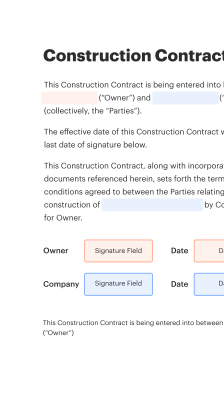
Signed Liquidation Agreement Template for Secure Transactions

Get rid of paper and automate digital document management for higher productivity and endless possibilities. Enjoy the perfect manner of doing business with airSlate SignNow.

Award-winning eSignature solution

What a signed liquidation agreement template is and when to use one

A signed liquidation agreement template standardizes the document used when a party disposes of assets, closes an account, or settles creditor claims. It codifies terms such as asset descriptions, payment schedules, release language, and signatory authority. Using a template reduces drafting time, ensures consistent clause placement, and simplifies review by legal counsel. When deployed with an electronic signature workflow, the template supports secure signature capture, an audit trail, and consistent storage practices for later enforcement or regulatory review in U.S. contexts.

Legal validity and compliance for signed liquidation agreement templates

Signed liquidation agreement templates executed electronically meet U.S. legal standards when they comply with ESIGN and UETA; proper authentication, intent, and a retained record are essential for enforceability.

Legal validity and compliance for signed liquidation agreement templates

Common challenges when creating liquidation agreement templates

  • Inconsistent clause language across agreements increases litigation risk and complicates negotiation.
  • Delays in signature collection can extend liquidation timelines and increase carrying costs.
  • Poor version control leads to using outdated provisions and incorrect signatory information.
  • Insufficient audit records make it hard to prove execution history during disputes or compliance reviews.

Representative roles using liquidation agreement templates

Corporate Counsel

Corporate counsel drafts and reviews liquidation agreement templates to ensure contract language protects the organization and aligns with internal policies and applicable law. They manage approval workflows, confirm signatory authority, and coordinate retention of executed records for potential future disputes or regulatory inspection.

Loan Servicer

Loan servicers use templates to standardize borrower releases, payoff statements, and asset transfer documentation. They integrate templates with servicing systems to populate borrower data, track signature status, and maintain audit trails for compliance and investor reporting purposes.

Who typically uses a signed liquidation agreement template

Legal, finance, and operations teams rely on standardized templates to manage liquidation events efficiently and consistently.

  • Corporate legal departments managing asset sales and releases.
  • Lenders and servicers documenting loan liquidations or foreclosures.
  • Receivers, trustees, and insolvency practitioners handling settlements.

Templates help these users reduce drafting time, maintain compliance, and produce reliable execution records for audits and enforcement.

Additional features that enhance liquidation agreement templates

Beyond core template and signature features, these capabilities improve scalability, control, and integration for complex liquidation workflows.

Conditional Logic

Conditional fields and logic let templates adapt wording and required fields based on transaction specifics, reducing errors and ensuring only relevant clauses and signature fields appear for each liquidation scenario.

Bulk Send

Bulk Send enables distributing the same template to many recipients with individualized fields, useful for parallel settlements or mass payoff notices while maintaining separate audit logs for each execution.

API Integration

APIs allow systems to programmatically generate and send templates, attach transactional metadata, and retrieve executed documents and audit logs for automated record-keeping.

Conditional Approvals

Conditional approval routing enforces internal review thresholds so higher-value or exception transactions pass through additional approvers before signature distribution.

Document Redaction

Redaction tools remove or obscure sensitive data in stored copies while preserving an auditable execution record and a separate secure original for compliance needs.

Version Control

Versioning tracks template changes, labels approved releases, and logs who updated the template to maintain governance and support audit or litigation inquiries.

be ready to get more

Choose a better solution

Core features to look for when using a signed liquidation agreement template

Choose capabilities that simplify preparing, executing, and storing liquidation agreements while preserving legal and audit requirements.

Template Library

Centralized storage for approved liquidation agreement templates enables consistent use across teams, enforces standardized clause sets, and reduces drafting errors by offering controlled, versioned documents that legal teams can update and republish for operational use.

Reusable Fields

Data fields and dropdowns that auto-populate from systems of record reduce manual entry, enforce required data types for amounts and dates, and speed up execution while lowering data entry errors in the final executed document.

Role-based Signing

Signatory roles and signing order ensure the correct parties sign in sequence; roles can enforce specific authentication methods and prevent bypassing required approvals during liquidation processes.

Audit Reporting

Comprehensive, tamper-evident audit logs record each signature event, IP address, and timestamp, producing admissible evidence of execution and supporting regulatory or internal compliance reviews.

How a signed liquidation agreement template works in an eSignature workflow

A template integrates with signature workflows to collect approvals, authenticate signers, and record execution events.

  • Create Template: Upload base document and map fields.
  • Assign Roles: Set signer order and responsibilities.
  • Send for Signature: Distribute via email or bulk send.
  • Archive Executed Copy: Save final PDF with audit log.
Collect signatures
24x
faster
Reduce costs by
$30
per document
Save up to
40h
per employee / month

Quick step-by-step: preparing a signed liquidation agreement template

Follow these four basic steps to prepare a reliable signed liquidation agreement template for repeat use.

  • 01
    Draft Core Terms: Define assets, payment, and release language.
  • 02
    Standardize Fields: Add placeholders for names and amounts.
  • 03
    Add Signature Roles: Specify signer duties and order.
  • 04
    Publish Template: Store in document library for reuse.
be ready to get more

Why choose airSlate SignNow

  • Free 7-day trial. Choose the plan you need and try it risk-free.
  • Honest pricing for full-featured plans. airSlate SignNow offers subscription plans with no overages or hidden fees at renewal.
  • Enterprise-grade security. airSlate SignNow helps you comply with global security standards.
illustrations signature

Recommended workflow settings for signed liquidation agreement templates

Configure workflow settings to match your organization’s approval, notification, and retention policies for liquidation events.

Setting Name Configuration
Signature Order Sequential signing
Reminder Frequency 48 hours
Expiration Window 30 days
Authentication Method Email + SMS
Retention Period 7 years

Using a signed liquidation agreement template across devices

Signed liquidation agreement templates can be created and executed on desktop, tablet, or mobile platforms with appropriate browser or app support.

  • Desktop Browsers: Modern Chrome, Edge, Safari
  • iOS App: iOS 13+ supported
  • Android App: Android 8+ supported

Ensure devices are updated, use secure networks, and apply device-level authentication to maintain signature integrity and reduce the risk of unauthorized access.

Security controls relevant to signed liquidation agreement templates

Encryption: AES 256-bit at rest
TLS: Transport encryption enabled
Access Controls: Role-based permissions
Audit Trail: Complete event logging
Authentication: Multi-factor options
Data Isolation: Segregated storage

Industry examples using signed liquidation agreement templates

Two representative scenarios show how templates streamline liquidation transactions and maintain compliance across industries.

Bank Loan Workout

A regional bank used a standardized liquidation agreement template to document collateral sales and borrower releases, reducing negotiation cycles with clear settlement terms

  • Pre-populated borrower and collateral fields reduced manual entry
  • Faster processing cut time to sale and improved record consistency

Resulting in a demonstrable reduction in turnaround time and clearer audit records for regulators.

Corporate Asset Divestiture

A manufacturing firm applied a template to multiple asset divestitures to ensure identical indemnities and closing conditions across buyers

  • Centralized clause library ensured legal-approved language
  • Consistent execution preserved corporate approvals and tax reporting accuracy

Leading to smoother closings and reduced post-closing disputes.

Best practices for drafting and using signed liquidation agreement templates

Adopt these drafting and operational controls to minimize risk and ensure consistent enforcement.

Use standardized, legally reviewed clause language
Work with in-house or external counsel to create a single approved template version; avoid ad hoc edits during transactions and maintain a changelog so each executed agreement references the template version used.
Implement signer authentication appropriate to transaction risk
Select multi-factor authentication or digital certificate requirements for high-value liquidations to strengthen enforceability and meet internal compliance protocols.
Automate population from authoritative systems
Integrate templates with accounting, loan servicing, or inventory systems to auto-fill amounts and identifiers, reducing manual errors and ensuring consistency across records used for audits or investor reporting.
Retain executed documents and audit trails securely
Store final PDFs and complete execution logs in encrypted, access-controlled archives with defined retention policies to support legal hold, compliance, and discovery processes.

FAQs About signed liquidation agreement template

Common questions and concise answers to help teams prepare, execute, and retain signed liquidation agreement templates effectively.

Feature availability comparison for executing signed liquidation agreement templates

Quick comparison of common capabilities across leading eSignature providers relevant to liquidation agreement templates.

Criteria signNow (Recommended) DocuSign Adobe Sign
Template Library
Bulk Send Limited
Advanced Authentication MFA & Certificate MFA MFA & Certificate
HIPAA Support Business associate ready Available Available
be ready to get more

Get legally-binding signatures now!

Risks and potential penalties from poor template management

Contract Invalidity: Enforceability loss
Regulatory Fines: Compliance penalties
Data Breach: Exposure fines
Litigation Costs: High legal fees
Investor Disputes: Claim exposure
Operational Delays: Process bottlenecks

Pricing snapshot for platforms that support signed liquidation agreement templates

Representative pricing and availability to help estimate cost differences for template-based eSignature usage in the U.S. market.

Plan / Vendor signNow (Featured) DocuSign Adobe Sign PandaDoc HelloSign
Monthly Starting Price (per user) $8 / user / month $25 / user / month $24.99 / user / month $19 / user / month $15 / user / month
Free Tier / Limited Free Offer Free trial only Free trial only Free trial only Limited free plan Free limited plan
Enterprise Plan Available Yes, scalable Yes, enterprise focus Yes, enterprise focus Yes, enterprise options Yes, enterprise options
API Access Included Available in higher tiers Available Available Available Available
Free Trial Length 7–14 days trial 30 days trial 14 days trial 14 days trial 30 days trial

Streamline complicated workflows

Generate, perform, and maintain workflows of any complexness, electronically from almost anywhere. Scalable electronic signature functionality allow you to share documents with the right users the proper order and assign roles for each receiver. Stream document workflows faster and easier than ever before.

Automate document management

Enhance intricate signing processes with airSlate SignNow�s effective features to boost your business. Manage your automatic signature workflows to guarantee they're running at top efficiency with fast notices and alerts.

Optimize in team collaboration

Get teammates together in a secure, shared workplace. Handle documents, use form templates and notices to create more effective cross-company collaboration. Free your staff from having to spend time on repeated actions so that they can center on beneficial, business-crucial projects.

Integrate into your current framework

Manage your tasks with industry-leading integration. Assemble Salesforce, Microsoft Teams, and SharePoint in multi functional business flow. Link your applications to a single system for unlimited opportunities and higher performance.

Remain compliant with market-leading data security

Feel safe with the knowledge that your data remains secure by the newest in encryption security. airSlate SignNow is GDPR and eIDAS compliant and provides you exposure into your eSigning experience with court-admissible audit trails. Set up user access permissions and roles to regulate who has access to what.


walmart logo
exonMobil logo
apple logo
comcast logo
facebook logo
FedEx logo
be ready to get more

Get legally-binding signatures now!