Tax Invoice Template for Enterprises

Boost your business efficiency with airSlate SignNow's user-friendly eSignature solution, designed to streamline document management and save costs.

Award-winning eSignature solution

What a tax invoice template for enterprises is and why it matters

A tax invoice template for enterprises is a preconfigured document that standardizes billing, tax calculations, line-item detail, and regulatory fields for large organizations. For enterprise use it reduces manual entry, ensures consistent VAT or sales tax capture across jurisdictions, supports multi-line invoices and discounts, and integrates with accounting systems. Templates typically include company identification, tax registration numbers, invoice numbering, itemized charges, taxable amounts, and clear payment terms to support auditability, reconciliation, reporting, and compliance with U.S. federal and state tax recordkeeping requirements.

Why enterprises adopt structured tax invoice templates

Using a standardized tax invoice template for enterprises reduces billing errors, accelerates reconciliations, and maintains records that meet tax and audit requirements, improving operational consistency across teams and systems.

Why enterprises adopt structured tax invoice templates

Common challenges when deploying invoice templates

  • Maintaining correct tax rates across multiple states and changing legislations increases administrative overhead for finance teams.
  • Ensuring template fields align with accounting and ERP systems often requires mapping and occasional manual adjustments.
  • Controlling access and versioning for templates across distributed teams can cause inconsistent invoice formats and errors.
  • Tracking approvals and signed invoices manually creates delays in collections and increases risk of compliance gaps.

Primary user roles and their template responsibilities

Billing Manager

Responsible for designing and approving enterprise invoice templates, ensuring tax fields, payment terms, and company identifiers are correct across all templates. Coordinates with accounting and IT for integrations and enforces version control and access permissions for the billing team.

Revenue Operations

Manages template deployment, bulk sending, and reporting. Handles mapping to CRM and ERP systems, monitors invoice delivery and payment status, and enforces compliance with internal controls and external tax recordkeeping requirements.

Which teams and roles commonly use tax invoice templates

Finance, billing, procurement, and contract teams in mid-size to large organizations use tax invoice templates to standardize billing and ensure compliance.

  • Accounts receivable teams that manage high invoice volumes and collections.
  • Procurement and vendor management groups issuing or validating supplier invoices.
  • Legal and compliance teams verifying tax ID, terms, and retention policies.

Standardized templates reduce errors, speed approvals, and create auditable records for internal controls and external tax reporting.

Core features that make enterprise tax invoice templates effective

A robust enterprise template includes calculation logic, reusable fields, integrations, and controls to support volume billing and tax compliance across teams.

Custom Fields

Define company-specific fields like tax registration numbers, purchase order references, internal cost centers, and contract identifiers to standardize invoice metadata across business units and reporting systems.


Line-item Tables

Add detailed line-item tables that support quantities, unit prices, discounts, tax codes, and extensible descriptions so invoices fully describe billed items for customers and auditors.

Tax Calculations

Embed automatic tax logic for federal, state, and local rates and support compound taxes, exemptions, and jurisdiction-based rules to reduce manual adjustments.

Reusable Templates

Create versioned, reusable templates for recurring billing, project-based invoices, and one-time charges to speed generation and maintain consistency across the enterprise.

Bulk Send

Support Bulk Send capabilities to deliver hundreds or thousands of invoices with individualized fields populated from CSV or system data, preserving auditability.

Integrations

Connect templates to ERP, CRM, and accounting systems to sync customer records, invoice numbers, payment status, and ledger entries automatically.

be ready to get more

Choose a better solution

Integrations and connectors that simplify invoice workflows

Connect templates to core business systems so invoices are generated and reconciled automatically without manual entry or rekeying.

Google Workspace

Allow template creation and editing from Google Docs, auto-populate fields from Sheets, and export finalized invoices to Drive for centralized document management and collaboration across teams.

CRM Connectors

Sync customer profiles, billing addresses, tax IDs, and contract terms from your CRM so invoices are accurate and reflect current account information for automated billing cycles.

Cloud Storage

Integrate with Dropbox or other cloud repositories to store signed invoices, enforce retention policies, and provide a single source for backups and audit responses.

API Access

Use REST APIs to generate invoices programmatically, submit line-item data from billing engines, and retrieve signed documents and status for downstream accounting reconciliation.
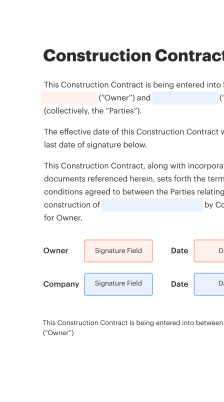
How tax invoice templates operate within document workflows

Templates serve as structured documents that feed data to billing engines, trigger approvals, and generate auditable invoices for customers and tax authorities.

  • Populate: Auto-fill customer and product data from CRM.
  • Calculate: Apply tax rates and compute totals automatically.
  • Approve: Route for managerial or compliance approval.
  • Archive: Store signed invoices in secure cloud storage.
Collect signatures
24x
faster
Reduce costs by
$30
per document
Save up to
40h
per employee / month

Quick setup: create a tax invoice template for enterprises

Follow these four practical steps to build and deploy a compliant enterprise invoice template that supports tax fields and integrations.

  • 01
    Create template: Start with company header and tax ID fields.
  • 02
    Add calculations: Include line-item tax and totals formulas.
  • 03
    Set permissions: Limit edit access to finance admins.
  • 04
    Publish: Publish and version-control the template.
be ready to get more

Why choose airSlate SignNow

  • Free 7-day trial. Choose the plan you need and try it risk-free.
  • Honest pricing for full-featured plans. airSlate SignNow offers subscription plans with no overages or hidden fees at renewal.
  • Enterprise-grade security. airSlate SignNow helps you comply with global security standards.
illustrations signature

Typical workflow settings for enterprise invoice templates

Configure workflow options to automate approvals, reminders, and routing so invoices proceed from draft to signed and archived with minimal manual intervention.

Setting Name Configuration
Approval Routing Two-step approval
Reminder Frequency 48 hours
Signature Requirement Electronic signature
Retention Policy 7 years
Notification Recipients Billing and legal teams

Security controls relevant to enterprise invoice templates

Encryption in transit: TLS-secured connections
Encryption at rest: AES-256 storage
Access controls: Role-based permissions
Authentication methods: Multi-factor options
Audit logging: Detailed change history
Data residency: Region-specific storage

Enterprise use cases that show template value

Real-world examples illustrate how standardized tax invoice templates streamline billing, compliance, and integrations across corporate systems.

Global services firm

A multinational consultancy implemented a standardized tax invoice template for enterprises to capture state and local tax details consistently across regions, reducing manual corrections by the billing team

  • Template included conditional tax fields and automated line-item tax calculation
  • The finance team saw fewer rejected invoices and faster reconciliations

Resulting in measurable reduction in DSO and clearer audit trails across subsidiaries.

SaaS provider

A software vendor adopted reusable tax invoice templates integrated with its CRM to auto-populate customer tax IDs and subscription line items

  • Templates supported prorations, discounts, and multi-tax jurisdictions
  • Integration cut manual data entry and reduced billing disputes

Leading to improved cash flow, fewer support tickets, and consistent records for tax filings.

FAQs and troubleshooting for tax invoice templates

Common questions about setting up, using, and troubleshooting tax invoice templates for enterprises, including integration and compliance concerns.

Feature comparison of enterprise eSignature and template capabilities

A side-by-side comparison of common capabilities for enterprise tax invoice templates and eSignature support across leading providers.

Feature Comparison and Criteria Header signNow (Recommended) DocuSign Adobe Sign
ESIGN and UETA compliance
Bulk Send capability
Template version control
Native CRM integrations Salesforce, HubSpot Salesforce only Salesforce, Microsoft Dynamics
be ready to get more

Get legally-binding signatures now!

Risks and penalties from poor invoice management

Tax audit fines: Monetary penalties
Late payment fees: Interest and charges
Contract disputes: Remediation costs
Data breach fines: Regulatory penalties
Compliance violations: Reporting obligations
Reputational harm: Client trust loss

Pricing and plan comparison for enterprise invoice templates and eSign

Pricing varies by user counts, features, and enterprise contracts; this comparison shows typical entry-level pricing and support characteristics.

Pricing Plan or Vendor signNow (Recommended) DocuSign Adobe Sign HelloSign PandaDoc
Free Tier Availability Limited free plan with basic features only No perpetual free plan; short trials only Free trial available for seven days Free tier includes basic eSigning functionality Trial period then paid subscriptions required
Entry Price (per user/month) $8 per user monthly billed annually $10 per user monthly billed annually $12 per user monthly billed annually $15 per user monthly billed annually $19 per user monthly billed annually
Bulk Send Cost Included in business plans; per-send limits apply Add-on or higher tiers required for large volumes Bulk send available in enterprise plans Bulk send available in growth plans Bulk send available with enterprise agreement
Annual Enterprise Discount Negotiable discounts for annual commitments Volume discounts for enterprise contracts Enterprise pricing with negotiable discounts Annual discounts for larger teams Custom pricing based on usage and seats
Support and SLAs Email support; enterprise SLAs for paid plans Tiered support with SLA options Enterprise support and dedicated success options Priority email support for paid plans Dedicated enterprise support for large contracts
walmart logo
exonMobil logo
apple logo
comcast logo
facebook logo
FedEx logo
be ready to get more

Get legally-binding signatures now!