Verifiable Signature Solutions with SignNow

Eliminate paper and optimize digital document management for increased performance and endless opportunities. Explore the best manner of running your business with airSlate SignNow.

Award-winning eSignature solution

What a verifiable signature is and why it matters

A verifiable signature is an electronic signature backed by cryptographic evidence and an auditable record that links a signer to a specific document and time. It typically includes tamper-evident hashes, signer authentication details, and a complete audit trail that can be used as proof of intent and execution. In the United States, verifiable signatures are used to meet legal standards under ESIGN and UETA when combined with appropriate identity verification and retention practices, and they help reduce disputes about authenticity.

Why use verifiable signatures in business workflows

Verifiable signatures reduce fraud, improve processing speed, and create legally defensible evidence of agreement when paired with reliable identity checks and document retention.

Why use verifiable signatures in business workflows

Common challenges when implementing verifiable signatures

  • Establishing signer identity reliably without creating excessive friction for users.
  • Maintaining chain-of-custody records that demonstrate no document tampering occurred.
  • Ensuring audit trails are preserved in secure, searchable formats for legal needs.
  • Integrating verification steps into existing workflows without causing delays or errors.

Typical user profiles and responsibilities

Contract Manager

Manages document lifecycles and ensures signatures are captured correctly. Responsible for configuring signing workflows, assigning roles, and maintaining audit records to support enforceability and contract compliance.

Compliance Officer

Oversees legal and regulatory requirements for signatures and records. Ensures identity verification, retention policies, and access controls meet ESIGN, UETA, HIPAA, or sector-specific obligations.

Who typically relies on verifiable signatures

Organizations across legal, HR, finance, and healthcare use verifiable signatures for regulated transactions and recordkeeping.

  • Legal and contracts teams managing high-value agreements and dispute risk.
  • Human resources for onboarding, tax forms, and employment contracts.
  • Healthcare administrators handling consent forms and protected records.

Adoption is common where regulatory compliance, auditability, and identity verification are priorities for operational and legal certainty.

Key tools that support verifiable signatures

A combination of signature features and administrative controls enables secure, verifiable signing across teams and systems.

Verifiable Signatures

Captures cryptographic evidence, signer details, and tamper-evident records to demonstrate who signed and when for legal and audit needs.


Multi-Factor Authentication

Adds an additional identity verification step such as SMS or authenticator apps to reduce impersonation risk during signing.

Audit Logs

Stores detailed, timestamped event records including IP addresses and actions taken by each participant.

Templates

Standardizes document structure and verification settings so compliance rules are applied consistently across recurring agreements.

API Access

Enables programmatic sending, verification configuration, and retrieval of signed documents and audit data for integrations.

Role-Based Access

Controls user capabilities to limit who can modify templates, change verification levels, or access sensitive signed records.

be ready to get more

Choose a better solution

Integrations and templates that support verifiable signatures

Connectors and reusable templates reduce manual work and ensure consistent application of verification settings across documents and teams.

Google Workspace

Integration with Google Docs and Drive enables sending documents directly from familiar productivity tools, preserving version history and allowing templates to be reused while applying verification and audit settings consistently across shared files.

CRM Integration

CRM connectors let sales and service teams attach verifiable signature workflows to records so agreements are created from templates, mapped with contact data, and tracked within the customer lifecycle for accurate auditability.

Cloud Storage

Dropbox and other storage integrations allow signed documents and full audit reports to be saved automatically in secure folders, simplifying retention policies and centralized access controls for legal review.

Document Templates

Prebuilt templates capture required fields, verification levels, and signature placements, reducing errors and ensuring every document uses the correct authentication and retention settings.
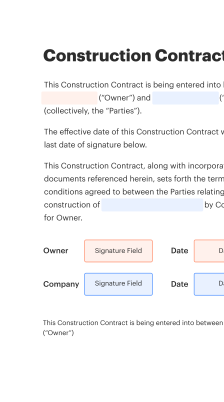
How verifiable signatures are created and validated

A verifiable signature process combines signer authentication, document hashing, and an immutable audit record to prove who signed and when.

  • Signer Authentication: Verify identity using email, SMS, or ID checks.
  • Document Hashing: Generate cryptographic hash of final document.
  • Apply Signature: Signer applies electronic signature to the document.
  • Store Audit: Save timestamped evidence and verification metadata.
Collect signatures
24x
faster
Reduce costs by
$30
per document
Save up to
40h
per employee / month

Quick setup: create a verifiable signature workflow

Follow these basic steps to prepare and send a document that will capture a verifiable signature.

  • 01
    Upload Document: Add the finalized file to the system.
  • 02
    Place Fields: Insert signature and data fields where needed.
  • 03
    Set Verification: Choose authentication level for signer identity.
  • 04
    Send and Track: Distribute document and monitor completion.

Managing audit trails and verification evidence

Audit trails are essential for verifiable signatures; follow these steps to ensure records are complete and accessible.

01

Enable Logging:

Activate system event capture.
02

Capture Metadata:

Record IPs, timestamps, and devices.
03

Store Hashes:

Keep cryptographic document hashes.
04

Secure Storage:

Use encrypted, access-controlled repositories.
05

Retention Settings:

Apply legal retention rules.
06

Export Options:

Provide PDF and machine-readable exports.
be ready to get more

Why choose airSlate SignNow

  • Free 7-day trial. Choose the plan you need and try it risk-free.
  • Honest pricing for full-featured plans. airSlate SignNow offers subscription plans with no overages or hidden fees at renewal.
  • Enterprise-grade security. airSlate SignNow helps you comply with global security standards.
illustrations signature

Typical workflow settings for verifiable signature processes

Configure these settings to align verification levels and retention rules with organizational policy and document risk.

Setting Name Configuration
Reminder Frequency 48 hours
Authentication Level Email, SMS, ID Check
Signature Type Electronic with hash
Retention Policy 7 years
Webhook Endpoint HTTPS callback

Supported platforms for verifiable signing

Verify that devices, browsers, and apps meet minimum requirements to ensure consistent signature capture and verification.

  • Desktop Browsers: Latest Chrome, Edge, Safari
  • Mobile OS: iOS 14+ and Android 9+
  • Native Apps: App versions updated regularly

Maintain a supported platform matrix and update schedule to reduce compatibility issues, and document mobile app and browser versions that your organization certifies for secure signing.

Core security components of verifiable signatures

Hashing: Creates tamper evidence
Encryption: Protects data at rest
TLS Transport: Secures data in transit
Audit Trail: Records signer actions
Authentication: Validates signer identity
Access Controls: Limits document access

Industry examples using verifiable signatures

Examples show how verifiable signatures reduce risk and speed approvals while meeting sector-specific documentation needs.

Healthcare Consent Forms

A hospital implemented verifiable signatures for patient consent to streamline intake while capturing identity checks

  • Uses multi-factor authentication and hashed document records
  • Reduces manual processing and secures consent validity

Resulting in faster admissions and clearer legal evidence for care decisions.

Real Estate Closings

A broker integrated verifiable signatures into purchase agreements to standardize execution across remote signers

  • Adds ID verification and a complete audit trail for each transaction
  • Minimizes last-minute disputes and simplifies lender review

Leading to shorter closing cycles and stronger enforceability of agreements.

Best practices for secure, reliable verifiable signatures

These practices help maintain legal defensibility and operational consistency when capturing verifiable signatures.

Standardize authentication levels for document types
Define and document which verification methods (email, SMS, knowledge-based, or government ID) are required for different document categories, and ensure signers receive clear instructions to avoid delays and maintain evidence quality.
Preserve audit trails and metadata long-term
Store cryptographic hashes, timestamps, IP addresses, and signer verification records in secure, immutable storage with access controls to support legal inquiries and audits without risking data loss.
Use templates and role-based permissions
Establish approved templates and assign role-based permissions to prevent unauthorized changes, ensure consistent verification settings, and reduce configuration errors across teams handling regulated documents.
Review retention and legal hold policies
Implement retention schedules that meet regulatory requirements and include processes for legal holds to prevent deletion of evidence when documents are needed for disputes or compliance audits.

FAQs About verifiable signature

Common questions about implementation, authentication, and legal status of verifiable signatures with concise answers for everyday issues.

Feature comparison: verifiable signature capabilities

Compare core verifiable signature features across common vendors to evaluate baseline support and advanced options.

Feature signNow DocuSign Adobe Acrobat Sign
Verifiable Signature Support
Detailed Audit Trail Comprehensive Comprehensive Comprehensive
Advanced ID Verification ID Check options ID Check options ID Check options
Bulk Send Capability Bulk Send Bulk Send Bulk Send
be ready to get more

Get legally-binding signatures now!

Document retention and review schedule recommendations

Set clear retention and review timelines to balance legal requirements, storage cost, and data lifecycle management for signed records.

Standard retention period:

7 years for most contracts

Financial and tax records:

Maintain for at least 7 years

Healthcare records (HIPAA covered):

Retain per state law

Periodic audit reviews:

Annual verification of records

Legal hold duration:

Preserve until release notice

Risks and penalties from poor implementation

Noncompliance Fines: Civil penalties possible
Contract Disputes: Agreements may be challenged
Data Breach Costs: Remediation expenses likely
Regulatory Audits: Increased oversight risk
Reputational Harm: Loss of trust
Operational Delays: Workflow disruptions

Pricing snapshot and cost-related features

High-level pricing and feature availability can influence total cost of ownership; this snapshot highlights starting points and core options for comparison.

Plan signNow (Recommended) DocuSign Adobe Acrobat Sign Dropbox Sign PandaDoc
Entry Price $8/user/month $10/user/month $14.99/user/month $13/user/month $19/user/month
Free Trial 7 days 30 days 7 days 30 days 14 days
API Included Available Available Available Available Available
Enterprise Features SSO, SAML SSO, SAML SSO, SAML SSO SSO, API
Support Level Email support Phone & Email Phone & Email Email support Priority support

Simplify challenging workflows

Prepare, execute, and manage workflows of any complexity, digitally from virtually anywhere. Scalable eSignature capabilities enable you to share documents with the right users the correct order and set up roles for every signee. Complete document workflows faster and simpler than ever before.

Automate document management

Enhance complicated signing processes with airSlate SignNow�s powerful functions to boost your business. Manage your automated signature workflows to make sure they're running at maximum performance with instant notifications and reminders.

Enhance in team communication

Bring teammates together in a safe, shared workspace. Handle documents, use form templates and notices to deliver more efficient cross-organization communication. Relieve your staff from having to hang out on recurring actions to enable them to focus on beneficial, business-essential activities.

Integrate into your current network

Manage your projects with industry-leading integration. Capture Salesforce, Microsoft Teams, and SharePoint in multi functional business stream. Hook up your software to a single system for endless opportunities and more performance.

Remain compliant with industry-leading data protection

Feel confident knowing that your information remains secure by the most up-to-date in encryption security. airSlate SignNow is GDPR and eIDAS compliant and gives you visibility into your signing process with court-admissible audit trails. Configure user authorization and roles to regulate who has access to what.


walmart logo
exonMobil logo
apple logo
comcast logo
facebook logo
FedEx logo
be ready to get more

Get legally-binding signatures now!