Party Identification
Full legal names, relationships to decedent, and identification details to tie the signer to estate records.
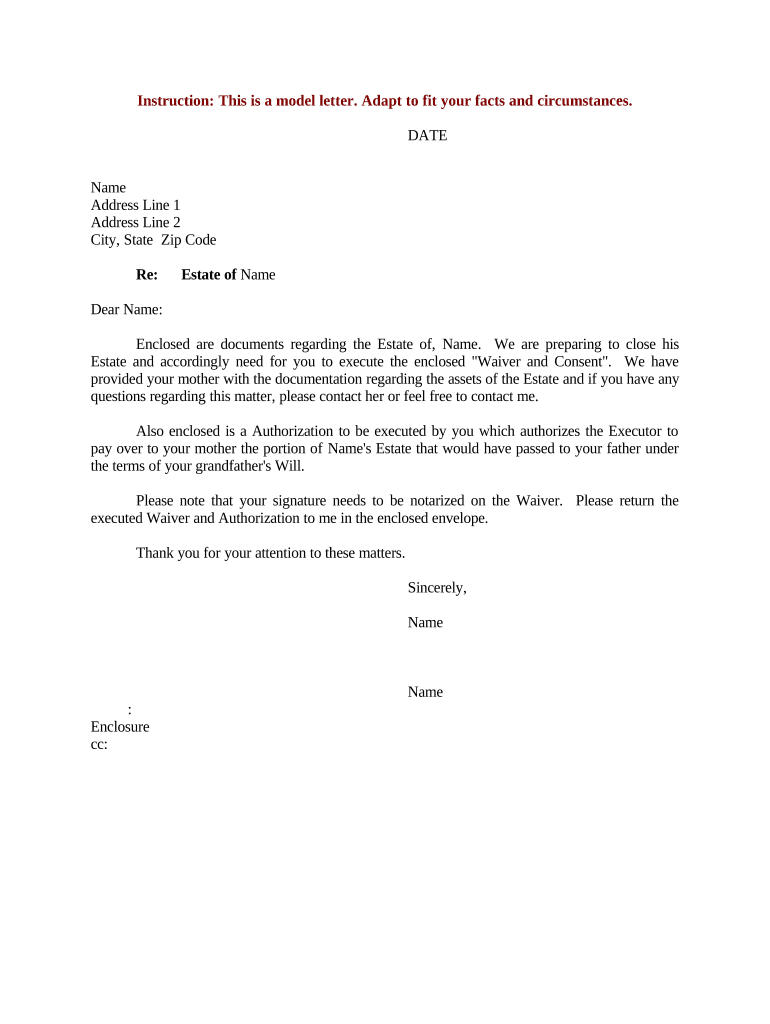
This letter reduces ambiguity about who can access estate assets and which claims are relinquished, helps institutions accept directions without litigation, and documents consent in a reproducible form under ESIGN (15 U.S.C. §7001) and state electronic transaction laws.

Parties involved in estate administration, financial institutions, and attorneys commonly prepare or request this letter.
Use parties and institutions listed above as a checklist to confirm distribution routing and acceptance requirements.
An executor, personal representative, or administrator named by a will or court. Responsible for submitting documented waivers and authorizations to institutions, coordinating with counsel, and maintaining the estate record during probate or administration.
A person entitled to receive property under a will or by intestacy who may sign to waive rights or authorize another to act. Their accurate identification and clear, dated signature are essential to prevent later disputes.
Full legal names, relationships to decedent, and identification details to tie the signer to estate records.
Precise phrasing listing the specific rights, claims, or portions of estate being waived.
Clear statement of who is authorized to act, the actions allowed, and any limits or expiry.
Date when waiver or authorization takes effect, written in MM/DD/YYYY format.
If applicable, description of consideration or mutual releases that support enforceability.
Signer name, signature, printed name, date, and any required witness or notary acknowledgements.
| Field | Configuration |
|---|---|
| Authentication Method | Email link, SMS code, or KBA as required |
| Conditional Fields | Show witness block only when state requires it |
| Routing Order | Executor first, then beneficiary, then notary |
| Reminder Settings | Automatic reminders at 3 and 7 days |
Use PDF or DOCX templates, ensure audit trails are captured, and confirm recipient acceptance of e-signatures.
Verify the receiving organization accepts electronic signatures and that your chosen platform can produce a tamper-evident PDF and maintain an audit trail for retention and dispute resolution.
Send signed letter to involved parties promptly after execution
Banks and title companies may take several business days
Complete notarization before delivery when required
Probate courts have jurisdictional submission practices
Retain signed originals per regulatory guidance
Prepare text and obtain attorney review if needed
Signer executes, and notarization or witness steps completed
Provide copies to banks, title, and counsel
Obtain written confirmation or updated account instructions
A beneficiary waives claim to a small brokerage account
A spouse authorizes a trustee to obtain medical and financial records
| Criteria | Estate Waiver Letter | Power of Attorney | Release Agreement |
|---|---|---|---|
| Purpose | waive claims | grant broad authority | settle claims |
| Scope | specific assets/claims | broad acts over assets | defined settlement terms |
| Authentication | signature/notary | often notarized/poa statutory | usually notarized |
| Timing | used during administration | effective when durable | used to close disputes |
| signNow | DocuSign | Adobe Sign | PandaDoc | HelloSign | |
|---|---|---|---|---|---|
| Starting Price | $8/user/mo | $15/user/mo | $14/user/mo | $19/user/mo | $15/user/mo |
| Free Trial | 7-day free trial | No | No | Yes, limited | Yes, limited |
| Bulk Send | Yes | Yes | Yes | Yes | No |
| Audit Trail | Yes | Yes | Yes | Yes | Yes |
| HIPAA Compliant | Yes | Yes | Yes | No | No |