Oklahoma Notice of Intent
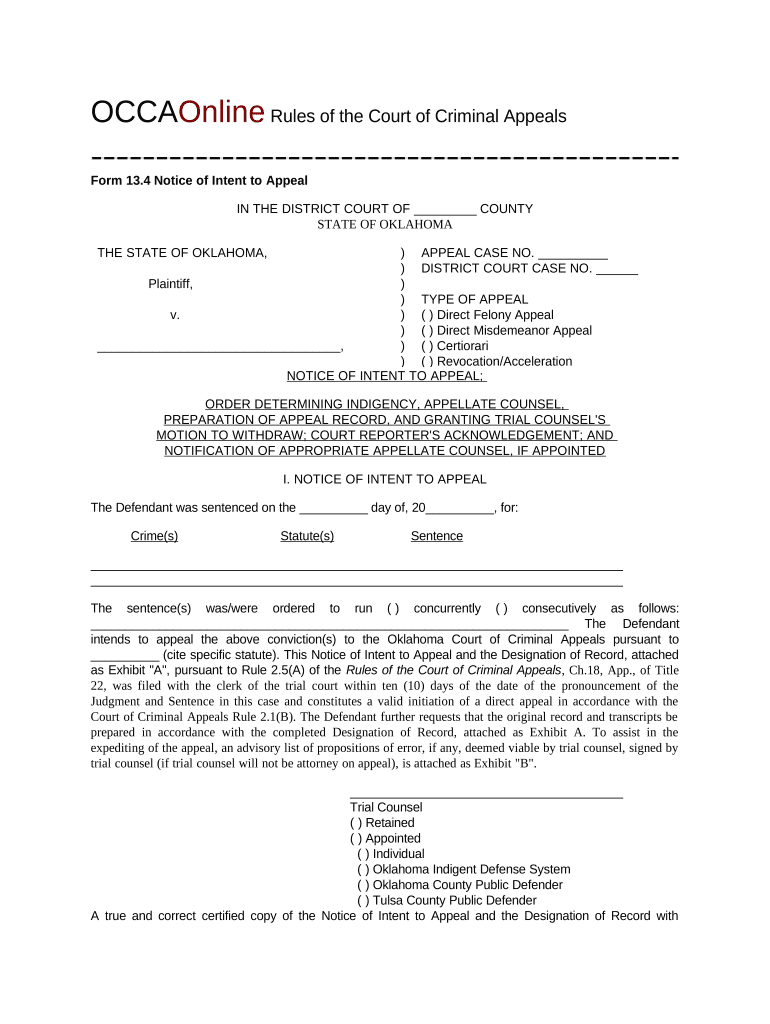
What the Oklahoma Notice of Intent Is
Why a Notice of Intent Matters
Serving a Notice of Intent preserves rights and creates a documented, time-stamped record that can trigger cure periods, focus settlement efforts, and strengthen later claims such as lien filings or litigation while aligning with ESIGN/UETA signature and record-retention standards.

Who Typically Prepares and Receives These Notices
Contractors, subcontractors, suppliers, and property owners commonly prepare an Oklahoma Notice of Intent when payment or contract performance is disputed.
- General contractor or prime — files to preserve lien or contractual remedies after nonpayment.
- Subcontractors and material suppliers — assert unpaid balances and notify owners or lenders of intent.
- Property owners and managers — receive notice and have an opportunity to cure or verify charges.
Step-by-step: Prepare and Serve a Notice
-
01Prepare Notice: Draft claim details and attach invoices.
-
02Verify Parties: Confirm owner, contractor, and lender names.
-
03Deliver Notice: Serve by required method and keep proof.
-
04Preserve Evidence: Save signed copy, delivery receipt, and supporting files.
How Electronic Notices Work
-
Upload Template: Start with a fillable PDF or DOCX.
-
Place Fields: Add name, date, amount, and signature fields.
-
Authentication: Choose email link, SMS code, or ID verification.
-
Archive & Audit: Store signed PDF with audit trail and metadata.
Recommended Electronic Workflow Settings
| Field | Configuration |
|---|---|
| Notice Type | Pre-lien or payment demand |
| Authentication | Email link; SMS code optional |
| Delivery Method | Certified mail, secure e-delivery |
| Retention Policy | Retain signed record per legal periods |
Technical Considerations for e-Delivery and Signing
Confirm file types, signer authentication options, and storage standards supported by your eSignature platform before sending legal notices.
- File Formats: PDF, DOCX, HTML
- Integrations: Salesforce, NetSuite, Google Workspace
- Authentication: Email, SMS, or ID verification
Comparing eSignature Pricing and Capabilities
| signNow | DocuSign | Adobe Sign | PandaDoc | HelloSign | |
|---|---|---|---|---|---|
| Starting Price | $8/user/mo | $15/user/mo | $14/user/mo | $19/user/mo | $15/user/mo |
| Free Trial | 7-day trial | Varies | Varies | Varies | Varies |
| Bulk Send | Yes | Yes | Yes | Yes | No |
| Audit Trail | Yes | Yes | Yes | Yes | Yes |
| HIPAA Compliant | Yes | Yes | Yes | No | No |
| Envelope Cap | No cap | 100 envelopes/user/year | Varies | Varies | Varies |
Typical Timeline Elements to Track
Notice Preparation:
Draft and attach invoices before sending.
Service Date:
Record the exact delivery date and method.
Cure Window:
Track the period allowed for payment or dispute resolution.
Lien Filing Deadline:
Note state lien filing deadlines to preserve rights.
Record Retention:
Begin retention clock once claim is resolved.
Common Mistakes to Avoid
- Sending notice to the wrong party or incorrect address undermines service and can forfeit remedies.
- Incomplete or inconsistent amounts and dates lead to disputes and potential dismissal of a later lien.
- Failing to preserve delivery proof—signed receipts, certified mail records, or electronic audit trails—weakens enforcement efforts.
- Using informal signatures or missing authority documentation can invalidate the notice in contested proceedings.
Consequences of an Incorrect or Late Notice
Real-world Examples of Electronic Notices
Martin Properties
Martin Properties used an electronic Notice of Intent workflow to address overdue tenant and vendor disputes.
- Cut turnaround from days to hours.
- Using signNow's mobile signing and audit trail, the team documented service, collected signatures remotely, and resolved matters without in-person meetings while preserving lien options and secure records.
Optica Ventures
Optica Ventures streamlined vendor claims by standardizing notices in a template library.
- Improved consistency across projects.
- The standardized electronic process reduced errors, centralized evidence, and allowed legal teams to triage disputes faster while maintaining auditable delivery histories.
FAQs and Troubleshooting
-
Is an electronic notice legally valid in Oklahoma?
Yes—electronic signatures and records are generally enforceable under the federal ESIGN Act (15 U.S.C. ch. 96) and state electronic transaction laws; however, confirm any Oklahoma-specific statutory requirements or exceptions before relying solely on e-delivery.
-
What proof of service should I keep?
Retain signed copies, delivery receipts (certified mail return receipt or secure e-delivery logs), and the platform audit trail showing signer identity, timestamps, and IP addresses to support later enforcement.
-
Do notices need notarization or witnesses?
Notarization is not typically required for a Notice of Intent itself, but certain downstream filings, affidavits, or county recorder submissions may require notarized documents; verify Oklahoma notary rules and RON availability with state authorities.
-
How can I revoke or correct a notice?
To revoke or amend, send a clear written replacement or retraction and preserve proof of delivery; document the reason for correction and retain both original and revision for evidentiary clarity.
-
What happens if the recipient disputes the notice?
Maintain supporting documents—contracts, invoices, delivery confirmations—and consult counsel; disputes commonly proceed to negotiation, lien filing, or litigation depending on state deadlines and statutory remedies.
-
How long should signed notices be stored?
Follow applicable retention rules: retain while claim active, at least three years for many financial records (IRC §6501(a)), and six years for HIPAA-related records (45 CFR §164.530(j)); verify state or industry-specific extensions.