Establishing secure connection…Loading editor…Preparing document…

Trustees Sale

This template is fully customizable. Edit the text, fill out the fields, and send it for signature. Give it a try!
Trustees Sale

What a Trustees Sale Is and when it applies

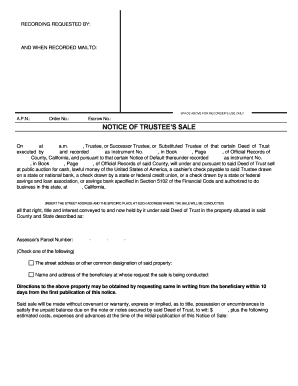
A Trustees Sale is a public auction of real property conducted under a recorded deed of trust after a borrower’s default, commonly used in non-judicial foreclosure states to satisfy a secured debt. The trustee—typically a title company, bank, or appointed third party—conducts the sale following statutory notice and publication procedures. Documents associated with a Trustees Sale (for example, Notice of Trustee’s Sale and Trustee’s Deed) identify the borrower, beneficiary (lender), trustee, legal property description, sale date and location, and any opening bid or redemption information required by state law.

Why a clear Trustees Sale document matters

A properly prepared Trustees Sale document ensures statutory notice, reduces disputes over title transfer, and sets clear sale mechanics for bidders, the trustee, and the beneficiary. Accurate forms support enforceability under state foreclosure statutes and help manage post-sale recording and title clearing.

Why a clear Trustees Sale document matters

Who interacts with Trustees Sale documents

Lenders, servicers, trustees, title companies, foreclosure attorneys, real estate investors, and property owners commonly prepare, serve, or respond to Trustees Sale notices and related filings.

  • Mortgage lenders and loan servicers initiating foreclosure under a deed of trust
  • Neutral trustees or title companies administering sale mechanics and recordkeeping
  • Attorneys, investors, and buyers who evaluate title and bid at auction

Typical signer and document owner roles

Trustee — Title Officer

The trustee arranges notices, posts required sale information, publishes where required, conducts the auction, and prepares the Trustee’s Deed after sale. The trustee must follow the deed of trust terms and applicable state statute to avoid procedural challenge.

Lender — Loan Servicer

The beneficiary or its servicer authorizes the sale, provides payoff figures and loan details, and may set minimum bid terms. Accurate beneficiary data ensures the sale satisfies the secured debt and supports post-sale clearance.

Essential information to include on a Trustees Sale notice

Property Description: Full legal description
Trustee Details: Name and contact
Beneficiary Name: Lender or servicer
Recording Reference: Deed of Trust book/page or instrument number
Sale Date and Time: Scheduled auction specifics
Opening Bid: Minimum or credit bid

Common errors to avoid when preparing a Trustees Sale

  • Missing or incorrect legal description that causes title to be unenforceable and invites challenge at sale or in quiet-title litigation.
  • Failing to meet state-specific notice and publication timing requirements, which can render the sale voidable by the borrower.
  • Using incorrect beneficiary or trustee names as recorded, producing conflicts in post-sale recording and title insurance issuance.
  • Improper signature, acknowledgement, or notarization format that prevents recording of the Trustee’s Deed after sale.

Risks and legal consequences of incorrect Trustees Sale documents

Voidable Sale: Sale may be set aside
Title Defect: Buyer faces clouded title
Litigation Costs: Attorney fees and damages
Regulatory Risk: State enforcement or sanctions
Delay in Conveyance: Recording and marketability impacts
Insurance Denial: Title insurer may refuse coverage

Step-by-step: preparing and executing a Trustees Sale

Follow a clear sequence: verify loan and deed records, prepare notice documentation, serve and publish notices, conduct the auction, then record the Trustee’s Deed and transfer funds.

  • 01
    Verify Records: Confirm deed of trust and beneficiary details
  • 02
    Prepare Notice: Draft Notice of Trustee’s Sale with required particulars
  • 03
    Serve and Publish: Record, post, and publish notices per statute
  • 04
    Conduct Sale: Hold public auction and prepare Trustee’s Deed

Where to file and how notices are distributed

Trustee’s Sale documentation is routed to recording offices, served to parties, and published or posted as required by state rules; different destinations ensure legal notice and recordation.

  • County Recorder: Record Notice of Trustee’s Sale and related instruments
  • Service to Borrower: Deliver statutory notice to borrower and occupants
  • Newspaper Publication: Publish sale notice where statute requires
  • Sale Location: Post sale place per county or statute

Setting up a digital Trustees Sale workflow

Configure an online process that combines secure document storage, correct signing order, and required authentication for trustees, lenders, and signers.

Field Configuration
Authentication Email with optional SMS code or stronger ID methods
Document Format Use PDF/A for record stability
Signing Order Set trustee, beneficiary, then witness sequence
Retention Policy Archive copies per retention rules

Technical considerations for e-filing and e-signing

Use platforms that accept PDF, DOCX, and support audit trails, identity verification, and secure storage to meet legal and record-keeping needs.

  • File Formats: PDF, Word DOCX supported
  • Integrations: Connects to title, CRM, and cloud storage
  • Authentication: Email, SMS code, or advanced ID proofing

Typical timelines and what to expect

Timelines for notice, publication, posting, and sale vary by state; planning should allow for statutory notice windows, publication cycles, and county recording schedules.

Notice Period:

Varies by state; commonly 30–120 days depending on statute

Publication Schedule:

Often weekly notices for multiple weeks where required

Posting Requirement:

Physical posting at courthouse or property per local rule

Redemption Window:

Some states allow limited post-sale redemption; varies widely

Recording After Sale:

Record Trustee’s Deed promptly to establish marketable title

Core elements a professional Trustees Sale should include

A complete Trustees Sale package combines legal accuracy, clear notice language, and post-sale conveyance documents to support title transfer and reduce post-sale disputes.

Notice of Trustee’s Sale

Clear, state-compliant notice including sale date, time, and location; names of trustee and beneficiary; full legal description; and any required opening bid or credit bid details to inform bidders and satisfy statutory notice obligations.

Legal Description

Precise metes-and-bounds or lot-and-block description tied to recorded plat and parcel number to prevent ambiguous identification of property and ensure correct recording and title chain continuity.

Recorded References

Recordation data for the deed of trust and related instruments (instrument number, book/page, or recorder index) so interested parties can verify encumbrances and lien priority prior to sale.

Trustee and Beneficiary Details

Accurate legal names, contact information, and roles for the trustee and beneficiary; errors here commonly cause post-sale title disputes or challenges to sale validity.

Publication and Posting Proof

Affidavits of publication, posting receipts, and proof of service documentation demonstrating compliance with statutory notice steps required for non-judicial foreclosure sales.

Trustee’s Deed Draft

Prepare a post-sale deed in recordable form that includes chain-of-title recitals and buyer information so successful bidders can record immediately and begin clearing title and obtaining insurance.

Real-world scenarios illustrating Trustees Sale use

These illustrative scenarios show typical issues and how properly prepared documents reduce friction and legal exposure.

Investor Auction Purchase

A local investor reviews public Notices of Trustee’s Sale to identify potential auctions near market value

  • Verifies recorded deed and posting evidence before bidding
  • After a clean title examination and prompt recording of the Trustee’s Deed, the investor secures title insurance and lists the property for resale, minimizing exposure to title defects.

Servicer-Driven Sale Process

A loan servicer coordinates a Trustees Sale after borrower default to enforce a deed of trust

  • Uses standardized notice templates and publication tracking
  • Proper timing, accurate beneficiary naming, and retained proof of publication prevent procedural challenges and support post-sale accounting reconciliation with investors.

Practical tips for accurate and efficient Trustees Sale completion

Adopt consistent templates, verify records, and preserve audit evidence to reduce errors and speed title clearance after sale.

Use recorded instruments
Always copy names, legal descriptions, and recording references directly from recorded deeds and assignments to avoid discrepancies.
Preserve proof of notice
Keep affidavits of service, publication tear sheets, and posting receipts to demonstrate statutory compliance if challenged.
Reconcile payoff figures
Confirm beneficiary payoffs and arrears amounts before setting opening bid to align sale proceeds with loan satisfaction.
Plan for recording
Prepare Trustee’s Deed in recordable form so the successful bidder can record immediately, reducing marketability delay.

Comparing common eSignature providers for Trustees Sale workflows

Pricing and key capabilities affecting Trustees Sale workflows vary by vendor; signNow is listed first to match platform comparison conventions.

signNow DocuSign Adobe Sign PandaDoc HelloSign
Starting Price $8/user/mo $15/user/mo $14/user/mo $19/user/mo $15/user/mo
Free Trial 7-day free trial, no credit card Varies Varies Varies Varies
Bulk Send Yes Yes Yes Yes No
Audit Trail Yes Yes Yes Yes Yes
HIPAA Compliant Yes Yes Yes No No

Frequently asked questions and answers about Trustees Sales

Answers address common procedural, filing, and title questions users encounter when preparing or responding to a Trustees Sale.


Need help? Contact support

be ready to get more
Join over 28 million airSlate SignNow users