Template mapping
Map CC roles to template variables so specific departments or compliance teams automatically receive copies for particular document types and reduce manual assignment errors.




Adding carbon copies recipients provides transparent notifications to stakeholders, preserves records for audit purposes, and reduces manual distribution tasks while keeping signer experience uninterrupted.

A contracts manager configures templates and routing so legal counsel and account teams are CC'd on executed contracts. They ensure recipients receive final PDFs and audit logs, and they review access permissions to prevent unauthorized disclosure while maintaining efficient contract cycle times.
An accounts payable specialist receives CC copies of vendor invoices and payment authorizations to trigger internal processing. They rely on consistent naming and metadata so documents automatically flow into accounting systems and match against purchase orders without manual forwarding.
Many business functions use add carbon copies recipients to keep non-signing stakeholders informed without interrupting signer steps.
Properly configured CC recipients reduce manual distribution while maintaining auditable distribution records and consistent stakeholder visibility.
Map CC roles to template variables so specific departments or compliance teams automatically receive copies for particular document types and reduce manual assignment errors.
Apply rules that add CC recipients only when certain field values or signer choices meet criteria, enabling dynamic distribution based on transaction data.
Use the platform API to programmatically add CC recipients during envelope creation in integrated systems, ensuring consistent distribution from CRM or ERP triggers.
Automatically redact sensitive fields before delivering copies to CC recipients, protecting confidential data while sharing necessary information for processing.
Tag documents delivered to CC recipients with retention labels so automated lifecycle policies apply consistently across records.
Track who was CC'd and when, helping teams monitor distribution compliance and address gaps in stakeholder notification.
Set whether CC recipients are notified immediately upon sending, only after completion, or at specific routing milestones to match business requirements.
Control whether CC recipients can download the signed PDF, limiting exposure for sensitive agreements and aligning distribution with recordkeeping policies.
Choose whether CC recipients see full document content or only selected fields; this supports privacy needs and reduces unnecessary data exposure.
Save preferred CC configurations within templates so teams use consistent routing and reduce errors when preparing recurring document types.

| Setting Name | Configuration |
|---|---|
| Reminder Frequency | 48 hours |
| Notification Timing | On completion |
| CC Role Mapping | By template role |
| Retention Label | 7 years |
| Access Permission | View only |
add carbon copies recipients can be configured from web browsers, dedicated mobile apps, and via API integrations depending on platform capabilities.
For mobile and tablet, basic CC configuration and notifications are available in native apps, while full template management and advanced rules are often most accessible via the desktop web interface or programmatic API.
A procurement team sends purchase orders for signature and CCs accounts payable to the final document
Resulting in faster payment cycles and fewer manual handoffs while preserving an auditable copy.
A university routes a FERPA-permitted release for a student signature and CCs the registrar and academic advisor
Leading to consistent recordkeeping and secure distribution with role-based access controls enforced.
| Feature and Compliance Criteria List | signNow (Recommended) | DocuSign | Adobe Acrobat Sign |
|---|---|---|---|
| Basic CC support | |||
| Conditional CC routing | Limited | ||
| Max CC recipients | Unlimited | Unlimited | Limited |
| API CC assignment |
Immediate, on-complete, or milestone-based.
Follow organizational retention rules.
Quarterly audits recommended.
Set per document class.
Support legal hold when needed.
| Platform | signNow (Recommended) | DocuSign | Adobe Acrobat Sign | Dropbox Sign | PandaDoc |
|---|---|---|---|---|---|
| Free plan availability | Trial available | Limited free trial | No free tier | Free basic plan | Free trial |
| Starter monthly price | Low-cost monthly | Higher entry price | Mid-range | Affordable | Mid-range |
| API access included | Paid plans include API | Enterprise tiers | Paid plans | Business plans | Enterprise plans |
| Bulk send capacity | Built-in bulk send | Add-on or higher tier | Enterprise feature | Paid feature | Included in plans |
| CC recipient options | Advanced CC controls | Standard CC support | Standard CC support | Basic CC | Standard CC support |
When inviting signers, you can also specify a recipient or recipients who will get a carbon copy of the document via email once it is completed and eSigned.
Click Invite to Sign next to the name of the document that needs signing.
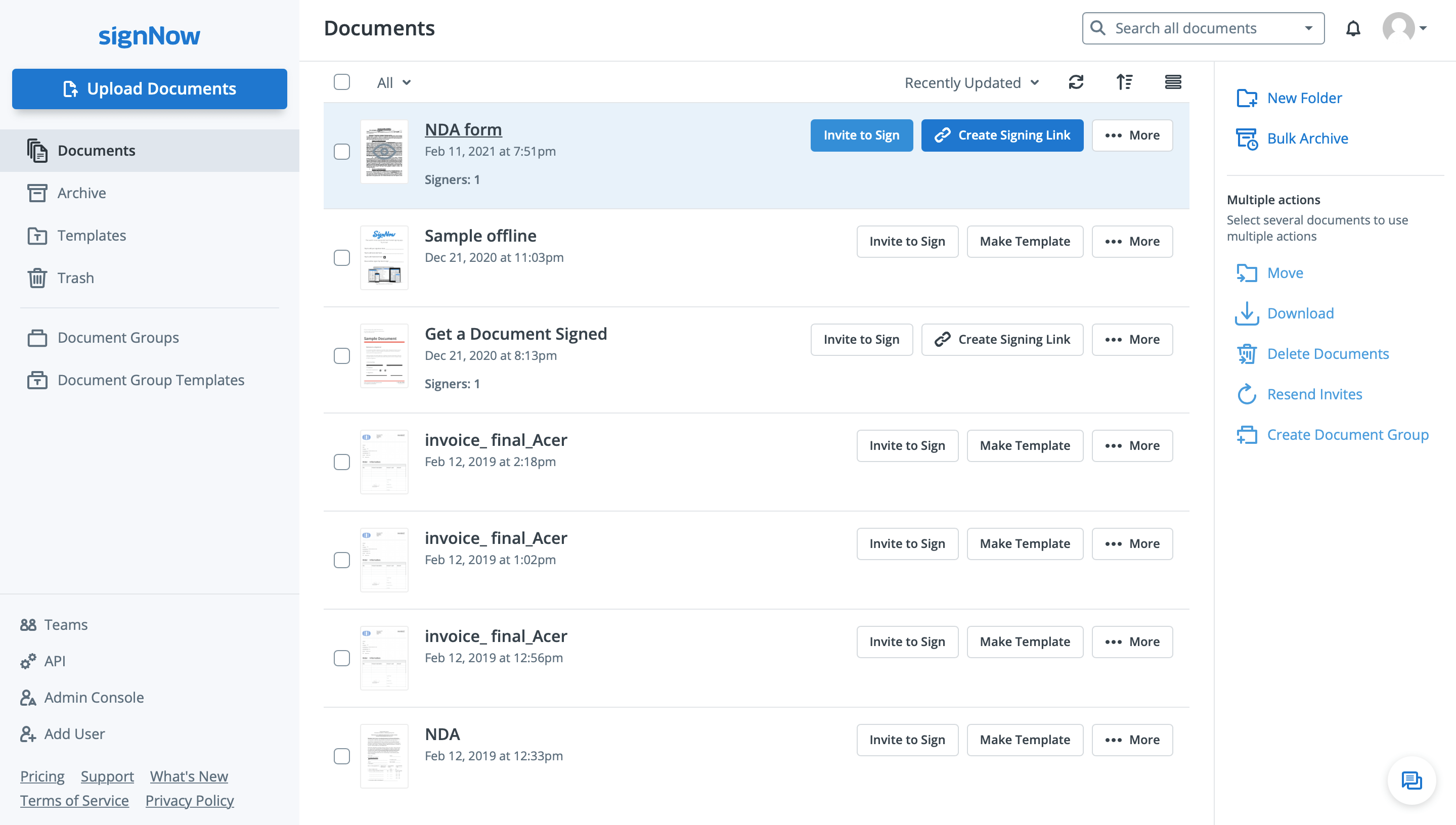
Once you add a signer or several signers, enter the emails of people that will receive a carbon copy of the document in the CC field. Then, click Send Invite.
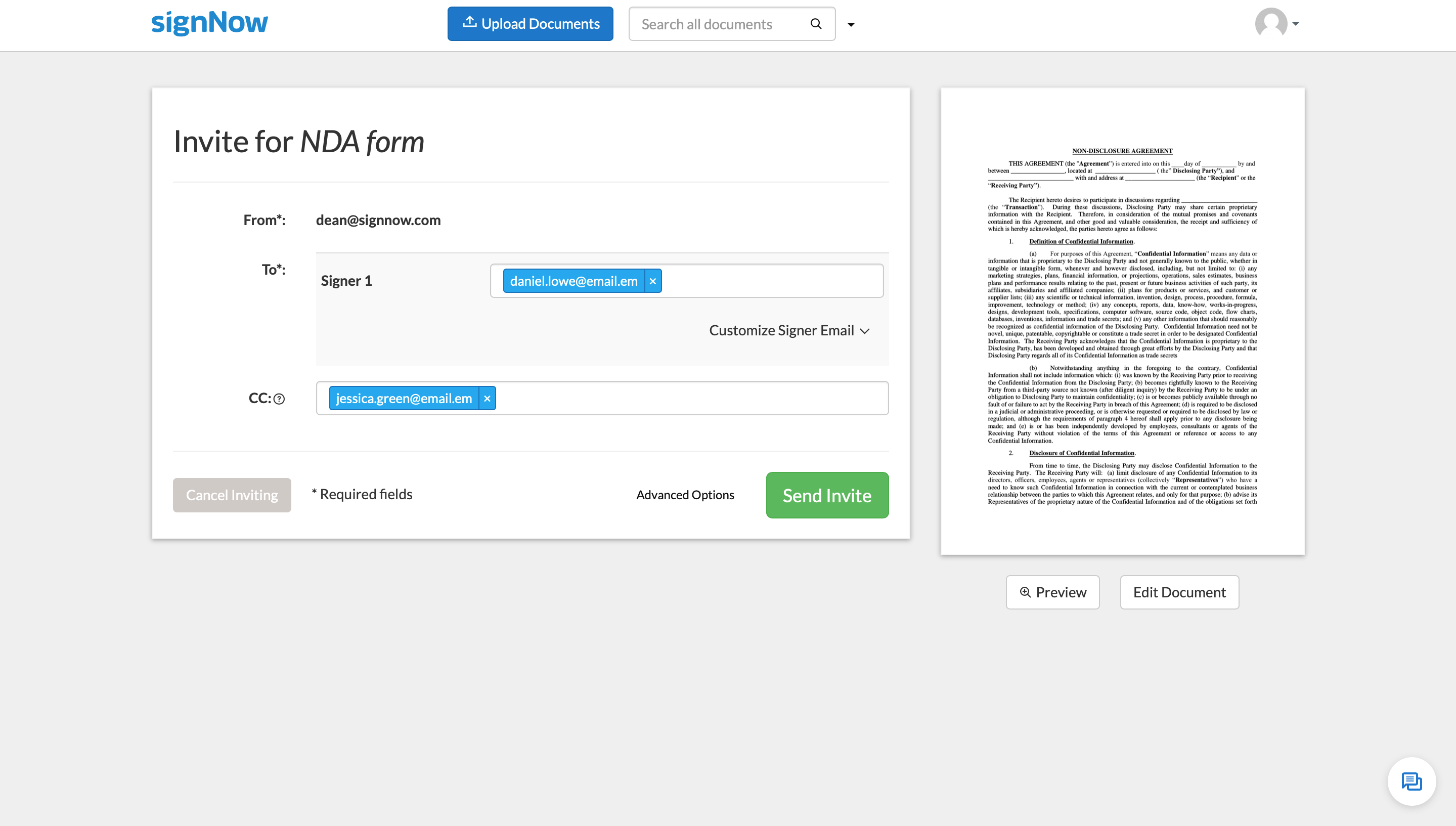
Once the signer completes and eSigns your document, the recipients you specified in the CC field will get a carbon copy of the document in their inbox.











