Fee Receipt Sample for Secure Transactions

Fee receipt sample provides a clear template for documenting transactions. SignNow offers a secure and compliant eSignature solution for various industries.

Award-winning eSignature solution

What a fee receipt sample is and why it matters

A fee receipt sample is a standardized document that records payment details, payer information, services or fees charged, date, and an authorization signature. In digital workflows, a fee receipt sample serves as proof of transaction and can be issued electronically or printed. When used with an eSignature service such as signNow, the receipt can include an audit trail, signer authentication, and tamper-evident seals that support legal validity under U.S. frameworks like ESIGN and UETA while enabling efficient recordkeeping and retrieval.

Why a clear fee receipt sample improves operations

A well-designed fee receipt sample reduces disputes, simplifies accounting, and creates an auditable record of payment and authorization for internal and regulatory review.

Why a clear fee receipt sample improves operations

Common challenges when issuing fee receipt samples

  • Inconsistent formatting across departments causes confusion and delays in reconciliation.
  • Manual signatures and paper handling slow turnaround and increase storage costs.
  • Missing payer or payment identifiers lead to reconciliation errors and disputes.
  • Poor version control can result in unauthorized or outdated receipt templates being used.

Typical user profiles for fee receipt sample workflows

School Bursar

Responsible for collecting tuition and fees, the bursar uses fee receipt samples to confirm payments, reconcile student accounts, and provide records for audits. Digital receipts reduce manual entry, speed refunds, and support FERPA-compliant handling of student data when properly configured.

Legal Clerk

A legal clerk issues and archives receipts for court or client payments, ensuring each fee receipt sample includes case identifiers and signature evidence. Digital issuance with an audit trail simplifies discovery and demonstrates chain of custody for funds.

Who typically issues and consumes fee receipt samples

Organizations across sectors issue fee receipt samples to document fees, payments, and authorizations in a consistent way.

  • Finance and accounting teams managing billing, reconciliations, and audit responses.
  • Customer service and operations issuing receipts and resolving payment inquiries.
  • Schools and government offices tracking fee payments and maintaining public records.

Clear responsibilities and roles for issuing, approving, and retaining fee receipt samples reduce risk and streamline audits.

Extended tools that enhance fee receipt sample workflows

Additional capabilities to consider for scaling, integration, and advanced compliance when managing fee receipt samples.

Bulk Send

Send hundreds of fee receipt samples in a single batch using variable fields for payer details, enabling mass issuance after payment sweeps or scheduled billing cycles.


API access

Programmatic endpoints to generate, sign, and retrieve fee receipt samples from internal systems such as ERPs, CRMs, or payment gateways for automated workflows.

Conditional fields

Smart fields that appear or hide based on payment type or payer category, simplifying form complexity and ensuring only relevant data is captured.

Retention policies

Built-in document lifecycle controls to archive or purge fee receipt samples according to organizational or regulatory retention schedules.

Integrations

Connectors for storage and productivity platforms to move finalized fee receipt samples into existing repositories and accounting systems.

Reporting

Dashboards and exportable reports summarizing issued fee receipt samples, amounts, and status for reconciliation and audit purposes.

be ready to get more

Choose a better solution

Core features to include in fee receipt sample tools

Focus on specific features that make creating and managing fee receipt samples reliable, auditable, and efficient across teams.

Template library

A central collection of pre-configured fee receipt sample templates with fixed fields and authorized signatures to ensure consistency and reduce manual errors when issuing receipts across departments.

Audit trails

Immutable logs that record who viewed, signed, or modified a fee receipt sample, including timestamps and IP data, to support dispute resolution and compliance reviews.

Signer authentication

Multiple authentication options for signers, including email verification, SMS codes, and enterprise SSO, to validate identity when approving or issuing fee receipt samples.

Secure storage

Encrypted cloud storage with retention settings and role-based access so fee receipt samples remain available for audits while protected against unauthorized access.
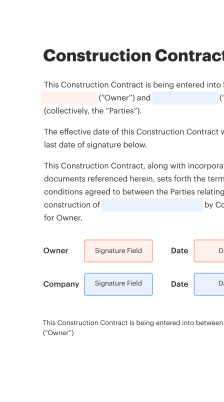
How a digital fee receipt sample workflow functions

Overview of the typical digital flow from document creation to storage for a fee receipt sample.

  • Template creation: Design reusable receipt templates with fixed fields.
  • Pre-populate data: Fill payer and payment details automatically.
  • Secure signing: Authenticate signer and capture signature evidence.
  • Archival: Store final receipt with an audit trail and metadata.
Collect signatures
24x
faster
Reduce costs by
$30
per document
Save up to
40h
per employee / month

Step-by-step: preparing a fee receipt sample

A short workflow for creating an accurate fee receipt sample that you can adapt to web or mobile platforms.

  • 01
    Upload document: Import the invoice or receipt template file.
  • 02
    Add payer fields: Place name, ID, amount, and date fields.
  • 03
    Apply signature: Assign signer roles and required signatures.
  • 04
    Issue receipt: Send signed receipt and store copy securely.

Managing audit trails for fee receipt sample transactions

Key actions to capture and preserve audit data for each issued fee receipt sample.

01

Record events:

Log all signing actions with timestamps.
02

Capture identities:

Store signer authentication details.
03

Store IP data:

Preserve connection metadata.
04

Archive versions:

Keep immutable final PDFs.
05

Export logs:

Provide exports for auditors.
06

Retention policy:

Apply lifecycle rules consistently.
be ready to get more

Why choose airSlate SignNow

  • Free 7-day trial. Choose the plan you need and try it risk-free.
  • Honest pricing for full-featured plans. airSlate SignNow offers subscription plans with no overages or hidden fees at renewal.
  • Enterprise-grade security. airSlate SignNow helps you comply with global security standards.
illustrations signature

Common workflow settings for fee receipt sample automation

Typical configuration values used to automate issuance, reminders, and archival of fee receipt samples within an eSignature platform.

Setting Name Configuration
Reminder Frequency 48 hours
Default Template Standard receipt template
Retention Period 7 years
Signer Authentication Email or SMS MFA
Archival Location Encrypted cloud storage

Device and platform considerations for fee receipt sample

  • Desktop: Windows and macOS supported
  • Mobile: iOS and Android apps
  • Browser: Modern TLS-capable browsers

Test template rendering and field behavior across devices; confirm mobile signing workflows preserve audit details and that PDF exports retain all receipt data for recordkeeping and compliance.

Security controls relevant to fee receipt sample management

Encryption in transit: TLS 1.2+ protected
Encryption at rest: AES-256 encrypted
Access controls: Role-based limits
Two-factor authentication: Optional enforcement
Document redaction: Field-level masking
Audit logging: Comprehensive trails

Industry examples: fee receipt sample in action

Two concise case examples show how fee receipt samples serve different operational needs and compliance contexts.

Municipal Payments

A city treasurer issues digital fee receipt samples for permit and licensing fees to reduce queue times and eliminate paper storage

  • Template includes payer name, permit ID, amount, and payment method
  • Enables faster reconciliation and fewer misplaced receipts

Resulting in improved municipal accounting efficiency and clearer public records for audits.

University Fees

A university bursar adopts standardized electronic fee receipt samples to document tuition and housing payments with student ID references

  • Receipts include FERPA-conscious fields and access controls
  • Students and administrators get timely, searchable records for disputes or financial aid verification

Resulting in reduced administrative overhead and clearer audit trails during accreditation reviews.

Best practices for secure and accurate fee receipt samples

Adopt consistent practices when designing, issuing, and storing fee receipt samples to reduce errors and support compliance obligations.

Use a single authoritative template across departments
Maintain and version-control a single approved fee receipt sample template so all issued receipts contain consistent fields, legal language, and required identifiers, reducing reconciliation issues and ensuring compliance with internal policies.
Enforce signer authentication appropriate to risk
Require multi-factor or enterprise SSO for high-value receipts while allowing lighter verification for small transactions, aligning authentication strength with the financial risk involved.
Enable immutable audit trails for each receipt
Record timestamps, actor identities, and actions taken on fee receipt samples, preserving tamper-evident records that support dispute resolution and regulatory review.
Define retention and purge schedules clearly
Set retention periods that meet accounting and regulatory requirements, and automate archival or deletion processes to limit storage costs and reduce exposure to unnecessary data retention.

FAQs About fee receipt sample

Answers to common questions about creating, issuing, and storing fee receipt samples in digital workflows.

Quick feature comparison for fee receipt sample tools

A concise side-by-side comparison of core capabilities relevant to fee receipt sample handling between signNow and DocuSign.

Feature signNow (Recommended) DocuSign
ESIGN / UETA validity
HIPAA support options Partial
Bulk Send capability
API and integrations REST API REST API
be ready to get more

Get legally-binding signatures now!

Document retention milestones for fee receipt samples

Suggested retention milestones to align fee receipt sample lifecycle with accounting and compliance needs.

Immediate issuance and storage:

Store signed receipt within 24 hours.

Short-term retention:

Keep accessible copies for 1 year for customer service.

Tax-related retention:

Retain for at least 7 years for tax audits.

Regulatory review window:

Preserve records for the regulator-specific period.

Secure disposal timing:

Purge per policy after retention expires.

Risks and penalties from poor fee receipt sample handling

Regulatory fines: Monetary penalties
Audit failures: Scope findings
Data breaches: Incident notifications
Reputational harm: Trust loss
Contract disputes: Payment reversals
Record loss: Compliance gaps

Common pricing and plan comparison for fee receipt sample use

Representative entry and mid-tier plan information across five providers to illustrate typical cost structures for fee receipt sample workflows.

Plan signNow (Recommended) DocuSign Adobe Sign PandaDoc HelloSign
Entry-level offering Business $8/user/mo Personal $10/user/mo Individual $12.99/mo Essentials $19/user/mo Essentials $15/user/mo
Mid-tier offering Business Premium $15/user/mo Standard $25/user/mo Small Business $24.99/user/mo Business Pro $39/user/mo Standard $20/user/mo
Enterprise options Custom enterprise plans Custom pricing Enterprise suites Custom pricing Enterprise plans
API access Available in Premium Available Available Available Available
Free trial availability Yes, trial available Yes, trial available Yes, trial available Yes, limited trial Yes, trial available

Understanding a Fee Receipt Sample

A fee receipt sample serves as a template for documenting payments made for services or products. This document is essential for both businesses and customers, as it provides proof of payment and details regarding the transaction. Typically, a fee receipt includes the date of payment, the amount paid, the method of payment, and a description of the services rendered or products purchased.

Utilizing a fee receipt sample can streamline the process of creating receipts, ensuring that all necessary information is captured accurately. This is particularly useful for small businesses and freelancers who need to maintain clear financial records.

Key Components of a Fee Receipt

When creating a fee receipt, certain elements should always be included to ensure clarity and professionalism. These components typically consist of:

  • Date: The date when the payment was received.
  • Receipt Number: A unique identifier for tracking purposes.
  • Payer Information: Name and contact details of the individual or organization making the payment.
  • Service or Product Description: A brief description of what the payment covers.
  • Amount Paid: The total amount received.
  • Payment Method: Indication of how the payment was made (cash, credit card, etc.).
  • Signature: Space for a signature, if required, to validate the receipt.

Creating a Fee Receipt with airSlate SignNow

Creating a fee receipt using airSlate SignNow is a straightforward process. Users can start by selecting a fee receipt sample from the template library. Once selected, the document can be customized to fit specific needs, such as adding the business logo or adjusting the layout.

After customizing the receipt, users can easily fill in the required details, such as the date, amount, and payer information. Once completed, the document can be saved and sent for eSigning if necessary, ensuring that both parties have a signed copy for their records.

Benefits of Using a Fee Receipt Sample

Using a fee receipt sample offers several advantages for businesses and individuals. Some of the key benefits include:

  • Time Efficiency: Templates save time by providing a ready-made format that can be quickly filled out.
  • Consistency: Using a standard template ensures that all receipts maintain a uniform appearance and structure.
  • Professionalism: A well-designed receipt enhances the credibility of a business and builds trust with clients.
  • Record Keeping: Receipts serve as essential documentation for accounting and tax purposes.

Common Use Cases for Fee Receipts

Fee receipts are commonly used in various scenarios, including:

  • Service Industries: Freelancers and service providers often issue receipts for consultations, repairs, or other services rendered.
  • Retail Transactions: Businesses provide receipts for purchases made in-store or online.
  • Event Registrations: Organizations issue receipts for fees paid to attend workshops, seminars, or events.
  • Membership Fees: Clubs and associations issue receipts for annual or monthly membership payments.

Ensuring Compliance with Fee Receipts

When issuing fee receipts, it is important to ensure compliance with local and federal regulations. This includes accurately documenting all transactions and retaining copies for record-keeping purposes. Depending on the nature of the business, specific laws may dictate how receipts should be formatted and what information must be included.

By using a fee receipt sample, businesses can ensure they meet these requirements while maintaining a professional standard in their financial documentation.


walmart logo
exonMobil logo
apple logo
comcast logo
facebook logo
FedEx logo
be ready to get more

Get legally-binding signatures now!