Merge Email Signature Order with SignNow

Get rid of paperwork and optimize digital document management for higher performance and endless opportunities. Experience the perfect manner of doing business with airSlate SignNow.

Award-winning eSignature solution

What merge email signature order means in electronic workflows

Merge email signature order refers to combining recipient-specific email data with a predetermined signing sequence so multiple signers receive and sign documents in the correct order. It covers merging personalized email fields, assigning signature roles, and enforcing a sequential or parallel routing policy so each signature field populates and locks only when its turn arrives. In practice, this ensures consistency across transactions, reduces manual coordination, and supports automated routing logic for multi-party agreements in regulated environments using an eSignature platform.

Why enforcing a merged signing order matters

Maintaining a merged email signature order reduces signing errors, enforces contractual sequence, and provides clearer auditability for multi-signer documents in regulated workflows.

Why enforcing a merged signing order matters

Common challenges when setting merge email signature order

  • Incorrect role mapping causes wrong recipients to receive signature requests and delays execution.
  • Variable recipient lists complicate templates and require dynamic merge logic per transaction.
  • Concurrent signing without proper locks leads to overwritten fields or signature conflicts.
  • Insufficient audit data makes it hard to prove the sequence and identify issues later.

Representative user profiles for merge email signature order

Contract Manager

A contract manager prepares templates and enforces signing order for multi-party agreements. They configure merge fields for recipient emails, define signer roles, and monitor execution to ensure each step completes before the next signature is requested.

Field Sales Rep

A field sales representative sends proposals that require customer signature first and then internal approval. They use merged email data to populate customer details and rely on sequential routing to capture signatures in the correct business order.

Typical teams and roles that rely on ordered merges

Organizations with multi-party approvals commonly use merge email signature order to keep signings predictable and auditable.

  • Legal and compliance teams managing contract execution and regulatory traceability.
  • Sales and account teams issuing sequential customer and internal approvals.
  • HR and finance teams coordinating offer letters and multi-step onboarding signatures.

Applying a defined merge and signing order reduces rework and makes responsibility clear across internal and external signers.

Additional capabilities that enhance merged signing order

Beyond basic ordering, advanced features support enterprise workflows, stronger authentication, and integration with business systems to scale merge email signature order processes.

Templates

Reusable templates store merge fields and signing order so transactions remain consistent across teams and reduce setup time for recurring document types.


Automation

Automated triggers start signing flows from CRM events, form submissions, or API calls to reduce manual sends and shorten overall cycle time.

Audit trail

Comprehensive logs record every action, timestamp, and IP address to prove signing sequence and support disputes or compliance checks.

Advanced authentication

Options such as SMS codes, knowledge-based verification, or SSO increase signer identity assurance for high-risk transactions.

Integrations

Connectors to CRM, document storage, and HR systems allow automatic population of merge fields and centralized recordkeeping.

Mobile signing

Signers can receive merged emails and complete sequential signing from mobile devices with the same ordering rules applied.

be ready to get more

Choose a better solution

Core features that support merging and ordering

Effective merge email signature order relies on coordinated features: template fields, role mapping, conditional routing, and data merge capabilities for accurate personalization at scale.

Signing Order

Explicit signing order enforces a sequence so signatures occur in a defined progression. This can be strictly sequential, grouped, or parallel depending on transaction needs and ensures that each signer sees the document only when authorized to sign.

Role Mapping

Assigning named roles ties signature fields to recipient identities. Role mapping simplifies template reuse, enables conditional routing, and reduces mistakes by separating the signer identity from the document layout.

Conditional Routing

Rules allow routing changes based on merged data or signer responses. Conditional routing supports scenarios like requiring manager approval only for high-value contracts or switching reviewers based on department fields.

Data Merge

Merge capabilities insert recipient emails and document data from CSV or CRM fields. This ensures each recipient receives a personalized message and document that pre-populates required fields, reducing manual entry and errors.
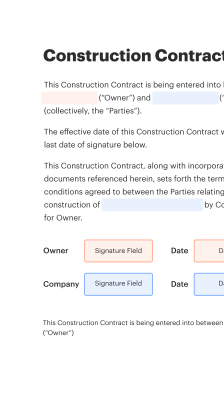
How merge email signature order operates in an eSignature flow

A concise breakdown of the operational steps shows how merged emails and role order produce a controlled signing sequence.

  • Merge data: Populate recipient fields from a data source or CSV.
  • Apply roles: Link document fields to role names for each signer.
  • Define routing: Choose sequential or simultaneous routing per role.
  • Execute: Platform sends emails and enforces order during signing.
Collect signatures
24x
faster
Reduce costs by
$30
per document
Save up to
40h
per employee / month

Quick setup: configure merge email signature order

Follow these four core steps to set signing order and merge recipient emails so documents route correctly to each signer.

  • 01
    Prepare template: Add signature fields and merge placeholders for name and email.
  • 02
    Assign roles: Map each signature field to a named signer role.
  • 03
    Set order: Define sequential or parallel routing for signer roles.
  • 04
    Test send: Send a trial transaction with sample merged emails to verify flow.

Operational checklist for managing order and auditability

Use this compact grid to verify routing rules, data sources, and audit settings before sending merged-signature transactions.

01

Confirm data file:

Validate email and role columns.
02

Review template fields:

Ensure all signature fields present.
03

Set routing mode:

Choose sequential or parallel.
04

Enable audit logging:

Turn on detailed event capture.
05

Test with samples:

Run end-to-end tests.
06

Monitor delivery:

Watch for bounced or failed sends.
be ready to get more

Why choose airSlate SignNow

  • Free 7-day trial. Choose the plan you need and try it risk-free.
  • Honest pricing for full-featured plans. airSlate SignNow offers subscription plans with no overages or hidden fees at renewal.
  • Enterprise-grade security. airSlate SignNow helps you comply with global security standards.
illustrations signature

Security controls relevant to merged signing workflows

Digital signatures: Cryptographic proof
Audit trail: Detailed event log
TLS encryption: Transport protection
Access controls: Role-based limits
Two-factor authentication: Optional signer verification
Document encryption: At-rest protection

Practical examples of merge email signature order in use

Two short case sketches show how ordered merges solve common multi-signer problems across contract and HR workflows.

Sales Agreement Sequence

A national account team sends a proposal with customer contact data merged into the email and document.

  • Signing roles are mapped: customer first, manager second.
  • This prevents internal approval before customer consent.

Resulting in a clear, auditable signature chain that speeds order processing and reduces disputes.

Onboarding and Approval Flow

An HR administrator merges new hire details into offer emails and sequences signatures for employee, hiring manager, and payroll.

  • Conditional fields populate based on the hire type.
  • The sequence locks payroll approvals until prior signatures complete.

Leading to accurate personnel records and consistent retention for compliance reviews.

Best practices to minimize errors in merged signing sequences

Follow these guidelines to reduce mistakes, maintain compliance, and keep multi-signer processes efficient when using merge email signature order.

Validate merge sources before sending
Confirm the data file or CRM export contains correct emails and role identifiers. Run a validation pass to detect missing or malformed addresses, and remove duplicates to prevent misrouted signature requests and failed deliveries.
Use role-based templates rather than fixed names
Design templates that refer to signer roles rather than individual email addresses. This enables reuse across transactions and maintains signing order even when recipients change between sends, lowering maintenance overhead.
Test full routing scenarios with sample data
Before going live, simulate common and edge-case recipient lists to ensure conditional routing and sequential locks behave as expected. Testing identifies issues like unintended parallel access or blocked fields.
Keep audit and retention policies consistent
Establish retention windows and configure audit logging so every merged transaction stores timestamps, IP addresses, and signer authentication events. Consistent policies simplify legal review and support regulatory compliance needs.

FAQs and troubleshooting for merge email signature order

Answers to common questions help resolve configuration and execution issues when merging recipient emails and enforcing signing order.

be ready to get more

Get legally-binding signatures now!

Retention and deadline considerations for merged signature workflows

Document timing, reminders, and retention schedules help ensure signed agreements remain accessible and meet organizational legal requirements.

Signature request expiry periods:

Set expiration (e.g., 30 or 90 days) to avoid stale requests.

Automatic reminders cadence:

Schedule reminders at intervals like 3 and 7 days.

Long-term retention policies:

Retain final signed copies per legal requirements.

Archived audit logs duration:

Keep logs for required compliance windows.

Document deletion schedules:

Enact secure deletion after retention expires.

Regulatory and operational risks of poor ordering

Invalid execution: Contract disputes
Compliance fines: Regulatory penalties
Process delays: Lost time
Record gaps: Evidence missing
Signature repudiation: Disputed consent
Privacy breaches: Exposed PII

Streamline challenging workflows

Generate, perform, and maintain workflows of any complexity, electronically from virtually anywhere. Scalable eSignature features enable you to share contracts with the right people in the correct sequence and determine roles for every recipient. Perform document workflows faster and easier than ever before.

Automate document management

Enhance complicated signing tasks with airSlate SignNow�s powerful capabilities to boost your company. Take control of your automatic signature workflows to make sure they're running at maximum efficiency with quick notices and reminders.

Enhance in team communication

Get teams together in a protected, shared workspace. Manage paperwork, use form templates and notifications to produce better cross-company collaboration. Relieve your employees from having to hang out on recurring activities to enable them to center on beneficial, business-crucial tasks.

Integrate into your existing network

Manage your jobs with industry-leading integration. Collect Salesforce, Microsoft Teams, and SharePoint all in one business thread. Hook up your software to a single unit for countless opportunities and higher performance.

Remain compliant with market-leading data protection

Feel safe knowing that your information remains secure by the most up-to-date in encryption security. airSlate SignNow is GDPR and eIDAS certified and provides you transparence into your signing procedure with court-admissible audit trails. Configure user access permissions and roles to manage who has access to what.


walmart logo
exonMobil logo
apple logo
comcast logo
facebook logo
FedEx logo
be ready to get more

Get legally-binding signatures now!