Purchase Bill Format for Financial Services

Empower your business with airSlate SignNow’s easy-to-use solution. Send and eSign documents effortlessly while saving time and costs.

Award-winning eSignature solution

What a purchase bill format for financial services is and why it matters

The purchase bill format for financial services defines a standardized document used to record procurement of goods or services, capture vendor details, payment terms, taxes, and account coding, and to serve as an auditable record for accounting and compliance. In financial services, the format should accommodate client-specific billing codes, regulatory reporting fields, and controls for approvals and signatory authority. Digital versions must preserve field integrity, support signature authentication and maintain an immutable audit trail to meet recordkeeping requirements. A consistent format reduces processing errors, accelerates reconciliations, and supports internal and external audits.

Why standardize your purchase bill format

Standardizing a purchase bill format for financial services improves accuracy, speeds vendor reconciliation, and simplifies audit preparation. Clear templates reduce manual entry, prevent misapplied charges, and make approval workflows predictable while supporting compliance controls and consistent financial reporting across teams.

Why standardize your purchase bill format

Common challenges with inconsistent purchase bill formats

  • Inconsistent field layouts cause delayed approvals and require manual rekeying across accounting systems, adding time and increasing risk of data entry errors.
  • Missing tax or vendor identifiers can trigger compliance reviews and complicate tax reporting, requiring corrective documentation and potential penalties.
  • Paper-based bills create storage, search, and retention challenges and lengthen audit response times for regulators and internal reviewers.
  • Poorly defined approval chains lead to unauthorized payments and difficulty tracing signatory authority during investigations.

Typical roles and responsibilities for purchase bill workflows

Procurement Manager

Oversees supplier selection, negotiates payment terms, and enforces standardized billing templates to ensure consistent data capture. Works with finance to resolve discrepancies, set approval thresholds, and reduce payment risk while maintaining vendor relationships across multiple business units.

Accounts Payable Clerk

Processes incoming purchase bills, validates coding and tax fields, and routes documents for approval. Relies on clear templates and automation to reduce manual entry, accelerate payments, and maintain accurate ledger postings for month-end close and audit readiness.

Who typically uses a standardized purchase bill format

Finance teams, procurement officers, and compliance staff rely on a standardized purchase bill format to maintain control, ensure accurate posting, and support audits.

  • Corporate finance teams managing vendor invoices, reconciliations, cash forecasting, and month-end close processes.
  • Procurement teams tracking purchase approvals, contracting details, and supplier onboarding requirements.
  • Compliance and audit groups verifying regulatory fields, signature validity, and retention policies for financial records.

Aligning these users around a clear purchase bill format reduces rework, supports traceability, and improves control over financial operations.

Advanced features that streamline purchase bill workflows

Advanced features extend a purchase bill format into an automated, auditable process that minimizes manual work while maintaining control and regulatory compliance.

Field Validation

Enforce formats, required entries, and data types for vendor IDs, tax numbers, and GL codes to prevent invalid submissions and ensure accurate ledger allocations during automated posting.


Calculations

Built-in calculation fields compute taxes, discounts, and totals automatically to reduce reconciliation adjustments and support consistency across invoices and financial statements.

Bulk Send

Send large batches of purchase bills or signature requests to multiple recipients with tracking, reducing repetitive setup and improving throughput for recurring vendor communications.

Mobile Capture

Capture receipts, attach photos, or edit bills on mobile devices to speed field submissions and accelerate processing for geographically distributed teams.

Role Templates

Create templates based on user roles or departments to control visible fields, approval chains, and permissions across finance, procurement, and operations teams.

Retention Policies

Apply document retention rules, archival schedules, and legal holds to comply with recordkeeping mandates and simplify audit retrieval for regulated financial records.

be ready to get more

Choose a better solution

Core tools to support an effective purchase bill format

Essential tools for an effective purchase bill format focus on template control, secure signatures, auditability, and integrations that support financial workflows across departments.

Templates

Centralized, customizable templates let finance define required fields, conditional logic, and approval sequences so every purchase bill uses consistent structure and captures all necessary regulatory and accounting information.

Audit Trail

Comprehensive logs record signer identity, timestamps, IP addresses, and document history, providing an immutable record for internal accounting reviews and external audits.

Authentication

Multiple authentication options including email verification, access codes, and two-factor methods confirm signer identity based on transaction risk and compliance needs.

Integrations

Prebuilt connectors and APIs enable synchronization with ERP, CRM, and cloud storage systems to automate posting and reduce duplicate entry across financial platforms.
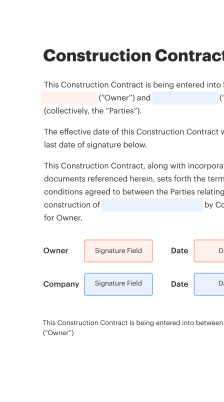
How to create and use your purchase bill format online

Creating and using a purchase bill format online centralizes records and enforces validation before approval and payment.

  • Upload draft: Import documents or start from a template in your account.
  • Add fields: Place standardized fields, validation, and calculation rules.
  • Assign signers: Specify approvers, set signing order, and authentication.
  • Finalize: Lock the document, generate audit trail, and archive.
Collect signatures
24x
faster
Reduce costs by
$30
per document
Save up to
40h
per employee / month

Quick setup: implement a purchase bill format in four steps

Follow these primary steps to set up and use a purchase bill format for financial services efficiently across teams.

  • 01
    Define fields: List required vendor, tax, coding, and approval fields.
  • 02
    Create template: Build a reusable template enforcing mandatory fields and formats.
  • 03
    Configure workflow: Set approvers, escalation, and reminder schedules.
  • 04
    Test and deploy: Pilot with a small vendor cohort before full rollout.

Manage audit trails for purchase bill transactions

An auditable trail is essential for compliance; these steps describe how to capture and retain required evidence for each purchase bill transaction.

01

Capture identity:

Record signer identity and method
02

Timestamp events:

Log exact action times
03

Record IP address:

Store origin IP for events
04

Store version history:

Preserve prior document versions
05

Exportable reports:

Generate CSV or PDF reports
06

Retention controls:

Apply legal hold and archival
be ready to get more

Why choose airSlate SignNow

  • Free 7-day trial. Choose the plan you need and try it risk-free.
  • Honest pricing for full-featured plans. airSlate SignNow offers subscription plans with no overages or hidden fees at renewal.
  • Enterprise-grade security. airSlate SignNow helps you comply with global security standards.
illustrations signature

Recommended workflow configuration for purchase bill processing

Consistent workflow settings help enforce approvals, reminders, and data validation across purchase bill submissions in financial services environments.

Workflow Setting Name and Configuration Default configuration values for each setting
Reminder Frequency Every 48 hours
Approval Escalation Timeframe 72 hours
Signer Authentication Level Access code or SSO
Document Retention Policy 7 years
Integration Post Behavior Auto-post to ERP

Supported platforms and technical prerequisites

Purchase bill templates and signing workflows are compatible with modern desktop and mobile browsers and common mobile operating systems.

  • Desktop: Modern Chrome, Edge, Safari supported
  • Mobile: iOS and Android recent versions
  • Integrations: API keys and admin access required

For best results, use up-to-date browsers that support TLS 1.2+, enable JavaScript, and ensure mobile devices run supported OS versions; additional integrations with ERP or storage systems may require API credentials and administrator access.

Security and protective controls for purchase bill documents

Encryption at rest: AES-256 encryption for stored documents
Role-based access: Granular permissions by user role
Single Sign-On: SAML 2.0 and OAuth support
Audit logging: Immutable logs include time and IP
Data residency: Choose regional storage locations
Secure transmission: TLS 1.2+ encrypted connections for transfers

Real-world examples of purchase bill format improvements

Examples below show how standardized purchase bill formats solve common operational and compliance problems in financial organizations.

Wealth Manager Consolidation

A mid-sized wealth manager consolidated vendor billing to reduce manual reconciliations and accelerate month-end close with fewer discrepancies.

  • Template-driven purchase bills with required fields and validation rules.
  • Reduced data entry errors and faster approval cycles.

Leading to a 40 percent reduction in processing time, clearer audit trails for compliance teams, and a measurable drop in invoice exceptions that improved working capital forecasting and vendor relationships.

Regional Bank Integration

A regional bank standardized purchase bill formats to integrate with its core accounting system and enforce signature authority.

  • Prebuilt templates, approval routing, and API integrations.
  • Streamlined posting and reduced late payments.

Resulting in faster vendor payments, fewer reconciliation exceptions, and comprehensive logs that satisfied internal and external auditors while meeting retention policies required for regulatory review and reducing response times for audit requests.

Best practices for secure and accurate purchase bills

Adopt these best practices to reduce errors, maintain compliance, and keep purchase bill processes efficient across finance and procurement teams.

Require standardized vendor identifiers and tax fields
Mandate vendor IDs, W-9 or tax identifiers, and vendor classification fields in every bill template so systems can automatically match payments, apply correct tax treatment, and reduce exceptions during reconciliation and audits.
Enforce multi-step approvals for high-value transactions
Set approval thresholds that require secondary or senior sign-off for larger amounts, including escalation paths and time limits, to prevent unauthorized payments and ensure appropriate oversight.
Maintain version control and audit logs
Track template and policy changes, preserve prior versions, and ensure audit trails capture who modified fields and when, supporting investigations and regulatory recordkeeping requirements.
Limit access and apply least privilege
Assign permissions by role, restrict template editing to administrators, and review access periodically to mitigate insider risk and reduce accidental template changes that could compromise billing accuracy.

FAQs About purchase bill format for financial services

Answers to common operational, technical, and compliance questions about implementing and managing a purchase bill format for financial services.

Feature availability: signNow compared with leading eSignature vendors

Quick availability and capability comparison for common purchase bill format requirements among major eSignature providers.

Features compared across signature platforms signNow (Recommended) DocuSign Adobe Sign
ESIGN and UETA legal compliance status
API availability and type REST API REST API REST API
Bulk Send capability for batches Bulk Send Bulk Send Bulk Send
HIPAA compliance and BAA options Available Available Available
be ready to get more

Get legally-binding signatures now!

Key risks and potential penalties from poor bill management

Noncompliance fines: Regulatory penalties and interest
Invalid signatures: Disputed transactions and delays
Data breach costs: Notification and remediation expenses
Operational delays: Extended processing and cash drag
Audit failures: Findings and corrective action
Reputation damage: Loss of client trust

Pricing snapshot: signNow and competitor plans

Representative entry-level pricing and feature highlights to compare cost and core capabilities across providers; actual prices and tiers vary by contract and usage.

Plan pricing across vendors signNow (Recommended) DocuSign Adobe Sign HelloSign PandaDoc
Entry-level monthly price Starts at $8/user/mo Starts at $10/user/mo Starts at $9/user/mo Starts at $15/user/mo Starts at $19/user/mo
Free tier availability Limited trial available Limited trial available Limited trial available Free tier with limits Free tier with limits
Per user or per seat pricing model Per user plans and volume discounts Per user and enterprise options Per user or enterprise licensing Per user plans Per user with templates
Advanced features included at entry level Templates and basic API access included Basic templates, API on higher tiers Core features included, API tiered Basic eSign features Templates and document editor
Compliance and BAA availability BAA available on request BAA available on enterprise plans BAA available on enterprise plans BAA available on enterprise plans BAA available on request
walmart logo
exonMobil logo
apple logo
comcast logo
facebook logo
FedEx logo
be ready to get more

Get legally-binding signatures now!