Sign Professional Employee Record Securely with SignNow

Remove paper and optimize document processing for increased efficiency and unlimited possibilities. Discover the best way of doing business with airSlate SignNow.

Award-winning eSignature solution

What sign professional employee record means for HR workflows

A sign professional employee record describes the process of executing, storing, and managing employee-related documents—such as offer letters, tax forms, policies, and performance acknowledgements—using electronic signatures and digital document controls. In the United States this approach relies on ESIGN and UETA for legal effect and must meet sector requirements such as HIPAA or FERPA when applicable. Using a secure eSignature platform that supports authentication, audit trails, and encrypted storage helps organizations reduce physical paperwork, centralize personnel files, and maintain a defensible compliance posture for employee records.

Why digitizing employee records matters

Digitizing employee records with electronic signatures reduces administrative overhead, improves retrieval speed, and creates an auditable chain of custody that aligns with ESIGN and UETA requirements for U.S. organizations.

Why digitizing employee records matters

Common challenges when managing paper employee records

  • Physical storage consumes space and increases risk of document loss or damage during retention periods.
  • Manual routing and wet signatures cause delays and lack consistent timestamped evidence.
  • Differing authentication standards make it hard to verify signer identity reliably across cases.
  • Compliance audits require reconstructing paper trails, which is time-consuming and error-prone.

Typical user roles in sign professional employee record processes

HR Manager

An HR Manager configures signing workflows, maintains employment templates, and reviews completed records for compliance. They need clear audit trails, role-based access, and reporting to support internal audits and regulatory requests.

IT Administrator

An IT Administrator integrates the eSignature platform with directory services and storage solutions, enforces authentication policies, and manages encryption keys and retention settings to meet organizational security standards.

Organizations that commonly implement sign professional employee record workflows

Human resources, payroll teams, and compliance groups use electronic signing for faster onboarding and secure recordkeeping.

  • Human resources departments handling onboarding, I-9s, and policy acknowledgements.
  • Small and medium-sized businesses consolidating personnel files for remote staff.
  • Educational institutions and healthcare units managing FERPA- or HIPAA-sensitive documents.

These groups prioritize reliable authentication, auditability, and retention features when selecting an eSignature solution.

Core features to look for when signing professional employee records

These six feature areas support secure, auditable, and efficient employee record signing, helping organizations meet legal and operational needs across HR and compliance teams.

Templates

Reusable document templates reduce preparation time and ensure consistent field placement across common employee records like offer letters, tax forms, and acknowledgements, enabling rapid distribution and standardized data capture.


Bulk Send

Bulk Send enables organizations to deliver the same document to many recipients efficiently while tracking individual completion status and preserving a separate audit trail for each signer.

Authentication

Multiple authentication options—email, SMS OTP, knowledge-based checks, and optional identity verification—allow you to tailor signer verification to the sensitivity of specific employee records.

Audit Trail

Complete, timestamped audit logs capture signer events, IP addresses, and document state changes to provide legally defensible evidence of intent and completion.

APIs

RESTful APIs support programmatic document generation, embedding signing flows into HR systems, and exporting signed records to secure storage or HRIS platforms.

Retention Controls

Configurable retention and disposition policies let organizations apply retention schedules, legal holds, and secure archival that align with internal records management requirements.

be ready to get more

Choose a better solution

Integrations that streamline sign professional employee record management

Integrations reduce manual steps by connecting the eSignature service to common productivity and business systems used in employee record workflows.

Google Workspace

Integrating with Google Docs allows HR teams to prepare and send documents directly from the editor, keep version history in Drive, and preserve signed PDFs back into shared folders for central access.

CRM and HRIS

CRM and HRIS integrations sync employee metadata, trigger signing workflows from record updates, and automatically attach signed documents to individual personnel records for consistent data management.

Dropbox and Cloud Storage

Cloud storage integrations automatically archive completed documents to designated folders, apply existing access controls, and simplify backup and retention across enterprise storage services.

API and SSO

API and single sign-on integrations enable secure user provisioning, embedded signing experiences, and centralized authentication aligned with organizational identity policies.
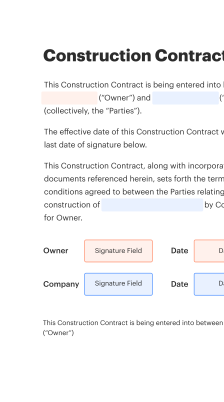
How electronic signing for employee records works in practice

A concise workflow overview clarifies the typical document lifecycle from creation to archival when using eSignatures for personnel records.

  • Create: Upload document and add signature fields.
  • Send: Dispatch to recipients with defined order.
  • Authenticate: Apply chosen signer verification method.
  • Finalize: Capture signatures, store with audit trail.
Collect signatures
24x
faster
Reduce costs by
$30
per document
Save up to
40h
per employee / month

Step-by-step: implementing sign professional employee record workflows

Follow these steps to set up consistent, auditable signing for employee records with an eSignature platform.

  • 01
    Prepare templates: Create standardized documents and required fields.
  • 02
    Set signer roles: Define employee, approver, and HR responsibilities.
  • 03
    Configure authentication: Select password, SMS, or knowledge-based checks.
  • 04
    Enable retention: Apply document retention and archival rules.
be ready to get more

Why choose airSlate SignNow

  • Free 7-day trial. Choose the plan you need and try it risk-free.
  • Honest pricing for full-featured plans. airSlate SignNow offers subscription plans with no overages or hidden fees at renewal.
  • Enterprise-grade security. airSlate SignNow helps you comply with global security standards.
illustrations signature

Typical workflow settings for employee record signing

Recommended default settings help ensure consistent handling of employee documents while meeting common compliance needs.

Setting Name Configuration
Reminder Frequency 48 hours
Signing Order Sequential
Authentication Method Email or SMS OTP
Template Library Access Organization-wide
Retention Period 7 years

Platform compatibility and technical requirements for signing employee records

Ensure your environment supports current browsers, mobile OS releases, and required integrations before deploying electronic employee record workflows.

  • Desktop browsers: Chrome, Edge, Safari
  • Mobile operating systems: iOS 14+ and Android 9+
  • Integrations: SAML SSO and REST API

For secure operations, coordinate with IT to whitelist service endpoints, confirm TLS and cipher requirements, and test SSO and API tokens prior to rolling out employee-facing processes.

Security controls relevant to signed employee records

Encryption at rest: AES-256 or equivalent
Transport encryption: TLS 1.2+ required
Access controls: RBAC and MFA
Data residency: U.S. regional options
Audit logs: Immutable event records
Document tamper-proofing: Checksum-based seals

Practical examples of electronic employee record signing

Two concise case descriptions show how electronic signing fits common HR scenarios and the measurable outcomes organizations can expect.

New Hire Onboarding

A mid-sized company digitized offer letters and I-9 completion to centralize records and reduce time-to-productivity by reducing in-person steps.

  • Bulk Send templates streamlined distribution.
  • New hires completed all forms remotely, improving completion rates and reducing delays.

Resulting in a consistent audit trail and faster, paper-free onboarding that met ESIGN and UETA requirements while preserving document integrity.

Annual Policy Acknowledgement

A university replaced paper acknowledgements for annual policy reviews, preserving FERPA-sensitive context in secured storage.

  • Email reminders encouraged timely responses.
  • Centralized tracking made it simple to identify non-respondents and follow up.

Leading to verifiable acknowledgements, simplified reporting for compliance teams, and clear retention metadata aligned with institutional recordkeeping policies.

Best practices for accurate and secure signed employee records

Apply consistent operational practices to reduce risk and ensure records are reliable, auditable, and easy to retrieve during audits or HR processes.

Standardize templates and required fields
Create centralized templates for common employee documents and enforce required fields to ensure complete data capture and consistent compliance across departments and locations.
Use appropriate signer authentication
Match authentication strength to document sensitivity, combining email, SMS OTP, or identity verification where necessary to maintain evidentiary value and reduce fraud risk.
Enable immutable audit trails
Preserve full event logs with timestamps, IP addresses, and document hashes to support legal defensibility and streamline investigations or audits.
Apply retention and legal hold policies
Define retention schedules and implement legal holds to meet regulatory obligations, ensuring secure archival and defensible disposition of employee records.

FAQs and troubleshooting for sign professional employee record workflows

Common questions and practical resolutions for issues that arise when creating, sending, and storing signed employee documents.

Feature availability comparison for employee record signing

This concise comparison highlights common capabilities across leading eSignature platforms relevant to employee record workflows.

eSignature solution capability comparison table signNow (Recommended) DocuSign Adobe Sign
Audit Trail
Bulk Send
Embedded Signing API
HIPAA Support
be ready to get more

Get legally-binding signatures now!

Risks of inadequate electronic employee record handling

Regulatory fines: Federal or state penalties
Breach exposure: PHI or PII leakage
Legal disputes: Insufficient evidence
Operational delays: Onboarding disruptions
Reputational harm: Loss of trust
Retention lapses: Noncompliant disposal

Representative monthly pricing and feature snapshot

Representative entry-level pricing and feature notes for common eSignature providers; actual pricing depends on plan, billing cycle, and negotiated enterprise rates.

Monthly pricing and features signNow (Featured) DocuSign Adobe Sign HelloSign PandaDoc
Entry plan price From $8/user/month From $10/user/month From $9.99/user/month From $15/user/month From $19/user/month
Core offer features Signatures, templates, audit logs Signatures, mobile app, templates Integrated with Acrobat, templates Simple signatures and templates Document creation and eSignatures
API availability Included on business plans Included on business plans Included with Acrobat Sign API Available on business plans REST API and SDKs
Bulk and templating Bulk Send and templates included Advanced bulk features Templates available Bulk on higher tiers Strong templating features
Enterprise controls Admin, SSO, retention available Enterprise-grade controls Enterprise administration Admin controls available Role-based admin and CLM features

Simplify challenging workflows

Create, deliver, and control workflows of any intricacy, digitally from virtually anywhere. Scalable eSignature functionality enable you to exchange contracts with the right users the right way and set up roles for every signee. Execute document workflows faster and easier than ever before.

Automate document management

Enhance intricate signing processes with airSlate SignNow�s effective functions to improve your operation. Control your automated signature workflows to make sure they're operating at top performance with fast notifications and reminders.

Enhance in team communication

Join teams together in a safe, shared workplace. Handle paperwork, use form templates and notices to deliver more effective cross-organization communication. Relieve your staff from having to hang out on repetitive actions so that they can focus on beneficial, business-vital duties.

Integrate into your current framework

Run your projects with industry-leading integration. Assemble Salesforce, Microsoft Teams, and SharePoint in multi functional business thread. Link your applications to a single unit for limitless opportunities and higher productivity.

Stay compliant with best-in-class data safety

Feel confident knowing that your data is protected by the newest in encryption security. airSlate SignNow is GDPR and eIDAS compliant and gives you exposure into your signing procedure with court-admissible audit trails. Configure user access permissions and rights to manage who has access to what.


walmart logo
exonMobil logo
apple logo
comcast logo
facebook logo
FedEx logo
be ready to get more

Get legally-binding signatures now!