Adopt Signature Service Order with SignNow

Eliminate paper and automate digital document management for more performance and endless opportunities. Discover a greater way of running your business with airSlate SignNow.

Award-winning eSignature solution

What it Means to Adopt a Signature Service Order

Adopt signature service order refers to the process of selecting, configuring, and enforcing an eSignature solution and a defined signing sequence for transactions and documents. This includes mapping who signs, in what order, and under which authentication methods, then embedding that sequence into document templates and workflows. A properly adopted signature service order ensures consistent execution, stronger auditability, and clearer handoffs between internal and external signers. In the United States, implementation decisions should align with ESIGN and UETA requirements and consider data residency, access controls, and audit trail standards for regulatory compliance.

Why Adopt a Formal Signature Service Order

A defined signature order reduces processing errors, enforces approvals, and preserves sequential accountability across multi-signer transactions. It supports consistent routing, simplifies audits, and reduces turnaround time for document completion.

Why Adopt a Formal Signature Service Order

Common Challenges When Adopting Signature Service Orders

  • Lack of standardized signing sequences leads to missed approvals and inconsistent records across departments.
  • Insufficient authentication options can create compliance gaps and increase risk for regulated industries.
  • Poorly formatted templates break automated field placement and delay signer completion.
  • Limited integration with core systems forces manual steps and reduces overall process efficiency.

Typical Users and Their Responsibilities

Contracts Manager

Oversees template creation, defines signer order, and enforces approval gates for commercial agreements. They monitor completion rates, manage reminders, and coordinate escalations when signatures are delayed.

Compliance Officer

Defines authentication and recordkeeping requirements to meet ESIGN and UETA obligations, audits signature trails, and ensures industry-specific controls such as HIPAA or FERPA are in place for sensitive documents.

Who Typically Implements Signature Service Orders

Organizations across sectors adopt signature service orders to standardize approvals and protect transaction integrity.

  • Legal and contracts teams managing multi-party agreements and sequential approvals.
  • Human resources for hiring paperwork that requires staged signatures and verification.
  • Healthcare and education administrators enforcing consent, authorization, and privacy controls.

Consistent signature sequencing improves audit readiness and operational predictability across business units.

Key Features to Support Signature Service Orders

Effective signature order management relies on a set of features that together enforce sequence, maintain security, and integrate with existing systems.

Sequential routing

Allows administrators to set exact signer order and conditional paths so documents move only after prior signatures are completed, reducing manual handoffs and ensuring compliance with approval policies.


Conditional logic

Supports branching workflows where next-step signers depend on earlier responses or field values, enabling dynamic routing for complex multi-party agreements or exception handling.

Bulk Send

Enables sending identical documents to many recipients while enforcing signer order per recipient, improving efficiency for mass enrollments or standardized acknowledgements.

Template library

Stores reusable templates with pre-defined signature sequences and field placement, which reduces setup time and ensures consistent application of signature orders across teams.

Audit trail

Captures timestamps, IPs, and authentication steps for each signer in sequence, providing a clear record for legal verification and internal audits under ESIGN and UETA frameworks.

API access

Programmatic control for creating, modifying, and enforcing signature orders within existing systems, enabling automated document generation and synchronized signer sequencing.

be ready to get more

Choose a better solution

Integrations That Streamline Signature Orders

Integrations reduce manual steps by embedding signature orders into document sources and business systems.

Google Docs

Connects templates directly to Google Docs, enabling teams to send documents for signatures without exporting files, while preserving pre-configured signer order and field mapping from the document.

CRM systems

Integrates signer order with CRM records so agreements follow account-level approval rules and signature events update contact and opportunity statuses automatically for accurate sales and compliance reporting.

Dropbox Sign

Syncs files and preserves workflow metadata so documents stored in Dropbox can trigger signature orders and return completed files to the correct folder with audit logs intact.

API and webhooks

Provides event-driven updates to external systems, allowing automated routing decisions, real-time status updates, and programmatic enforcement of complex signer orders within back-office processes.
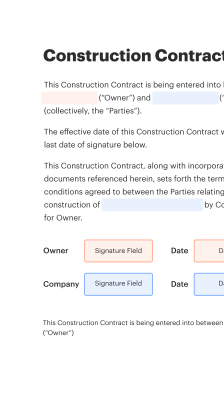
How Signature Orders Flow in a Transaction

A signature order enforces the sequence of signing events, routing documents automatically from one signer to the next until completion.

  • Initiation: Sender uploads document and selects template.
  • Routing: System assigns signers and locks order.
  • Authentication: Signers complete identity checks as configured.
  • Finalization: System applies final seal and records audit trail.
Collect signatures
24x
faster
Reduce costs by
$30
per document
Save up to
40h
per employee / month

Step-by-Step: Implementing a Signature Service Order

Follow these practical steps to define and activate a signature order in your eSignature solution.

  • 01
    Define sequence: Document the required signer order and dependencies.
  • 02
    Configure template: Place fields and set signing roles in templates.
  • 03
    Set authentication: Choose signer verification methods per role.
  • 04
    Test and deploy: Run pilot transactions before broad rollout.
be ready to get more

Why choose airSlate SignNow

  • Free 7-day trial. Choose the plan you need and try it risk-free.
  • Honest pricing for full-featured plans. airSlate SignNow offers subscription plans with no overages or hidden fees at renewal.
  • Enterprise-grade security. airSlate SignNow helps you comply with global security standards.
illustrations signature

Recommended Default Workflow Settings for Signature Orders

Use these baseline configuration values when setting up a new signature order workflow to balance security and usability.

Feature Configuration
Default Signature Reminder Frequency Setting 48 hours after initial send
Default Signer Authentication Method Configuration Email link plus optional SMS
Document Expiration and Retention Policy 90 days active, archive thereafter
Automatic Escalation and Approval Routing Escalate after 7 days of inactivity
Default Field Validation and Required Fields Require name, date, and signature

Platform and Device Considerations for Signature Orders

Verify supported platforms to ensure signers can complete ordered signatures from their preferred devices and browsers.

  • Desktop browsers: Chrome, Edge, Safari supported
  • Mobile apps: iOS and Android apps
  • Browser versions: Recent stable releases required

Confirm mobile and desktop compatibility before deployment, and provide guidance for supported browser versions and app updates to minimize signer friction and ensure consistent order completion across devices.

Security Controls for Signature Service Orders

Encryption at rest: AES-256 encryption
Encryption in transit: TLS 1.2+ encryption
Multi-factor authentication: Optional for signers
Access control: Role-based permissions
Audit logging: Immutable activity logs
Document integrity: Tamper-evident seals

Industry Examples: Signature Order in Practice

Below are two practical scenarios showing how a signature order is applied to common document workflows across industries.

Commercial Lease Execution

A property manager initiates the lease with standardized fields and a required order for signatures

  • Manager signs first to confirm terms
  • Tenant signs second after identity verification

Resulting in a clear, auditable agreement executed within a defined timeframe that reduces move-in delays and legal ambiguity.

Patient Consent for Treatment

A healthcare administrator sends consent with a specified order: clinician review, patient signature, witness acknowledgement

  • Clinician verifies treatment details
  • Patient provides eSignature with two-factor authentication

Ensures a verifiable consent record that supports HIPAA-aligned documentation and reduces post-treatment disputes.

Best Practices for Secure and Accurate Signature Orders

Adopt these practices to reduce errors, improve compliance, and make signature orders reliable across teams.

Standardize templates and role definitions
Create a templating standard with pre-defined signer roles, required fields, and validation rules. Maintain version control and document ownership for each template so updates to signature order logic are tracked and approvals are consistent across departments.
Use conditional routing sparingly and clearly
Limit conditional branches to necessary exceptions and document their logic. Complex branching can obscure sequence expectations; add clear labels and test all branches to ensure they preserve legal intent and auditability.
Align authentication with document risk
Match stronger verification methods to high-risk or regulated documents. For routine acknowledgements, email-based links may suffice, but contracts and healthcare consents often require two-factor or identity verification to ensure enforceability.
Monitor completion metrics and audit logs
Regularly review completion rates, resend frequencies, and audit trail entries for anomalies. Use these insights to refine signer order, improve template clarity, and address recurring signer friction points that delay finalization.

FAQs About adopt signature service order

Common questions and troubleshooting advice for implementing a signature order, including configuration and compliance considerations.

Feature Comparison: signNow and Major Competitors

A concise availability and capability comparison for commonly required features when implementing signature orders.

Criteria signNow (Recommended) DocuSign Adobe Sign
Legal Compliance (US)
Bulk Send capability
REST API support REST API REST API REST API
Native mobile app
be ready to get more

Get legally-binding signatures now!

Regulatory and Operational Risks

Noncompliance fines: Monetary penalties possible
Contract disputes: Enforceability challenges
Data breach exposure: Regulatory reporting required
Operational delays: Missed deadlines
Loss of trust: Stakeholder confidence erodes
Audit failures: Remediation costs incurred

Pricing and Tier Comparison for Signature Orders

High-level pricing and feature availability across providers to inform budgeting and procurement decisions for signature order deployments.

Plan Feature signNow (Recommended) DocuSign Adobe Sign Dropbox Sign PandaDoc
Starting price per user $8/user/mo $10/user/mo $12/user/mo $8/user/mo $19/user/mo
Free trial availability Yes Yes Yes Yes Yes
Advanced workflow support Included Add-on Included Add-on Included
HIPAA support option Available Add-on Add-on Limited Available
API access included Included Included Included Included Included

Simplify challenging workflows

Generate, deliver, and control workflows of any complexity, electronically from near any place. Scalable electronic signature features enable you to exchange contracts with the right people in the proper sequence and set up roles for every recipient. Perform document workflows faster and simpler than ever before.

Automate document managing

Improve intricate signing processes with airSlate SignNow�s highly effective capabilities to enhance your operation. Take control of your automatic eSignature workflows to ensure they're running at maximum performance with instant notifications and reminders.

Enhance in team collaboration

Join teammates together in a protected, shared environment. Manage paperwork, use form templates and notices to produce more efficient cross-company communication. Free your workers from having to spend time on recurring routines so that they can concentrate on beneficial, business-crucial duties.

Integrate into your current network

Manage your tasks with market-leading integration. Assemble Salesforce, Microsoft Teams, and SharePoint in multi functional business thread. Hook up your applications to a single system for countless possibilities and more productiveness.

Stay compliant with best-in-class data security

Feel safe with the knowledge that your information remains secure by the most up-to-date in encryption security. airSlate SignNow is GDPR and eIDAS certified and provides you exposure into your signing experience with court-admissible audit trails. Configure user authorization and rights to regulate who has access to what.


walmart logo
exonMobil logo
apple logo
comcast logo
facebook logo
FedEx logo
be ready to get more

Get legally-binding signatures now!