Agreement Format between Company and Employee

Agreement format between company and employee is essential for clear communication. signNow provides a secure eSignature solution for all your documentation needs.

Award-winning eSignature solution

What an agreement format between company and employee entails

An agreement format between company and employee is a structured document that defines terms of employment, responsibilities, compensation, confidentiality, and termination conditions. It standardizes how offers, contracts, and amendments are presented and signed, ensuring both parties understand obligations. For digital execution, platforms like signNow provide eSignature and document management features that preserve integrity, timestamps, and signer intent while supporting U.S. legal frameworks such as ESIGN and UETA to maintain enforceability in most employment contexts.

Why standardize the company–employee agreement format

Standardized agreement formats reduce ambiguity, accelerate onboarding, and make compliance easier by using consistent clauses and signature records across roles and jurisdictions.

Why standardize the company–employee agreement format

Common challenges when implementing agreement formats

  • Inconsistent clause language across templates creates enforceability risks and internal disputes.
  • Manual signature collection delays onboarding and increases administrative overhead for HR teams.
  • Poor version control leads to outdated terms being accidentally reused or enforced.
  • Lack of secure storage and audit trail complicates audits and legal responses.

Primary user profiles for agreement templates

HR Manager

An HR Manager configures templates, maintains the agreement library, and enforces approval workflows. They ensure clauses reflect company policy, manage role-based access to sensitive templates, and coordinate with legal for periodic reviews to keep agreements compliant with federal and state employment laws.

New Employee

A New Employee reviews assigned agreement documents, completes required fields, and signs electronically. They rely on clear formatting, labeled signature fields, and audit records that confirm the document version and timestamps for future reference.

Typical users and teams involved

Human resources, hiring managers, legal counsel, and IT administrators commonly manage and approve company–employee agreement formats.

  • Human resources teams handling templates and onboarding workflows.
  • Legal teams reviewing clauses and maintaining compliance records.
  • IT and security managers controlling access and integrations.

Coordination among these roles ensures agreements are accurate, legally sound, and integrated into payroll and personnel systems.

Essential features for effective agreement formats

These capabilities help HR and legal teams create enforceable, repeatable company–employee agreement formats while maintaining security and efficiency.

eSignature

Legally binding electronic signatures with time-stamped records and signer authentication options, enabling faster acceptance and clear evidence of intent for employment agreements.


Templates

Centralized, versioned templates with conditional logic and merge fields to automatically populate names, compensation, and role-specific clauses for consistent agreement generation.

Bulk Send

Capability to distribute identical agreements to many recipients simultaneously while tracking individual completion status and maintaining separate audit trails for each signer.

Audit Trail

Comprehensive, tamper-evident activity logs capturing timestamps, IP addresses, and user actions for each agreement to support disputes and regulatory audits.

Role Access

Granular, role-based permissions and single sign-on integration to limit template editing and viewing to authorized HR and legal personnel.

Third-party Integrations

Prebuilt connectors to document storage, HRIS, and CRM systems for automated population of agreements and secure archival of signed records.

be ready to get more

Choose a better solution

Integrations and templates that streamline agreement workflows

Integrations with common productivity and storage tools reduce duplication and improve accuracy when preparing employee agreements.

Google Docs

Two-way integration allows importing and updating agreement drafts from Google Docs, converting collaborative drafts into verifiable templates while preserving formatting and revision history.

CRM Sync

CRM connectors populate candidate and employee fields automatically into agreement templates, reducing manual data entry and ensuring agreement fields match personnel records.

Dropbox

Automatic saving of signed agreements to a designated Dropbox folder provides centralized backup and simplifies long-term retention policies for HR records.

Custom Templates

Template editor supports clause libraries, conditional sections, and role-based placeholders so legal-approved language can be reused across positions and departments.
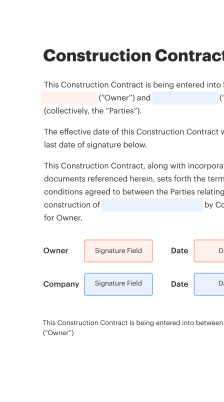
How to create and use the agreement format online

A streamlined online workflow turns a template into a signed agreement in a few actions, preserving legal and audit data for compliance.

  • Upload or draft: Import a DOCX or start from a blank template.
  • Add fields: Place signature, date, and input fields where needed.
  • Set recipients: Define signer order and CC recipients.
  • Send and monitor: Dispatch document and track status in dashboard.
Collect signatures
24x
faster
Reduce costs by
$30
per document
Save up to
40h
per employee / month

Quick setup: create an agreement format between company and employee

Follow these four concise steps to prepare and deploy a standardized employee agreement format using an eSignature-enabled platform.

  • 01
    Gather clauses: Collect required legal, compensation, and policy language.
  • 02
    Build template: Assemble fields, signature blocks, and conditional clauses.
  • 03
    Configure workflow: Set approvers, routing order, and reminders.
  • 04
    Publish and audit: Assign templates and verify audit trails after signing.

Managing audit trails and signed agreement records

Maintain searchable records and clear logs for every signed employee agreement to support audits and legal inquiries.

01

Capture metadata:

Record timestamp, IP, and device data.
02

Version control:

Archive pre-sign and post-sign versions.
03

Tamper evidence:

Apply digital seals on executed PDFs.
04

Export logs:

Provide CSV or PDF audit exports.
05

Retention indexing:

Tag by employee, role, and date.
06

Access review:

Periodic permission audits.
be ready to get more

Why choose airSlate SignNow

  • Free 7-day trial. Choose the plan you need and try it risk-free.
  • Honest pricing for full-featured plans. airSlate SignNow offers subscription plans with no overages or hidden fees at renewal.
  • Enterprise-grade security. airSlate SignNow helps you comply with global security standards.
illustrations signature

Automation and configuration settings for agreement workflows

Key workflow settings optimize routing, reminders, and integrations to minimize manual tasks and errors when issuing employee agreements.

Setting Name Configuration
Reminder Frequency 48 hours
Approval Routing Sequential routing
Template Library Access Restricted groups
Expiration Settings 30 days
Webhook Notifications Enabled

Using agreement formats on mobile, tablet, and desktop

Agreement templates and signing workflows should be accessible across devices so signers can complete documents conveniently and securely.

  • Supported browsers: Chrome, Edge, Safari
  • Mobile platforms: iOS and Android apps
  • File formats: DOCX, PDF, TXT

Ensure templates render correctly on small screens, configure touch-friendly signature fields, and verify that mobile authentication and audit logging match desktop security settings to maintain legal and compliance standards.

Core security and protection controls

Encryption at rest: AES-256 encryption for stored files
Encryption in transit: TLS 1.2+ protection for data transfer
Access controls: Role-based permissions and SSO
Two-factor authentication: Optional 2FA for account access
Document watermarking: Configurable visible identification
Tamper-evident seals: Integrity checks and signatures

Industry scenarios for company–employee agreement formats

Two practical case examples illustrate how standardized agreement formats reduce risk and speed processes across different sectors.

Healthcare hiring

A large regional clinic used a standardized electronic agreement to onboard clinical staff quickly, including HIPAA confidentiality clauses

  • Prebuilt medical confidentiality clause
  • Faster credentialing and clear data-handling obligations

Resulting in reduced onboarding time and stronger audit readiness for patient privacy compliance.

Education employment

A school district deployed uniform teacher contracts with FERPA and background-check disclosures integrated into the agreement

  • Single template for multiple school sites
  • Simplified renewals and centralized recordkeeping

Resulting in consistent compliance and faster administrative approvals across schools.

Best practices for secure and accurate agreement formats

Adopting consistent processes and controls reduces legal exposure and administrative friction while improving signer experience.

Maintain a single source of truth for templates
Keep one version-controlled template library managed by legal and HR, enforce approval gates for edits, and record change logs so all agreements derive from approved language.
Use conditional logic for role differences
Apply conditional sections to include role-specific terms automatically, preventing manual edits that could introduce inconsistent or incorrect clauses into employee agreements.
Enforce signer authentication and audit logs
Require appropriate authentication levels for signers, capture IP and timestamp metadata, and retain tamper-evident audit trails to support legal validity and future dispute resolution.
Define retention and destruction policies
Document and implement retention timelines aligned to federal and state requirements, and automate archival or secure deletion processes for expired or superseded agreements.

FAQs About agreement format between company and employee

Common questions about creating, signing, and retaining standardized company–employee agreement formats, with concise practical answers for administrators and HR teams.

Feature comparison: digital vs paper signing capabilities

A concise product feature comparison shows availability of key digital signing capabilities across popular eSignature vendors for company–employee agreements.

Feature signNow (Featured) DocuSign Adobe Sign
Legally binding eSignatures
Template conditional logic
Bulk Send capability
API access for automation
be ready to get more

Get legally-binding signatures now!

Retention and storage timelines for signed agreements

Establish clear retention dates and backup cycles to meet compliance and operational needs while minimizing storage risk.

Standard retention period:

6 years for most employment records

Background check records:

3 years after hire decision

Payroll and compensation records:

7 years per IRS guidelines

Confidentiality agreements:

Retain for term plus 3 years

Automated backups:

Daily incremental backups

Potential legal and operational risks

Invalid signatures: Contract unenforceability
Data breaches: Privacy regulation violations
Noncompliance: Fines or litigation exposure
Version confusion: Wrong terms applied
Unauthorized access: Insider data misuse
Retention lapses: Missing records for disputes

Pricing and plan comparison for employee agreement workflows

Overview of typical plan attributes and relative cost indicators across leading eSignature vendors to help compare TCO and available features for HR use cases.

Plan/Feature signNow (Featured) DocuSign Adobe Sign HelloSign PandaDoc
Free tier or trial Free trial available Free trial available Free trial available Free plan available Free trial available
API availability REST API included REST API included REST API included REST API included REST API included
Advanced workflows Conditional templates included Workflow add-on Included in enterprise Limited Included
Enterprise admin features Role management and SSO Advanced admin controls Enterprise controls Team admin Advanced admin
Typical SMB cost indication Lower-cost per user Mid-range per user Mid-range per user Affordable Mid-range per user

Understanding the Agreement Format Between Company and Employee

An agreement format between a company and an employee serves as a formal document outlining the terms and conditions of employment. This document typically includes essential details such as job responsibilities, compensation, benefits, and the duration of employment. A well-structured agreement ensures clarity for both parties, reducing the likelihood of misunderstandings and disputes.

Key components often found in this agreement include:

  • Job Title and Description: Clearly defined roles and responsibilities.
  • Compensation: Details regarding salary, bonuses, and payment schedules.
  • Benefits: Information on health insurance, retirement plans, and other perks.
  • Duration: The length of the employment period, whether it is permanent or temporary.
  • Termination Clause: Conditions under which either party may terminate the agreement.

Creating an Agreement Using airSlate SignNow

With airSlate SignNow, creating an agreement format between a company and an employee can be done efficiently. Users can start by selecting a template that suits their needs or by creating a document from scratch. The platform allows for easy editing, enabling users to customize the agreement to reflect specific terms and conditions relevant to their organization.

Steps to create an agreement include:

  • Selecting a template or starting a new document.
  • Filling in necessary details such as employee information and job specifics.
  • Adding clauses related to compensation, benefits, and termination.
  • Reviewing the document for accuracy.
  • Saving and preparing the document for eSigning.

Benefits of Digital Agreements

Utilizing a digital agreement format offers numerous advantages for both companies and employees. Digital agreements streamline the signing process, making it faster and more efficient. With airSlate SignNow, users can prepare documents for eSigning and share them securely, ensuring that sensitive information remains protected.

Additional benefits include:

  • Accessibility: Employees can review and sign agreements from any location, using any device.
  • Environmentally Friendly: Reduces paper usage, contributing to sustainability efforts.
  • Storage and Retrieval: Digital documents are easy to store and retrieve, reducing clutter and improving organization.

Common Use Cases for Employee Agreements

Employee agreements are essential in various scenarios. Companies often use them when hiring new employees, promoting existing staff, or changing employment terms. Each situation requires careful consideration of the agreement's content to ensure it meets legal standards and protects both parties' interests.

Common use cases include:

  • Onboarding new employees with clear job expectations.
  • Updating agreements for promotions or role changes.
  • Defining terms for temporary or contract positions.
  • Establishing agreements for remote work arrangements.

Ensuring Compliance with Employment Laws

When drafting an agreement format between a company and an employee, it is crucial to ensure compliance with federal and state employment laws. This includes adhering to regulations regarding minimum wage, overtime pay, and anti-discrimination laws. Companies should regularly review their agreements to remain compliant with any changes in legislation.

To ensure compliance, consider:

  • Consulting legal professionals for guidance on employment law.
  • Staying informed about changes in labor regulations.
  • Including clauses that reflect compliance with relevant laws.

Securing Signatures with airSlate SignNow

Once the agreement is finalized, the next step is to obtain signatures from both the company representative and the employee. airSlate SignNow simplifies this process by allowing users to send documents for signature electronically. This method not only saves time but also enhances security, as documents are encrypted during transmission.

Steps to secure signatures include:

  • Uploading the completed agreement to airSlate SignNow.
  • Designating signers and specifying signing order if necessary.
  • Sending the document for eSigning.
  • Tracking the signing process in real-time.
walmart logo
exonMobil logo
apple logo
comcast logo
facebook logo
FedEx logo
be ready to get more

Get legally-binding signatures now!