Electronic Form Software for Organizations: SignNow

Empower your business with airSlate SignNow to send and eSign documents effortlessly. Experience a user-friendly and cost-effective solution designed for seamless workflows.

Award-winning eSignature solution

What electronic form software for organizations does

Electronic form software for organizations centralizes form creation, distribution, and data capture in a secure, auditable environment. It replaces paper processes with digital forms that can include conditional logic, pre-filled fields, and embedded signing steps. Organizations use these systems to accelerate approvals, reduce manual entry, and maintain records for compliance and reporting. A reliable solution integrates with cloud storage and business applications, supports team roles and permissions, and produces tamper-evident audit trails to demonstrate transaction integrity across departments and external counterparties.

Legal validity and compliant operations

Electronic form software for organizations can meet U.S. legal standards when implemented correctly, aligning with ESIGN and UETA for signature validity and supporting industry rules such as HIPAA and FERPA for protected data handling.

Legal validity and compliant operations

Common implementation challenges

  • Legacy paper processes create workflow bottlenecks and increase turnaround time for approvals and recordkeeping.
  • Poorly designed forms lead to incomplete submissions, increasing back-and-forth and manual correction work.
  • Integration gaps with CRM, HR, or finance systems force duplicate entry and reconciliation effort.
  • Inadequate access controls raise compliance exposure and complicate audits for regulated records.

Typical user roles and responsibilities

HR Manager

HR Managers create reusable templates for onboarding, benefits enrollment, and policy acknowledgements. They assign signing roles, set reminders, and maintain retention rules to ensure personnel records meet regulatory and internal audit requirements.

Field Technician

Field Technicians complete inspection, delivery, or service forms on mobile devices. They use offline-capable forms and photo attachments to capture evidence quickly and submit structured data to central systems for billing and compliance checks.

Who relies on electronic form solutions

Organizations of many sizes and sectors adopt electronic form software for organizations to streamline approvals, capture data, and maintain auditable records.

  • Small and mid-size businesses handling customer agreements and employee onboarding processes.
  • Healthcare providers managing intake forms, consents, and HIPAA-compliant communications.
  • Educational institutions processing admissions, FERPA-protected records, and parental consents.

These solutions support centralized administration while enabling departmental autonomy for templates, workflows, and role-based access.

Advanced capabilities for enterprise needs

Enterprises often require integrations, developer APIs, advanced access controls, and localization to scale electronic form programs securely and consistently.

Integrations

Prebuilt connectors to CRM, HRIS, and cloud storage systems streamline data flow and reduce duplicate entry, enabling forms to populate business records automatically.


API

A developer API enables embedding signing and form flows within custom applications, automating document generation and status tracking from backend systems.

Mobile signing

Native mobile support ensures signers can complete forms from smartphones and tablets with an experience optimized for touch and offline capture.

Role-based access

Granular permission models let administrators control who can create templates, send forms, view results, or manage retention, aiding compliance and separation of duties.

Document workflows

Configurable routing, conditional approvals, and escalations automate multi-step processes and reduce manual handoffs across teams and departments.

Branding

Customizable appearance and messaging maintain corporate identity across recipient experiences and signed documents for consistent external communications.

be ready to get more

Choose a better solution

Essential features for organizational use

Organizations should prioritize features that reduce manual work, secure data, and integrate with existing systems to preserve continuity and control.

Templates

Reusable templates speed form creation and ensure consistent field placement, validations, and business logic across departments to reduce errors and accelerate processing.

Conditional Fields

Dynamic field rules present only relevant questions to the user, simplify complex forms, and route data correctly to downstream systems without manual review.

Bulk Send

Bulk Send enables distributing identical forms to many recipients with individualized fields, reducing repetitive work and producing a consolidated status view for administrators.

Audit Trail

Comprehensive, tamper-evident logs record each action, timestamp, and IP detail to support legal defensibility and internal or external audits.
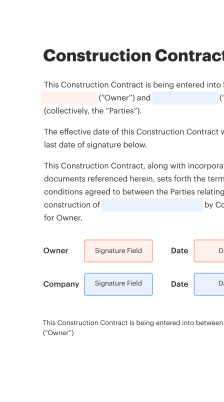
How creating and sending forms works

The end-to-end process moves from form design to recipient interaction and final archiving, preserving an audit trail at every step.

  • Design: Add fields, rules, and templates.
  • Prepare: Upload documents or use templates.
  • Send: Choose recipients and routing order.
  • Close: Capture signatures and archive securely.
Collect signatures
24x
faster
Reduce costs by
$30
per document
Save up to
40h
per employee / month

Quick setup: deploy forms in four steps

A straightforward rollout focuses on templates, workflows, access control, and training to get teams productive quickly.

  • 01
    Create template: Build fields and conditional logic.
  • 02
    Assign roles: Set signer and admin permissions.
  • 03
    Configure workflow: Define routing and reminders.
  • 04
    Train users: Run short sessions and documentation.

Managing audit trails and signed records

A disciplined approach to audit management ensures evidence is preserved for legal and operational needs while supporting easy retrieval.

01

Enable logging:

Turn on full event logging.
02

Configure retention:

Set retention per policy.
03

Store securely:

Use encrypted archives.
04

Index records:

Tag metadata for search.
05

Export evidence:

Generate reports for audits.
06

Review regularly:

Schedule audit checks.
be ready to get more

Why choose airSlate SignNow

  • Free 7-day trial. Choose the plan you need and try it risk-free.
  • Honest pricing for full-featured plans. airSlate SignNow offers subscription plans with no overages or hidden fees at renewal.
  • Enterprise-grade security. airSlate SignNow helps you comply with global security standards.
illustrations signature

Recommended workflow settings for common processes

Default workflow configurations can speed deployment while remaining adjustable for specific teams and processes.

Setting Name Configuration
Reminder Frequency 48 hours
Approval Escalation 72 hours
Signature Order Sequential
Default Retention 7 years
Access Expiration 90 days

Supported platforms and device requirements

Electronic form software for organizations typically supports modern browsers, mobile apps, and APIs to accommodate desktop and mobile users.

  • Supported browsers: Chrome, Edge, Safari
  • Mobile OS: iOS and Android
  • Connectivity needs: Internet or offline sync

Confirm specific version requirements and update policies with your vendor before wide deployment to ensure compatibility and security across devices.

Core security and protection controls

Encryption: AES-256 at rest
Transport security: TLS 1.2+ in transit
Audit trails: Tamper-evident logs
Access controls: Role-based permissions
Authentication: Multi-factor options
Key management: HSM-backed keys

Practical examples by industry

These concise case scenarios show how electronic form software for organizations solves common operational needs across sectors.

Healthcare intake and consents

A hospital digitized patient intake and consent forms to reduce wait times and transcription errors

  • Electronic signatures ensured timely authorization
  • Integrated data populated EHR fields automatically

Leading to faster billing cycles and clearer audit records.

Higher education admissions

A university replaced paper advisement and FERPA consent forms with digital equivalents to streamline student onboarding

  • Conditional logic served appropriate forms by program
  • Central storage preserved access controls for student records

Resulting in improved record retrieval and regulatory compliance.

Operational best practices for reliability and security

Follow a set of consistent practices to maintain form quality, legal validity, and efficient operations across teams while protecting sensitive data.

Standardize templates and naming conventions
Use a governance model for templates, naming, and version control so teams deploy consistent forms, reduce duplication, and simplify audits and training across the organization.
Limit access with role-based permissions
Grant the minimum necessary privileges for form creation, sending, and administration to reduce exposure and ensure accountability for sensitive workflows and records.
Implement retention and archival policies
Define retention schedules aligned with legal obligations, automate archival to secure storage, and periodically review deletions to avoid unintentional data loss or compliance gaps.
Validate identity for high-risk transactions
Require multi-factor authentication or identity verification for transactions involving contracts, financial transfers, or regulated information to strengthen non-repudiation and legal enforceability.

FAQs about electronic form software for organizations

Answers address common operational, legal, and technical questions organizations raise when adopting electronic form software for organizations.

Feature availability: signNow versus other providers

A high-level comparison of common enterprise capabilities across three established e-signature providers, with signNow listed first as Recommended.

Feature signNow (Recommended) DocuSign Adobe Sign
Bulk Send
API Access REST API REST API REST API
HIPAA Support Available Available Available
Mobile Apps iOS/Android iOS/Android iOS/Android
be ready to get more

Get legally-binding signatures now!

Typical rollout timeline

A staged rollout minimizes disruption and verifies integrations before broad adoption; the following phases reflect a common multi-week rollout plan.

01

Week 1: Planning

Identify use cases and stakeholders.

02

Week 2: Design

Create templates and workflows.

03

Week 3: Integration

Connect systems and test APIs.

04

Week 4: Pilot

Run with a small user group.

05

Week 5: Training

Train admins and end users.

06

Week 6: Deploy

Roll out organization-wide.

07

Week 7: Monitor

Review metrics and feedback.

08

Week 8: Optimize

Refine forms and automations.

Retention and scheduling considerations

Document lifecycle planning helps meet regulatory requirements and controls storage costs while preserving access for audits and legal matters.

Retention schedule definition:

Map legal retention periods.

Archival automation settings:

Automate after finalize.

Deletion and purge policy:

Enforce secure removal.

Audit review frequency:

Schedule periodic checks.

Legal hold procedures:

Suspend deletions when needed.

Risks and regulatory penalties to avoid

Noncompliance fines: Substantial
Data breach loss: Severe
Operational delays: Costly
Invalid signatures: Contract risk
Reputational harm: Long-term
Audit failures: Enforcement actions

Pricing and plan focus across providers

Pricing models differ by target customer and included features; signNow is listed first as Featured for quick reference. Verify current plan details with each vendor.

Pricing Element signNow (Featured) DocuSign Adobe Sign Dropbox Sign PandaDoc
Entry plan focus Core eSign features for teams Individual and small teams Individual eSign and PDF tools Simple eSign for teams Free eSign and document templates
API included Available on business plans Available with developer plans Available with enterprise plans Available on higher tiers Available on paid tiers
Enterprise services Dedicated support and SSO options Large account services and compliance Enterprise deployment and SSO Advanced admin features Enterprise onboarding available
Free trial or tier Free trial and limited free use Free trial available Trial available via Creative Cloud Free tier with limits Free eSign tier available
Typical customer SMBs and mid-market teams Large enterprises and regulated industries Enterprises and Adobe customers Small teams and Dropbox users Sales-driven teams and document workflows
walmart logo
exonMobil logo
apple logo
comcast logo
facebook logo
FedEx logo
be ready to get more

Get legally-binding signatures now!