Fill Signatory Order with SignNow's Secure eSignature Solution

Get rid of paperwork and optimize digital document managing for more productivity and unlimited possibilities. Enjoy a greater strategy for doing business with airSlate SignNow.

Award-winning eSignature solution

What fill signatory order means in document workflows

The fill signatory order feature lets senders define the sequence in which recipients complete and sign a document, ensuring fields and signatures occur in the correct legal and operational order. This capability coordinates multi-party transactions, supports conditional routing, and reduces errors caused by parallel signing. In signNow, configurable signing order can be applied per envelope or saved as part of a template to enforce business rules consistently across recurring agreements and multi-step approvals.

Legal and operational reasons to use signing order

Establishing a clear signatory order reduces disputes and enforces process control by recording who signed and when, which supports compliance and auditability for regulated transactions.

Legal and operational reasons to use signing order

Common challenges solved by fill signatory order

  • Unclear signing sequences create incomplete documents and delay closing times due to missed or out-of-order signatures.
  • Parallel signing without enforced order can produce conflicting edits and missing required fields across multiple signers.
  • Manual coordination of signers increases administrative overhead and the risk of sending the wrong document version.
  • Lack of audit context for signing steps makes it harder to resolve disputes or demonstrate chain of custody.

Typical users who configure signing order

Contract Manager

Contract Managers set signing sequences for agreements involving legal, finance, and external parties. They use templates and conditional routing to ensure signatures occur in the approved order and to maintain an auditable trail for compliance and internal governance.

HR Administrator

HR Administrators use signing order for onboarding documents so offer letters, benefits forms, and managerial approvals complete in sequence. This reduces follow-up, ensures required approvals occur before final onboarding, and standardizes the process across departments.

Core features that enhance ordered signing

These features make it easier to design, enforce, and monitor signatory order across routine and complex transactions.

Template Support

Save predefined recipient sequences and field placements so recurring agreements always follow the same approved signing order, reducing setup time and improving consistency across teams and document types.


Conditional Routing

Configure rules that alter the subsequent signer or route based on completed field values, allowing dynamic order adjustments without manual intervention for exceptions or alternate approval paths.

Sequential Notifications

Automated notifications move to the next signer only after prior steps are completed, which prevents simultaneous edits and ensures each signer sees the final state before they sign.

Signature Locking

Fields and signatures lock after completion by each signer to preserve integrity and prevent later changes to earlier-signed content, providing a reliable chain of custody for the document.

Audit Trail

Detailed timestamps, IP addresses, and action logs record each signing step in sequence, supporting dispute resolution and compliance with legal recordkeeping requirements for signed documents.

Bulk Templates

Apply saved signing orders to multiple documents at once for batch processing, enabling scalable workflows for mass agreements while keeping signer sequencing intact for each envelope.

be ready to get more

Choose a better solution

Integrations that complement signing order

Common integrations streamline document creation, recipient selection, and storage while preserving ordered signing behavior across systems.

Google Docs

Integrating with Google Docs allows senders to convert collaborative drafts into signable documents and preserve recipient order when exporting, reducing duplication and ensuring the sequential workflow remains intact as documents move from draft to signature-ready files.

CRM Systems

CRM integration maps contact and opportunity data into documents and automatically populates recipient roles and sequence, enabling sales teams to generate agreements with predefined signing order tied to account and deal stages for consistent execution.

Dropbox

Dropbox integration stores completed agreements in designated folders and maintains metadata about signing order and execution timestamps, supporting archival policies and easy retrieval for audits or post-signature processing.

Document Storage

Integration with cloud storage ensures final signed copies, audit trails, and version history are saved automatically, preserving the order-related metadata required for compliance and internal recordkeeping.
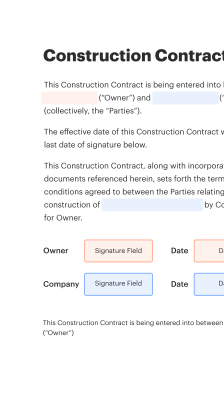
How ordered signing functions in practice

Ordered signing enforces a sequential flow so each recipient completes their portion before the next is notified, preserving document integrity.

  • Initiation: Sender specifies recipients and order.
  • Notification: First signer receives an email or link.
  • Completion: Signed fields lock for that signer.
  • Next Steps: System notifies the next signer automatically.
Collect signatures
24x
faster
Reduce costs by
$30
per document
Save up to
40h
per employee / month

Quick steps to set a signatory order

Follow these basic steps to configure signing order when preparing a document for signature.

  • 01
    Upload Document: Add the PDF or template to the platform.
  • 02
    Add Recipients: Enter signer names and email addresses.
  • 03
    Set Order: Assign signing sequence numbers to recipients.
  • 04
    Place Fields: Add signature and data fields for each signer.

Audit trail checklist for ordered signing

Use this checklist to ensure your ordered signing transactions are auditable and defensible.

01

Capture Timestamps:

Record each action time
02

Record IP Addresses:

Log signer IPs
03

Log Authentication Method:

Note MFA or email
04

Store Field History:

Preserve field changes
05

Archive Signed PDF:

Save final executed copy
06

Preserve Routing Rules:

Keep rule configuration
be ready to get more

Why choose airSlate SignNow

  • Free 7-day trial. Choose the plan you need and try it risk-free.
  • Honest pricing for full-featured plans. airSlate SignNow offers subscription plans with no overages or hidden fees at renewal.
  • Enterprise-grade security. airSlate SignNow helps you comply with global security standards.
illustrations signature

Typical workflow settings for ordered signing

These configuration items support automated and compliant ordered signing across accounts and templates.

Feature Configuration
Reminder Frequency 48 hours
Signature Verification Email or SMS
Template Locking Admin only
Conditional Routing Rules Field-based
Document Expiration 30 days

Supported platforms and technical considerations

Ordered signing is supported across modern browsers and native mobile apps, but check browser compatibility and mobile OS versions before large-scale deployment.

  • Desktop: Chrome, Edge, Safari
  • Mobile: iOS and Android apps
  • API: RESTful endpoints

For enterprise deployments validate single sign-on, API rate limits, and network requirements; coordinate with IT to whitelist service domains and configure secure callback URLs to preserve ordered signing across integrated systems.

Security controls relevant to signing order

Access Controls: Role-based signer permissions
Encryption: AES-256 at rest
Transport Security: TLS for data in transit
Authentication: Multi-factor options available
Audit Logs: Immutable event records
Data Segmentation: Tenant and account isolation

Industry scenarios for using fill signatory order

Real-world examples show how ordered signing simplifies multi-party processes across common verticals.

Real Estate Closing

A purchase agreement is prepared by the broker and routed first to the buyer for signature

  • Buyers initial and sign key fields
  • Lender review and signature follow to verify financing approval

Resulting in a clear chain of signatures that supports title recording and closing coordination without manual follow-up.

Employment Onboarding

An offer letter and benefits forms are issued to a new hire for completion

  • New hire fills personal and tax fields first
  • HR and hiring manager review and countersign after completion

Leading to standardized onboarding records that meet HR policy and provide a verifiable execution timeline for personnel files.

Recommended practices for accurate signing order

Follow these practical recommendations to avoid errors and maximize the effectiveness of signing order in your workflows.

Standardize templates with order presets
Create and maintain centrally managed templates that include predefined signer roles and sequence. Regularly review templates for accuracy, adjust for regulatory updates, and restrict template edits to authorized administrators to prevent unintended changes to signing order.
Validate recipient details before sending
Confirm email addresses, names, and role assignments before initiating the envelope. Incorrect recipient data is a common source of delays; verification reduces bouncebacks, misdirected notifications, and the need to reissue documents with corrected signing sequences.
Use conditional routing sparingly and clearly
When implementing conditional signatory paths, document the business rules and test scenarios. Keep conditions simple to avoid creating ambiguous routes that could skip required approvals or cause recipients to receive unexpected requests.
Maintain clear audit and retention policies
Ensure that audit logs, signed copies, and metadata reflecting the signing order are preserved according to legal and company retention schedules. This practice supports dispute resolution and compliance audits without reconstructing execution details manually.

FAQs About fill signatory order

Common questions and solutions about configuring and troubleshooting signatory order in electronic signing workflows.

Ordered signing: digital platforms compared with paper workflows

A concise feature comparison shows how eSignature platforms enforce signing order versus traditional paper-based processes.

Feature signNow (Recommended) DocuSign Adobe Sign
Sequential signing
Conditional routing
Central audit trail
Paper alternative Manual routing Courier or email Manual routing
be ready to get more

Get legally-binding signatures now!

Retention and deadlines related to signing order records

Set clear retention and access schedules for executed documents and their associated signing-order metadata to meet legal and internal requirements.

Retention Start Date:

Starts on execution date

Minimum Retention Period:

Default 7 years

Access Review Frequency:

Annual review

Archive to Cold Storage:

After retention period ends

Legal Hold Procedure:

Suspend deletion during disputes

Risks when signing order is not enforced

Invalid Execution: Disputes arise
Compliance Exposure: Regulatory fines possible
Operational Delay: Closings postponed
Data Inconsistency: Incorrect document versions
Audit Failures: Insufficient evidence
Increased Costs: Manual remediation needed

Cost-related comparison of ordered signing options

Pricing structures vary; this table contrasts typical entry-level offerings and key pricing characteristics across major providers.

Pricing Overview signNow (Recommended) DocuSign Adobe Sign Dropbox Sign PandaDoc
Entry-level plan Monthly plans available with basic eSign features Individual and small biz plans Individual and business plans Free tier with limits Free trial then paid plans
API access Available on paid plans Available on business plans Available on enterprise plans Available on paid plans Available on business plans
Template library Yes, saved templates supported Yes Yes Yes Yes
Bulk send capability Included on select plans Add-on or higher tier Enterprise feature Limited Available
SSO and enterprise features Available on enterprise tiers Enterprise-level only Enterprise-level only Enterprise add-on Enterprise plans

Make simpler complicated workflows

Generate, execute, and maintain workflows of any complexness, electronically from near any place. Scalable electronic signature features allow you to exchange contracts with the right people in the correct order and set up roles for each signee. Stream document workflows faster and easier than ever before.

Automate document management

Optimize intricate signing procedures with airSlate SignNow�s highly effective features to improve your business. Take control of your automatic signature workflows to make sure they're running at maximum efficiency with immediate notices and reminders.

Enhance in team communication

Join teams together in a safe, shared environment. Handle paperwork, use form templates and notices to create more efficient cross-company interaction. Free your staff from having to spend time on recurring actions so that they can give attention to valuable, business-critical projects.

Integrate into your existing systems

Work your assignments with industry-leading integration. Capture Salesforce, Microsoft Teams, and SharePoint all in one business flow. Link your software to a single unit for endless possibilities and more performance.

Remain compliant with industry-leading data safety

Feel safe with the knowledge that your information is protected by the most recent in encryption security. airSlate SignNow is GDPR and eIDAS compliant and gives you transparence into your signing experience with court-admissible audit trails. Configure user authorization and roles to regulate who has access to what.


walmart logo
exonMobil logo
apple logo
comcast logo
facebook logo
FedEx logo
be ready to get more

Get legally-binding signatures now!