Establishing secure connection…Loading editor…Preparing document…

Ohio Application for Expungement

This template is fully customizable. Edit the text, fill out the fields, and send it for signature. Give it a try!
Ohio Application for Expungement

What the Ohio Application for Expungement Is and What It Does

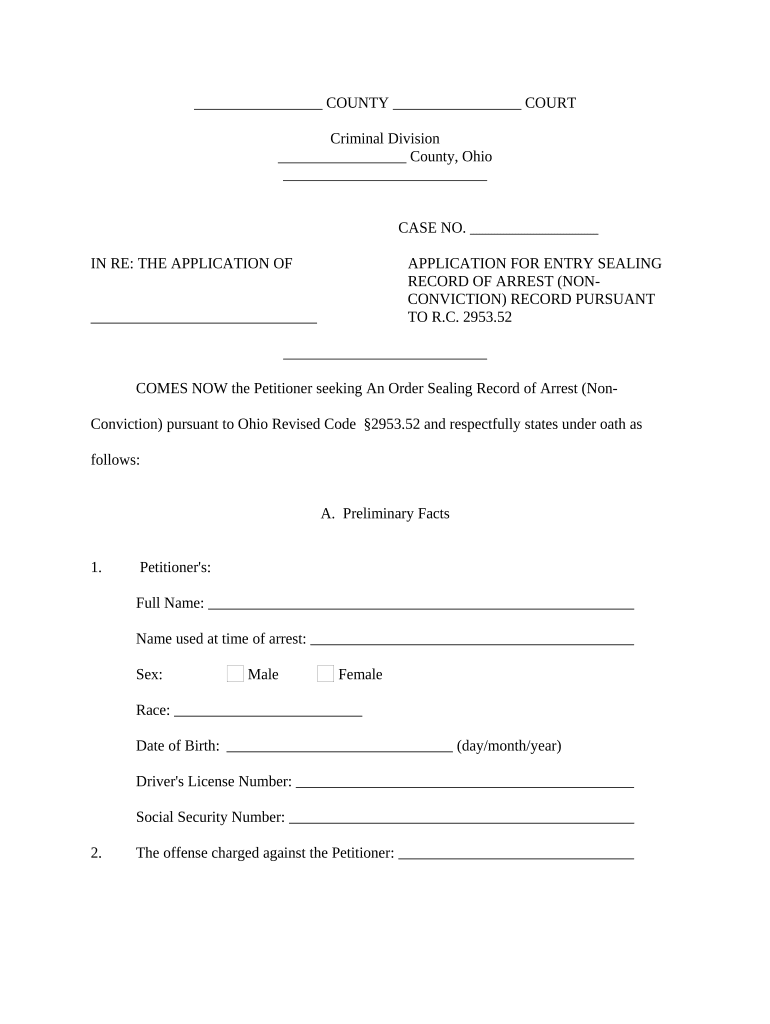
The Ohio Application for Expungement is the court filing used to request removal or sealing of specified criminal records from public access in Ohio. It asks the court to evaluate eligibility, review case dispositions, and, where permitted by statute, order records sealed or expunged so they are not readily available to employers, landlords, or the public. The application is typically filed in the court that handled the underlying case and must include identifying information, case numbers, dispositions, and any required attachments such as sentencing entries or proof of completion of court-ordered conditions.

Why Filing an Ohio Application for Expungement Matters

Expungement can reduce barriers to employment, housing, and education by limiting public access to old records, while preserving court records for authorized agencies and background checks required by law. A successful order can simplify applications and reduce the need to disclose sealed offenses where statutory exceptions do not apply.

Why Filing an Ohio Application for Expungement Matters

Who Typically Completes This Application

Courts, prosecutors, and background-screening entities are stakeholders in the process; accuracy and full disclosure are important, even where sealing is requested.

  • Affected individuals seeking employment or housing access
  • Attorneys preparing a court petition on a client’s behalf
  • Public defenders or legal-aid providers assisting qualifying clients

Primary Components of a Complete Ohio Expungement Application

A comprehensive application groups identifying details, case references, legal grounds, supporting documents, a proposed order, and a signature section. Each component helps the court verify eligibility and reach a decision without procedural delay.

Caption

Court name and case caption must match the original case file exactly to avoid clerical rejection.
Defendant Details

Full legal name, aliases, date of birth, and current address to ensure the court links the petition to the correct record.

Case List

List each case number, charge, disposition, and sentencing entry so the court can confirm eligibility and scope of relief.

Grounds

State the statutory basis for relief and any waiting period completion, including proof of rehabilitation or compliance where required.

Supporting Papers

Attach certified disposition entries, certificates of completion, and any pardon or set-aside documentation if applicable.

Proposed Order

Include a proposed journal entry or order the court can sign to clarify the scope of sealing or record entry changes.

Required Information Fields at a Glance

Full Legal Name: As on government ID
Date of Birth: MM/DD/YYYY format
Case Number(s): Court docket numbers
Court Name/County: Filing court jurisdiction
Disposition: Guilty, dismissed, etc.
Contact Info: Current address and phone

Step-by-Step: Filing an Ohio Expungement Application

Follow this sequence to prepare and file an accurate petition that the court can review promptly.

  • 01
    Gather Records: Collect case numbers, certified dispositions, and completion certificates.
  • 02
    Complete the Form: Fill each field exactly, following the fillable fields guide.
  • 03
    File With Court: Submit to the clerk in the proper county, in person or via approved e-filing.
  • 04
    Attend Hearing: Appear if the court schedules a hearing or request is opposed.

How to Set Up an Online Filing and eSubmission Workflow

Configure your digital workflow to include required fields, attachments, authentication, and a retained audit trail before sending to the court.

Field Configuration
Authentication Email validation or SMS code for signer identity
Attachments PDF certified dispositions and completion certificates
Audit Trail Enable timestamps, IP logging, and event history
Delivery Method E-file portal or printed filing with clerk

Digital Signing and eSubmission: Technical Requirements

When using an eSignature provider, verify compliance with ESIGN and UETA and that records are exportable for court submission.

  • File Formats: PDF and PDF/A are widely accepted
  • Integrations: Supports common cloud storage and court portals
  • Audit Trail: Retain signer IP, timestamps, and event logs

Timelines and Typical Deadlines to Expect

Timing depends on eligibility rules, county court schedules, and whether the petition is uncontested. Plan for clerical processing time and possible hearing dates.

Eligibility Waiting Periods:

Vary by offense and statute; check local rules

Clerk Processing:

Often several business days to docket

Hearing Scheduling:

May take weeks depending on court calendar

Notice to Prosecutor:

Courts often require service and time for response

Appeal Window:

If opposed, appellate deadlines follow state rules

Common Mistakes That Delay or Jeopardize an Application

  • Submitting incomplete case numbers or mismatched names that prevent clerks from locating the record.
  • Failing to attach certified disposition entries, sentencing entries, or certificates of completion required to prove eligibility.
  • Filing in the wrong court or county instead of the court of original jurisdiction.
  • Neglecting to serve required parties, such as the prosecutor, which can cause procedural dismissal.

Consequences of Incorrect or Incomplete Filings

Application Denial: Court may dismiss petition
Clerical Rejection: Clerk returns filing for correction
Delay: Processing and hearing postponement
Additional Costs: Repeat filing or service fees
Lost Fees: Nonrefundable county charges
Appeal Risk: Prosecutor may contest order

Supporting Documents Commonly Submitted with an Expungement Application

Courts typically require certified court entries and documentation proving completion of court-ordered conditions; include clear, legible copies as specified by local filing rules.

Certified Disposition

Court-certified docket entry showing final disposition—essential to verify eligibility and scope of relief requested.

Sentencing Entry

Official record of sentence and conditions, including probation terms and any required completion dates or certificates.

Certificates

Proof of program completion or restitution payments helps demonstrate compliance with court-ordered requirements.

Proposed Order

A drafted journal entry the court can sign clarifying which records will be sealed or excised from public view.

eSignature Provider Pricing and Feature Snapshot

Compare common entry-level costs and essential features for eSignature providers used to prepare or submit court documents; signNow appears first per platform comparison conventions.

signNow DocuSign Adobe Sign PandaDoc HelloSign
Starting Price $8/user/mo $15/user/mo $14/user/mo $19/user/mo $15/user/mo
Free Trial 7-day free trial, no credit card Trial available Trial available Trial available Trial available
Bulk Send Yes (plan-dependent) Yes Yes Yes No
Audit Trail Yes Yes Yes Yes Yes
HIPAA Compliant Yes Yes Yes No No

Frequently Asked Questions About the Ohio Application for Expungement

Answers to common questions about eligibility, documentation, notarization, e-signatures, processing time, and next steps after filing.


Need help? Contact support

be ready to get more
Join over 28 million airSlate SignNow users