Establishing secure connection…Loading editor…Preparing document…

Submission to Arbitration of Dispute Between Contractor and Owner

This template is fully customizable. Edit the text, fill out the fields, and send it for signature. Give it a try!
Submission to Arbitration of Dispute Between Contractor and Owner

What the Submission to Arbitration of Dispute Between Contractor and Owner Is

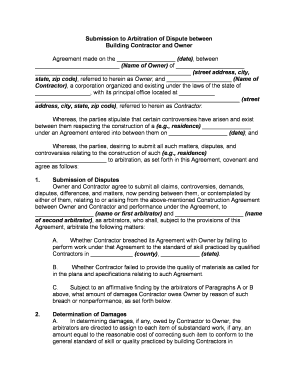
A Submission to Arbitration of Dispute Between Contractor and Owner is a written document that formally starts the arbitration process when a construction-related disagreement cannot be resolved by negotiation. It identifies the parties, summarizes the dispute, cites the contractual arbitration clause (if present), selects or requests an arbitral forum or rules, and asks the arbitrator or administering body to take jurisdiction and schedule a hearing. The submission explains relief sought, specifies any proposed witnesses or evidence, and provides contact information for service and correspondence, enabling procedural steps that lead to an arbitral award.

Why a Clear Submission Matters for Contractor–Owner Disputes

A precise submission frames the issues for the arbitrator, preserves claims and defenses, and speeds case administration by reducing ambiguity about scope, remedies, and jurisdiction.

Why a Clear Submission Matters for Contractor–Owner Disputes

Who Typically Prepares and Responds to an Arbitration Submission

Contractors, owners, construction counsel, project managers, and claims administrators commonly prepare or respond to arbitration submissions depending on contractual authority and the dispute's dollar value.

  • Contractors or their counsel preparing claims, summaries, and supporting exhibits for relief.
  • Owners or property managers responding to asserted claims and attaching corrective or offset documentation.
  • Project administrators or insurance representatives coordinating exhibits, witness lists, and scheduling availability.

Who Signs and Submits the Arbitration Request

Contractor Representative

A contractually authorized officer, project manager, or attorney typically signs on behalf of the contractor. That signer must have authority to pursue claims, attach exhibits, and accept awards; lacking authority can render the submission procedurally deficient and delay appointment of an arbitrator.

Owner Representative

An owner’s designated representative, facilities manager, or legal counsel signs responses and counterclaims. The representative must identify authorization or attach a power of attorney where corporate or trustee authority is not otherwise evident to avoid challenges to standing.

Step-by-Step: Preparing a Submission to Arbitration

Follow a consistent order to ensure the tribunal accepts the filing and the opposing party can respond without procedural disputes.

  • 01
    Confirm Contract Clause: Locate and quote the arbitration clause and any notice requirements.
  • 02
    Summarize the Dispute: State facts, project, dates, and the specific claim or breach.
  • 03
    List Relief Sought: Specify damages, interest, costs, or injunctive relief requested.
  • 04
    Attach Exhibits: Include contract, change orders, invoices, correspondence, and schedules.

Core Components to Include in a Professional Submission

A complete submission ensures jurisdictional clarity, efficient scheduling, and minimal procedural challenges; include these six elements to present a coherent case.

Caption

Parties’ legal names, contact information, and any file numbers used by the administering institution or contract.
Statement of Jurisdiction

Citation to the contract clause or mutual agreement conferring arbitrability and choice of rules or forum.

Factual Summary

Concise chronological statement of facts, critical dates, and previously attempted remedies or notices given.

Claims and Defenses

Number each claim, identify legal or contractual basis, and summarize expected defenses where known.

Evidence Index

Tabulated exhibit list referencing all attachments, including change orders, photos, schedules, and correspondence.

Procedural Requests

Requests for emergency measures, bifurcation, witness lists, proposed hearing dates, and confidentiality orders.

Essential Administrative and Security Information to Include

Party Contact: Name and full mailing address
Email for Service: Designated service email address
Phone Number: Direct business phone
Document Hash: Checksum or signed PDF indicator
Confidentiality: Any protective order requests
Authentication: Signer identity method noted

Where the Submission Goes and What Happens Next

The filing path depends on the contract and selected administering body; clarity in routing avoids administrative rejection or delay.

  • To Administering Body: Send to AAA, JAMS, or agreed forum per contract.
  • To Opposing Party: Serve the owner or contractor as contract notice procedures require.
  • Tribunal Response: Administering body acknowledges receipt and assigns case number.
  • Scheduling: Tribunal issues procedural timelines and appoints arbitrator(s).

Configuring a Digital Workflow for Submission and Service

Set up a reproducible digital workflow to assemble exhibits, obtain signatures, and transmit the submission securely.

Field Configuration
Document Assembly Merge contract, exhibits, and submission into one PDF
Signature Authentication Choose email link, SMS code, or ID verification
Distribution Send certified copies to tribunal and opposing counsel
Archive Store final package with audit trail

Digital Submission and eSigning: Technical Considerations

Ensure the chosen platform supports export to a single PDF, audit logs, and secure storage consistent with tribunal rules and any confidentiality needs.

  • File Formats: PDF/A preferred for long-term integrity
  • Integrations: Connectors for NetSuite, Salesforce, Procore
  • Authentication: Email, SMS code, or advanced ID checks

Supporting Documents Commonly Attached to the Submission

Attach a focused set of exhibits to prove damages, notice compliance, and any contractual prerequisites to avoid scope disputes.

Contract and Amendments

Include the original agreement, all change orders, and written amendments that affect scope or payment terms.

Notices and Correspondence

Attach certified delivery receipts, notice letters, and project communication showing claimed events and responses.

Invoices and Payments

Provide invoices, payment records, lien waivers, and accounting summaries supporting the claimed amounts.

Schedules and Photos

Submit project schedules, delay logs, daily reports, and photographic evidence illustrating defects or delays.

Typical Timeframes and Deadlines to Watch

Arbitration timing depends on contract provisions, tribunal rules, and any statutory limitations; missing a deadline can forfeit claims.

Contract Notice Period:

Follow contract-specified notice periods for claims and cure opportunities prior to arbitration.

Statute of Limitations:

File before applicable state statute of limitations expires for breach or tort claims.

Tribunal Filing Deadlines:

Administering bodies may require filing within set periods after demand; check rules.

Response Period:

Opposing party often has a set number of days to answer the submission.

Hearing Scheduling:

Hearing dates are set after procedural conference and availability confirmations.

Key Milestones from Submission to Award

A representative sequence clarifies expectations from filing through final award and post-award enforcement.

01

File Demand

Submit the demand and supporting exhibits to the administering body.

02

Acknowledge & Assign

Tribunal acknowledges receipt and assigns a case number and administrator.

03

Preliminary Conference

Parties meet to set schedules, discovery scope, and hearing logistics.

04

Hearing & Award

Arbitrator conducts hearing and issues a written award within scheduled timeframe.

Comparing eSignature Options for Submitting Arbitration Documents

Choose a platform that supports secure PDF export, audit trails, and any compliance needs; below is a high-level pricing and capability snapshot.

signNow DocuSign Adobe Sign PandaDoc HelloSign
Starting Price $8/user/mo $15/user/mo $14/user/mo $19/user/mo $15/user/mo
Free Trial 7-day free trial Varies Varies Varies Varies
Bulk Send Yes Yes Yes Yes No
Audit Trail Yes Yes Yes Yes Yes
HIPAA Compliant Yes Yes Yes No No
Envelope Cap No cap 100 envelopes/user/year Varies by plan Varies by plan Varies by plan

Common Mistakes to Avoid When Preparing the Submission

  • Failing to quote the exact arbitration clause can create jurisdictional disputes and delay appointment of an arbitrator and scheduling of the case.
  • Submitting incomplete exhibits or unindexed evidence often forces procedural adjournments and increases administrative fees and opponent objections.
  • Using an unauthorized signer without proof of delegation can lead to challenges to standing or motions to dismiss the submission as defective.
  • Neglecting contract notice or cure requirements may be deemed a procedural failure and provide grounds for the tribunal to decline relief.

Risks and Consequences of an Incorrect or Late Submission

Dismissal Risk: Loss of claim if procedural prerequisites are unmet
Default Award: Failure to respond may lead to an adverse default award
Sanctions: Potential fee sanctions for frivolous or dilatory filings
Lost Evidence: Late submissions can preclude admission of critical exhibits
Increased Costs: Additional tribunal and counsel fees for remedial filings
Enforcement Delay: Errors prolong award enforcement and collection timelines

Real-World Examples of Arbitration Submissions in Construction Disputes

Two brief examples show how submissions vary by dispute type and claim complexity.

Delay Claim Example

A contractor files a delay claim based on change order denial and schedule impact

  • Claim quantifies days and associated labor costs
  • The submission included daily reports, change order requests, and a delay analysis; the tribunal scheduled a preliminary conference to narrow issues and set discovery deadlines.

Defect and Remediation Example

An owner submits a counterclaim alleging defective work after final inspection

  • Seeks remediation costs and reduced contract price
  • The packet attached inspection reports, remediation estimates, and correspondence; parties agreed to document-only review for discrete technical issues.

Frequently Asked Questions About Submission to Arbitration

Answers to common questions about form, timing, service, and electronic submission for contractor–owner arbitration matters.


Need help? Contact support

be ready to get more
Join over 28 million airSlate SignNow users