Establishing secure connection…Loading editor…Preparing document…

Colorado Petition to Register Foreign Decree

This template is fully customizable. Edit the text, fill out the fields, and send it for signature. Give it a try!
Colorado Petition to Register Foreign Decree

What the Colorado Petition to Register Foreign Decree Is

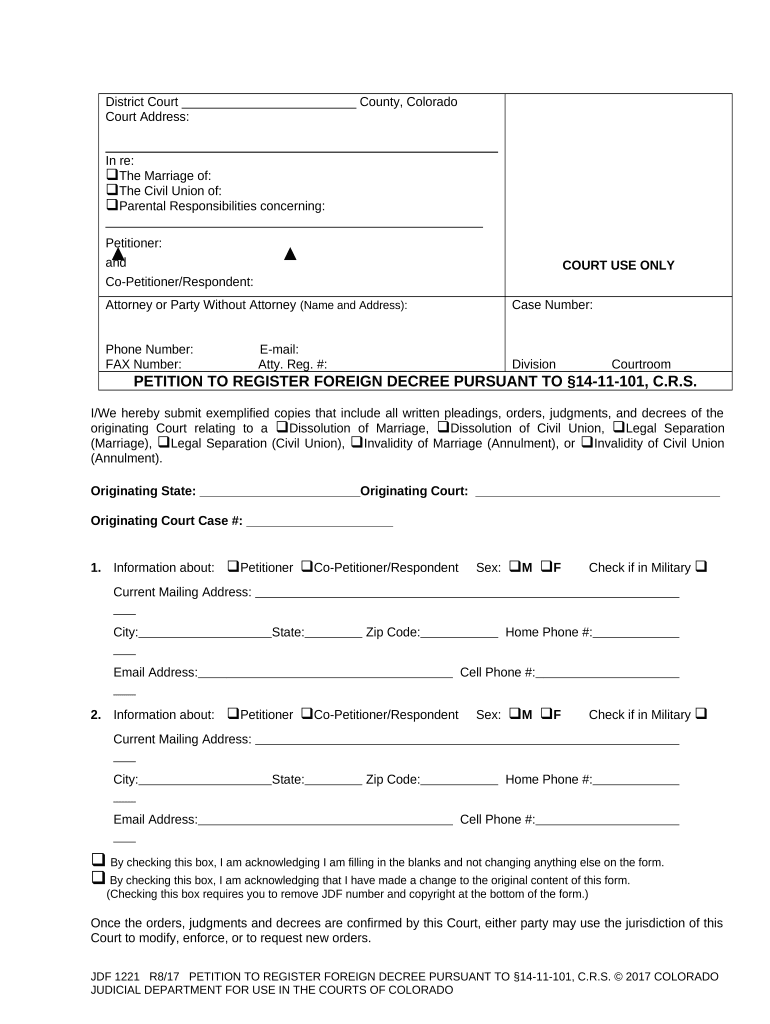
The Colorado Petition to Register Foreign Decree is a court filing used to record and domesticate a judgment or decree issued outside Colorado so it can be enforced within Colorado. Typical uses include registering out-of-state divorce, custody, support, or civil judgments; the petition attaches a certified copy of the original decree and requests recognition by a Colorado court. Registration creates a local entry that enables remedies such as wage garnishment, liens, or contempt proceedings consistent with Colorado procedure. The form begins the local review and gives Colorado courts jurisdiction to enforce the foreign order.

Why Register a Foreign Decree in Colorado

Registering a foreign decree establishes a local record that permits Colorado courts to enforce obligations, protect rights, and trigger local remedies that are otherwise difficult to obtain from an out-of-state judgment.

Why Register a Foreign Decree in Colorado

Who Typically Files This Petition

The petition is used by individuals and agencies that need Colorado enforcement of an out-of-state or foreign court order.

  • Individual recipients of out-of-state support or custody orders seeking Colorado enforcement.
  • Attorneys representing creditors, custodial parents, or judgment holders needing local remedies.
  • State agencies (child support enforcement, revenue departments) pursuing compliance for residents in Colorado.

Representative Filing Profiles

Petitioner — Individual

A private party who holds an out-of-state decree (for example, child support or divorce) and lives or locates a respondent in Colorado. The individual drafts the petition, attaches a certified copy of the original decree, and follows Colorado filing and service rules to obtain local enforcement.

Petitioner — Agency / Attorney

A state child support agency or private counsel files on behalf of a client or the state. Filers in this role often coordinate certified documentation, statutory citations, and service arrangements and may appear for enforcement hearings before Colorado courts.

Required Core Information

Party Names: Full legal names
Decree Type: Divorce, custody, support, judgment
Original Date: MM/DD/YYYY
Issuing Court: Court name and jurisdiction
Case Number: Original docket number
Certified Copy: Official certified copy attached

Consequences of an Incorrect Filing

Rejection: Clerk may refuse filing
Delay: Processing and enforcement stalled
Service Failure: Nullifies subsequent remedies
Contempt Risk: Improper procedure weakens contempt
Fee Loss: Nonrefundable court fees paid
Jurisdiction Conflict: Competing orders may complicate enforcement

Common Preparation Pitfalls to Avoid

  • Submitting uncertified or photocopied decrees instead of an official certified copy leads to immediate rejection by the clerk.
  • Using inaccurate party names or former names can prevent proper service and later enforcement actions in Colorado courts.
  • Failing to follow Colorado service rules or to serve the respondent within required timeframes may void the registration effort.
  • Omitting translations or apostilles for foreign-country decrees undermines admissibility and delays court recognition.

Step-by-Step: Filing the Petition in Colorado

Follow this sequence to prepare, file, and pursue enforcement after registration of a foreign decree in Colorado.

  • 01
    Collect Documents: Obtain certified copy, translations, and apostille if needed.
  • 02
    Complete Petition: Fill forms exactly and include required attachments.
  • 03
    File With Clerk: Submit petition to the appropriate Colorado court clerk.
  • 04
    Serve Parties: Arrange service on respondent per Colorado rules.

Where the Petition Goes and What Happens Next

The petition follows a short administrative path: filing, clerk review, registration entry, then enforcement steps if requested or necessary.

  • File Location: County court or district court where enforcement is sought.
  • Clerk Review: Clerk checks for certified copy and procedural compliance.
  • Registration Entry: Court enters registration and notifies parties as required.
  • Enforcement Options: Garnishment, liens, contempt, or other local remedies.

Digital Workflow Settings for Online Filing and Tracking

Configure a consistent workflow to ensure each petition includes required attachments, signer authentication, and delivery confirmations.

Field Configuration
Notification Method Email with read receipt or certified mail
Authentication Email link, SMS code, or identity verification
Attachments Required Certified copy, translation, apostille when applicable
Filing Method Clerk filing portal or in-person delivery

Technology Considerations for eFiling and eSignatures

Ensure your platform supports required file formats, secure signer authentication, and an audit trail for court use.

  • Integrations: Salesforce, NetSuite, Microsoft 365 supported
  • File Formats: PDF, DOCX accepted by most clerks
  • Authentication: Email link, SMS code, KBA optional

Key Components of a Complete Colorado Petition

Assemble a petition package that answers jurisdictional questions, proves authenticity, and enables efficient court processing and enforcement actions.

Certified Original Copy

Attach an official certified copy of the foreign decree or judgment; courts typically require certification or apostille for foreign-country orders to prove authenticity.
Translation and Apostille

Provide certified English translations and an apostille for documents issued outside the United States to meet Colorado admissibility requirements.

Notarization

If signatures require notarization, include notary acknowledgements; for remote notarization, confirm Colorado accepts the notarization method used.

Service Proof

Include affidavit or certificate of service showing how and when the respondent was served under Colorado rules.

Filing Fee Receipt

Attach payment or receipt for the county or district court filing fee to avoid administrative returns.

Proposed Enforcement

State the relief requested—garnishment, lien, or contempt—and include supporting financial or factual declarations as necessary.

Typical Timelines and Processing Expectations

Processing times and deadlines vary by county; plan for clerk review, service periods, and potential response windows from the respondent.

Clerk Processing Time:

Typically 1–4 weeks depending on county workload

Service Period:

Respondent usually has 21–30 days to answer or respond

Hearing Scheduling:

Enforcement hearing dates vary by docket and venue

Statute of Limitations:

Limitations depend on underlying judgment type and jurisdiction

Correction Window:

Clerk may request supplemental documents within a short deadline

eSignature Vendor Pricing Snapshot for Petition Workflows

Compare basic pricing and compliance features that commonly affect petition filing workflows; signNow is listed first per platform comparison conventions.

signNow DocuSign Adobe Sign PandaDoc HelloSign
Starting Price $8/user/mo $15/user/mo $14/user/mo $19/user/mo $15/user/mo
Free Trial 7-day free trial Varies by plan Varies by plan Varies by plan Varies by plan
Bulk Send Yes Yes Yes Yes No
Audit Trail Yes Yes Yes Yes Yes
HIPAA Compliant Yes Yes Yes No No
Envelope Cap No cap 100 envelopes/user/year Varies by plan Varies by plan Varies by plan

Key Milestones from Filing to Enforcement

This sequential view highlights typical milestones and what to expect at each stage of a registration and enforcement matter.

01

Prepare Package

Assemble certified copy, translations, and required affidavits for filing.

02

Clerk Filing

Submit petition and fee; clerk confirms completeness and accepts or returns.

03

Service Completed

Serve the respondent and file proof of service per Colorado rules.

04

Enforcement Action

Request garnishment, lien, or contempt after registration is entered.

FAQs and Troubleshooting for Colorado Registration

Answers to common questions about evidence, timing, e-signature acceptance, and next steps to avoid delays or rejection by Colorado courts.


Need help? Contact support

be ready to get more
Join over 28 million airSlate SignNow users