Online Estimating Software for Retail Trade

Streamline your document workflows with airSlate SignNow. Enjoy easy eSigning and cost-effective solutions tailored for the retail industry.

Award-winning eSignature solution

What online estimating software for retail trade does and why it matters

Online estimating software for retail trade centralizes the creation, delivery, and management of sales estimates and quotes for store-based and omnichannel retailers. It typically includes templates, pricing tables, tax and discount rules, and integrations with POS and inventory systems so estimates reflect current stock and pricing. The software reduces manual calculation errors, standardizes customer-facing documents, and speeds approvals while providing a searchable record of proposals. Retailers use these systems for custom orders, repairs, bulk sales, and in-store consultations to improve accuracy and operational consistency.

When an estimating system improves retail operations

Online estimating software for retail trade reduces time to produce accurate quotes, enforces pricing rules, and creates consistent customer documents that integrate with sales and inventory workflows.

When an estimating system improves retail operations

Common challenges retailers face without estimating software

  • Manual price calculations increase the risk of errors and inconsistent customer quotes.
  • Disconnected pricing, inventory, and POS systems create mismatches between estimates and actual availability.
  • Slow approval cycles and paper-based quotes delay customer decisions and order fulfillment.
  • Lack of audit trails complicates disputes and reduces visibility into estimate history.

Representative user profiles for retail estimating

Store Manager

A store manager oversees quotes for custom orders and promotions, ensures pricing rules are applied consistently, and approves nonstandard discounts. They rely on estimate histories to resolve customer inquiries and coordinate with inventory managers to confirm availability before finalizing sales.

Estimating Specialist

An estimating specialist builds complex estimates for large orders, applies labor and installation line items, and maintains template libraries. They use integrations with catalog and pricing systems to automate calculations and produce professional, auditable proposals for customer sign-off.

Typical retail roles that rely on estimating tools

Retail teams use estimating software across functions to streamline quoting, approvals, and order handoff from sales to fulfillment.

  • Store managers who need consistent pricing and quick customer approvals for custom orders.
  • Sales associates preparing on-the-spot estimates during consultations and in-store demos.
  • Operations staff who reconcile estimates with inventory and POS records for fulfillment.

Smaller retailers and larger chains both use these tools to reduce errors, speed cycles, and maintain consistent pricing across channels.

Advanced features for larger retail operations

Larger retailers benefit from additional capabilities that support automation, analytics, compliance, and enterprise-scale integrations.

Bulk Estimate Creation

Generate multiple estimates for group orders, events, or promotions from a single template and dataset to reduce repetitive work across locations.


Role-Based Approvals

Enforce multi-tier approval workflows with conditional routing for discounts above set thresholds or nonstandard terms to maintain margin controls.

Catalog Sync

Automate updates from a centralized product catalog so pricing, SKUs, and descriptions remain current across all store estimates.

Integration APIs

RESTful APIs connect estimating to ERP, CRM, and fulfillment systems to automate order creation and status tracking after approval.

Multi-currency Support

Handle currency conversion and localized taxes for cross-border sales or regional pricing consistency across store networks.

Custom Fields

Add store-specific or product-specific fields to captures installation, delivery or service details directly on estimates for operational clarity.

be ready to get more

Choose a better solution

Core capabilities to evaluate in retail estimating tools

Retailers should prioritize features that reduce manual work, ensure pricing accuracy, and integrate with sales systems to maintain consistency across channels.

Template Library

A centralized template system lets stores maintain standardized estimate layouts, prefilled tax and discount logic, and adjustable line-item sections so staff produce consistent, professional documents quickly.

Pricing Rules

Flexible pricing and discount rules support tiered pricing, promotional offers, and contract-specific margins, ensuring estimates reflect current business logic and reduce manual overrides.

POS Integration

Direct integration with point-of-sale and inventory systems ensures estimates use real-time stock levels and pricing, preventing overcommitments and speeding order fulfillment.

Reporting

Built-in reporting tracks estimate conversion rates, common discount patterns, and team performance to inform pricing strategy and inventory planning.
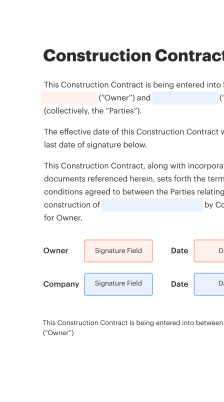
How an estimate moves from draft to sale

A typical estimate lifecycle includes creation, review, customer approval, and conversion to order or invoice, with logging at each step.

  • Create: Build an estimate using templates or from scratch.
  • Review: Apply approvals and internal checks as needed.
  • Approve: Customer signs or accepts the estimate digitally.
  • Convert: Turn approved estimates into orders or invoices automatically.
Collect signatures
24x
faster
Reduce costs by
$30
per document
Save up to
40h
per employee / month

Quick setup: start producing estimates in four steps

Follow these practical steps to configure an estimating workflow that aligns with retail pricing, inventory, and approval needs.

  • 01
    Define templates: Create standard estimate templates for common sale types.
  • 02
    Configure pricing: Set tax, discount, and margin rules.
  • 03
    Connect inventory: Integrate with POS or catalog for live stock levels.
  • 04
    Test workflow: Run sample estimates and approve flows before going live.

Detailed steps for completing an estimate and closing the sale

This grid covers the main actions from estimate creation through conversion, focusing on accuracy and traceability for retail teams.

01

Initiate estimate:

Select customer and sales context.
02

Add line items:

Choose products, services, and quantities.
03

Apply pricing rules:

Auto-apply taxes and discounts.
04

Review and approve:

Internal checks and manager sign-off.
05

Present to customer:

Send digitally or show in-store.
06

Convert to order:

Finalize sale and create invoice.
be ready to get more

Why choose airSlate SignNow

  • Free 7-day trial. Choose the plan you need and try it risk-free.
  • Honest pricing for full-featured plans. airSlate SignNow offers subscription plans with no overages or hidden fees at renewal.
  • Enterprise-grade security. airSlate SignNow helps you comply with global security standards.
illustrations signature

Typical workflow settings for retail estimating

The following configuration items reflect common workflow settings to control approvals, notifications, and estimate-to-order transitions.

Feature Configuration
Estimate Approval Flow Two-step approval
Reminder Frequency 48 hours
Auto-convert on Approval Enabled
Default Expiration 30 days
Notification Channel Email and in-app

Supported devices and platform considerations

Ensure the estimating tool supports the devices and browsers commonly used in your retail environment to avoid friction at point of sale.

  • Desktop browsers: Chrome, Edge supported
  • Mobile devices: iOS and Android apps
  • Tablet support: Responsive web and apps

Confirm minimum operating system and browser versions, test in-store hardware (barcode scanners, printers), and validate offline capabilities if sales staff need to work without a constant network connection.

Security controls relevant for retail estimating systems

Encryption in transit: TLS-based transport
Encryption at rest: AES-256 storage
Role-based access: Granular user roles
Two-factor authentication: Optional MFA available
Audit logging: Immutable event trail
Data partitioning: Tenant or account isolation

Industry examples where estimating software adds value

Practical retail scenarios show how estimating tools standardize proposals, link estimates to inventory, and speed customer decisions.

Custom Furniture Quote

A boutique furniture retailer creates detailed estimates for custom pieces with material options and lead times

  • Configurable price tables reflect choices and add-ons
  • Customers receive transparent line-item costs and timelines

Resulting in clearer purchase commitments and fewer post-sale adjustments for the store and customer.

Electronics Trade-In and Repair

A regional electronics retailer issues repair and trade-in estimates at point of service

  • Integrated diagnostics and parts pricing populate the estimate automatically
  • Customers see repair costs and expected completion dates before approval

Leading to faster approvals, improved repair throughput, and better customer satisfaction scores.

Operational best practices for accurate retail estimates

Implementing clear standards and controls reduces errors, speeds approvals, and ensures consistent customer experiences across stores.

Maintain a centralized template and pricing library
Keep a single source of truth for templates and price lists so all stores use approved language, tax treatments, and discount rules. Regularly review templates for promotions and legal updates.
Automate integrations to POS and inventory systems
Automate data flows between estimating and point-of-sale or inventory systems to prevent manual entry errors, ensure accurate availability, and speed order fulfillment from approved estimates.
Enforce role-based approvals for discounts and exceptions
Set approval thresholds so only authorized staff can apply large discounts or nonstandard terms, and route exceptions to managers to preserve margins and provide accountability.
Document retention and audit policies for dispute resolution
Establish retention schedules and maintain audit trails that record who changed estimates, when, and why to facilitate dispute resolution and regulatory compliance.

FAQs About online estimating software for retail trade

Common questions address setup, legal validity, integrations, and troubleshooting to help retail teams implement and maintain estimating workflows.

Feature availability across eSignature providers for estimating workflows

A quick comparison of common capabilities relevant to retail estimating shows where different providers align on core technical and compliance support.

Criteria signNow (Recommended) DocuSign Adobe Sign
Legally binding under ESIGN/UETA
Bulk Send support
Native POS integrations Limited Extensive Limited
Offline signing capability
be ready to get more

Get legally-binding signatures now!

Typical document and retention deadlines for retail estimates

Retailers should align estimate retention and review deadlines with accounting, warranty, and legal obligations to support audits and customer inquiries.

Estimate expiration period:

Standard 30 days

Retention for tax records:

Seven years recommended

Warranty documentation retention:

Match product warranty terms

Audit log retention:

Minimum three years

Periodic review schedule:

Annual policy review

Operational and compliance risks to watch for

Pricing errors: Lost revenue
Inventory mismatch: Order cancellations
Data breaches: Regulatory fines
Unauthorized changes: Reputational harm
Poor retention: Audit failures
Noncompliant signatures: Legal disputes

Representative pricing and plan attributes across providers

Pricing and plan features vary by provider; the table below summarizes starter price points, support levels, and common enterprise capabilities for comparison.

Plan/Provider signNow (Featured) DocuSign Adobe Sign HelloSign PandaDoc
Starting monthly price $8 per user per month billed annually $10 per user per month billed annually $14 per user per month billed annually $15 per user per month billed annually $19 per user per month billed annually
Annual commitment terms Annual billing common with monthly options Flexible billing available Annual or monthly options available Monthly and annual plans Annual plans with monthly billing options
Included users in base plan Single user included with add-on seats available Single user base with team tiers Single user base with enterprise add-ons Single user base tier Single user with scalable team plans
Enterprise features available SAML SSO and API access in enterprise tiers Enterprise-grade features and admin controls Advanced admin controls and integrations API and SSO in higher tiers Advanced workflow and API support
Document retention policy Configurable retention and export options for accounts Retention controls with enterprise policies Admin-managed retention and export Retention configurable per account Retention policies and archival options
Support level Email and business hours support; premium support available 24/7 support for enterprise customers Standard and priority support tiers Email and chat support; priority for paid plans Email, chat, and priority enterprise support
walmart logo
exonMobil logo
apple logo
comcast logo
facebook logo
FedEx logo
be ready to get more

Get legally-binding signatures now!