Role Permissions
Granular role-based permissions control who can create, edit, publish, or delete receipt templates, and restrict access to sensitive patient fields to comply with least-privilege principles.




Using a store receipt maker for pharmaceutical reduces manual entry errors, standardizes receipt output for audits and insurers, and helps meet documentation timelines while improving patient handoff with clearer transaction records.

Responsible for compliance, audits, and operational oversight. Uses the receipt maker to enforce templates, set retention policies, and verify that receipts include required controlled-substance metadata and counseling records for regulatory inspections.
Handles patient interactions and finalizes receipts at the point of sale. Relies on prebuilt fields and quick signature capture to document dispensing, record pharmacist ID, and provide a clear patient copy without extra administrative steps.
Pharmacy teams rely on different roles to manage prescriptions, receipts, and compliance documentation across retail and institutional settings.
Role-based adoption simplifies permissioning and ensures each team member sees only the tools and data required for their tasks.
Granular role-based permissions control who can create, edit, publish, or delete receipt templates, and restrict access to sensitive patient fields to comply with least-privilege principles.
Business Associate Agreement options enable covered entities and their vendors to formalize HIPAA obligations for handling protected health information when receipts contain identifiable data.
Retention policies allow administrators to set document lifecycle rules per jurisdiction or location, automatically archiving or deleting receipts in line with record-keeping requirements.
Single sign-on via SAML integrates with enterprise identity providers for centralized authentication and consistent account lifecycle management across pharmacy staff.
A RESTful API enables programmatic receipt creation, retrieval, and status checks to integrate with existing pharmacy management or billing workflows.
Mobile-optimized interfaces let pharmacists capture signatures, scan prescription barcodes, and deliver receipts directly from tablets or phones at point of care.
Prebuilt and customizable templates let pharmacies include required prescription metadata, NDC numbers, pharmacist identifiers, and payer fields while enforcing mandatory fields and conditional visibility based on medication class.
Connectors to POS, EMR, and inventory systems synchronize prescription and transaction data automatically so receipts reflect accurate dispensing details and reduce duplicate data entry across systems.
Batch receipt generation and delivery capabilities support mass communications for insurer remittances or medication synchronization programs while tracking delivery and open status for each recipient.
Immutable logs record who generated, modified, and delivered each receipt, including timestamps and signer identity, supporting audits and compliance reviews with clear event histories.
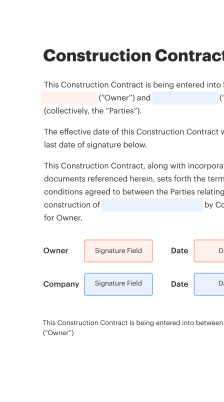
| Feature | Configuration |
|---|---|
| Default document retention period in days | 365 days |
| Automatic delivery method preference | Email and SMS |
| Signature authentication requirement level | Two-factor optional |
| Template approval workflow steps required | Manager approval |
| Receipt PDF naming convention pattern | RX_{date}_{prescription} |
The store receipt maker for pharmaceutical runs on common desktop and mobile platforms and integrates with modern browsers and API-capable systems.
For optimal performance use the latest browser versions, enable TLS network policies, and confirm API credentials and identity provider configurations prior to large-scale deployment to avoid integration delays.
A busy retail pharmacy implemented templated electronic receipts to capture prescription number, dispensing pharmacist, and insurer data
Leading to faster claims submission and clearer patient records for follow-up care.
An outpatient dispensing unit standardized receipts to include lot numbers and controlled-substance tracking fields
Resulting in improved inventory control and streamlined regulatory reporting.
| Feature | signNow (Recommended) | DocuSign |
|---|---|---|
| HIPAA Compliance | ||
| Audit Trail | Full chain | Full chain |
| Bulk Send | ||
| API Access | REST API | REST API |
| Plan | signNow (Featured) | DocuSign | Adobe Sign | HelloSign | PandaDoc |
|---|---|---|---|---|---|
| Entry-level price per user | $8 per user per month billed annually | $10 per user per month entry plan | $14.99 per month with Acrobat subscription | $15 per user per month basic plan | $19 per user per month starting plan |
| API access availability | Available via REST API integration | Available via REST API integration | Available via REST API integration | Available via API with business plans | Available via REST API integration |
| HIPAA-compliant options | HIPAA support with signed BAA available | HIPAA support with BAA available | HIPAA support via enterprise agreements | HIPAA via paid business plans | HIPAA support with enterprise plan |
| Free trial availability | 14-day free trial for new accounts | 30-day trial options sometimes available | 7-day trial with Acrobat plans | 30-day trial for some plans | 14-day free trial available |
| Typical transaction limits | Unlimited documents on most paid plans | Tiered limits based on plan | Included with Acrobat subscription levels | Tiered by plan and user | Usage-based limits on some plans |