Header
Date the letter and add employee contact information, employee ID, position, and department so HR and payroll can identify the record immediately.
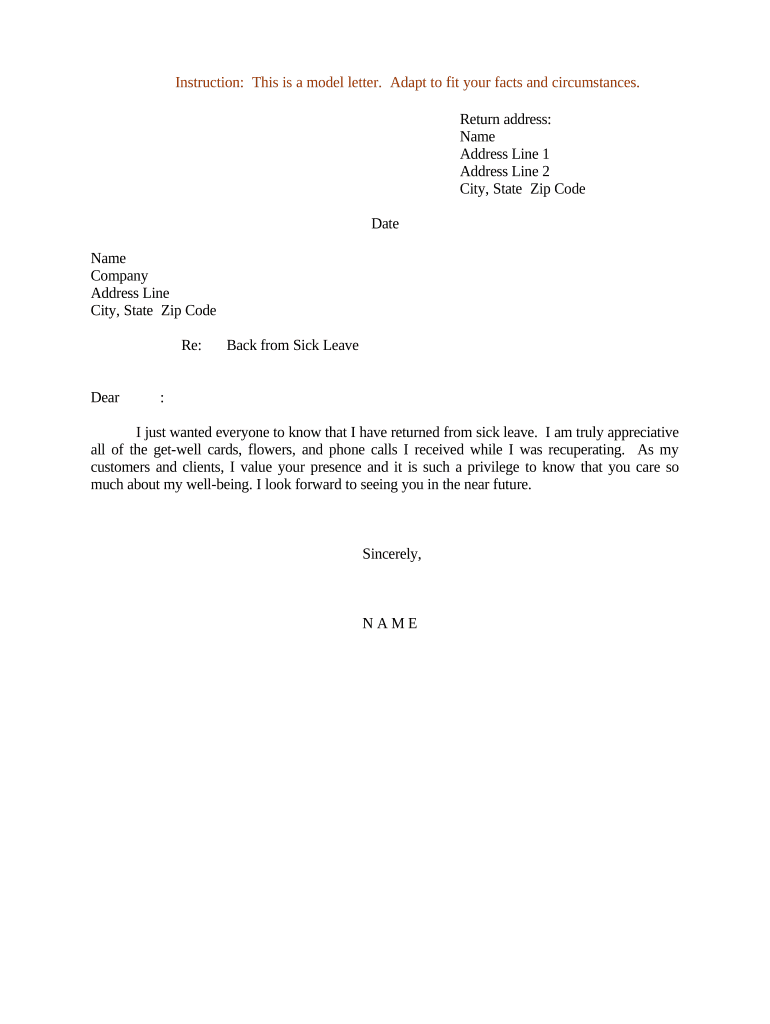
A concise, dated letter protects both employee and employer by confirming the return date, clarifying work capacity, and enabling timely payroll and benefits adjustments. It reduces misunderstandings about schedule and accommodations, and it creates an auditable record for personnel files.

Typical senders include employees, HR professionals, and supervisors; recipients include HR, payroll, and direct managers.
Use the letter to create a dated personnel record; retain a copy in the employee file per company policy and legal retention rules.
Date the letter and add employee contact information, employee ID, position, and department so HR and payroll can identify the record immediately.
State clearly that you are returning from sick leave and include the exact return-to-work date using MM/DD/YYYY format to avoid ambiguity.
Indicate full duty or specify limited duty and list precise restrictions or accommodations requested, with expected duration and attached medical notes when applicable.
Reference any attached medical release, fitness-for-duty form, or clinician note that HR requires for reinstatement or accommodation review.
Sign (wet or compliant electronic signature), print your name, and include a phone number and email for follow-up questions or verification.
Note intended recipients (HR, payroll, manager) and indicate if a copy should be placed in the personnel or medical leave file per company policy.
| Field | Configuration |
|---|---|
| Routing | HR → Payroll → Manager |
| Authentication | Email link or SMS code |
| Retention | Archive personnel record |
| Notifications | Auto-notify HR and manager |
Choose delivery that preserves security, audit trail, and access controls appropriate for personnel records.
Use a system that supports export to the secure record store, audit logs, and access controls to meet retention and privacy obligations.
Provide notice as soon as return is known.
Meet payroll deadlines to resume pay.
Allow time for benefits reinstatement.
Submit clinician forms before return if required.
Completing I-9 updates may be required post-absence.
Employee submits dated return letter to HR.
HR confirms documentation and benefits status.
Manager plans workload and accommodations.
Payroll restores pay and leave balances.
| signNow | DocuSign | Adobe Sign | PandaDoc | HelloSign | |
|---|---|---|---|---|---|
| Starting Price | $8/user/mo | $15/user/mo | $14/user/mo | $19/user/mo | $15/user/mo |
| Free Trial | 7-day free trial | Varies | Varies | Varies | Varies |
| Bulk Send | Yes | Yes | Yes | Yes | Varies |
| Audit Trail | Yes | Yes | Yes | Yes | Yes |
| HIPAA Compliant | Yes | Yes | Yes | No | No |
A small operations team standardized a return letter to reduce HR follow-ups and centralize files.
A healthcare provider added secure attachments and limited PHI in the letter workflow.
The returning employee signs to confirm the return date, capacity to work, and contact details. This signature establishes intent and attribution for HR processing and payroll adjustments.
An HR representative reviews attachments, confirms benefits and payroll changes, and signs or initials any internal acknowledgment. HR approval documents the employer's acceptance and any accommodation plan.