Automatic Field Detection
When a Word document is imported, signNow can detect common signature and form fields, suggesting placements to reduce manual field creation and speed up preparation while preserving document structure.




Documents imported into signNow retain legal effect when executed electronically under ESIGN and UETA in the United States; signNow provides auditable records, signature metadata, and authentication options supporting enforceability in commercial transactions.

Administrators manage account-level settings for importing Word documents, configure integrations and retention policies, assign user roles, and oversee security settings to ensure consistent handling across the organization.
Template Managers prepare Word templates for repeated use, define fields and recipient roles, validate imported layout, and maintain template libraries to support operational efficiency and compliance.
When a Word document is imported, signNow can detect common signature and form fields, suggesting placements to reduce manual field creation and speed up preparation while preserving document structure.
Convert frequently used Word documents into reusable templates so you can import once and reuse across teams, predefining fields, roles, and workflow settings for consistent processing.
After importing a populated Word file or template, Bulk Send allows distribution to many recipients with individualized fields or data merging, reducing manual sends for high-volume workflows.
Edit text and adjust layout within signNow after import to fix formatting differences or to add clarifying notes without returning to the original Word source file.
Each imported document retains a detailed audit trail recording uploads, field placements, signer actions, timestamps, and IP addresses for compliance and recordkeeping.
Import directly from storage connectors or CRM systems to avoid downloads and re-uploads; signNow integrates with common cloud services and productivity tools for streamlined document import.
Import Word files stored in Google Drive directly into signNow, edit or map fields in-platform, and return signed copies to the original folder for consistent document management across teams.
Connect signNow to CRM systems to pull contact details and push signed documents, ensuring Word-based contracts imported for signature automatically attach to the relevant customer records.
Link Dropbox, OneDrive, or Box accounts to import Word documents without manual downloads, keeping source files and signed copies synchronized according to your storage policies.
After importing a Word document, save it as a template with predefined fields and recipient roles to avoid repeated setup for recurring agreements or internal forms.

| Setting Name | Configuration |
|---|---|
| Default signer order | Sequential |
| Reminder Frequency | 48 hours |
| Automatic field detection | Enabled |
| Template auto-save | On |
| Retention policy | 90 days |
Importing Word documents to signNow is supported on modern browsers, desktop environments, and mobile apps for common iOS and Android devices.
For best results, use the latest browser versions (Chrome, Edge, Safari, Firefox) on desktop and update the signNow mobile app; ensure network connectivity when uploading large documents and use device storage permissions for local file access.
Patient consent forms are often authored in Word and imported to signNow for signature and secure storage
Resulting in reduced turnaround times while maintaining HIPAA-aware handling of authentication and records.
Purchase agreements and disclosures created as Word documents can be imported, adjusted, and routed to multiple parties for sequential signing
Leading to faster closings and clear records across buyer, seller, and agent interactions.
| Feature | signNow (Recommended) | DocuSign | Adobe Sign |
|---|---|---|---|
| Word file upload | |||
| Automatic field recognition | Partial | ||
| Bulk Send for templates | |||
| HIPAA support options | Available | Enterprise-only | Available |
90 days
7 years
Daily snapshots
PDF/A and DOCX
Preserve on request
| Plan | signNow (Recommended) | DocuSign | Adobe Sign | PandaDoc | HelloSign |
|---|---|---|---|---|---|
| Starting price (per user) | $8/user/month | $10/user/month | $14.99/user/month | $19/user/month | $15/user/month |
| Template capability | Included | Included | Included | Included | Included |
| API access | Available on paid plans | Available | Available | Available | Available |
| Bulk send support | Included on business plans | Enterprise feature | Included | Included | Included |
| Enterprise services | Custom pricing and SLAs | Custom pricing | Custom pricing | Custom pricing | Custom pricing |
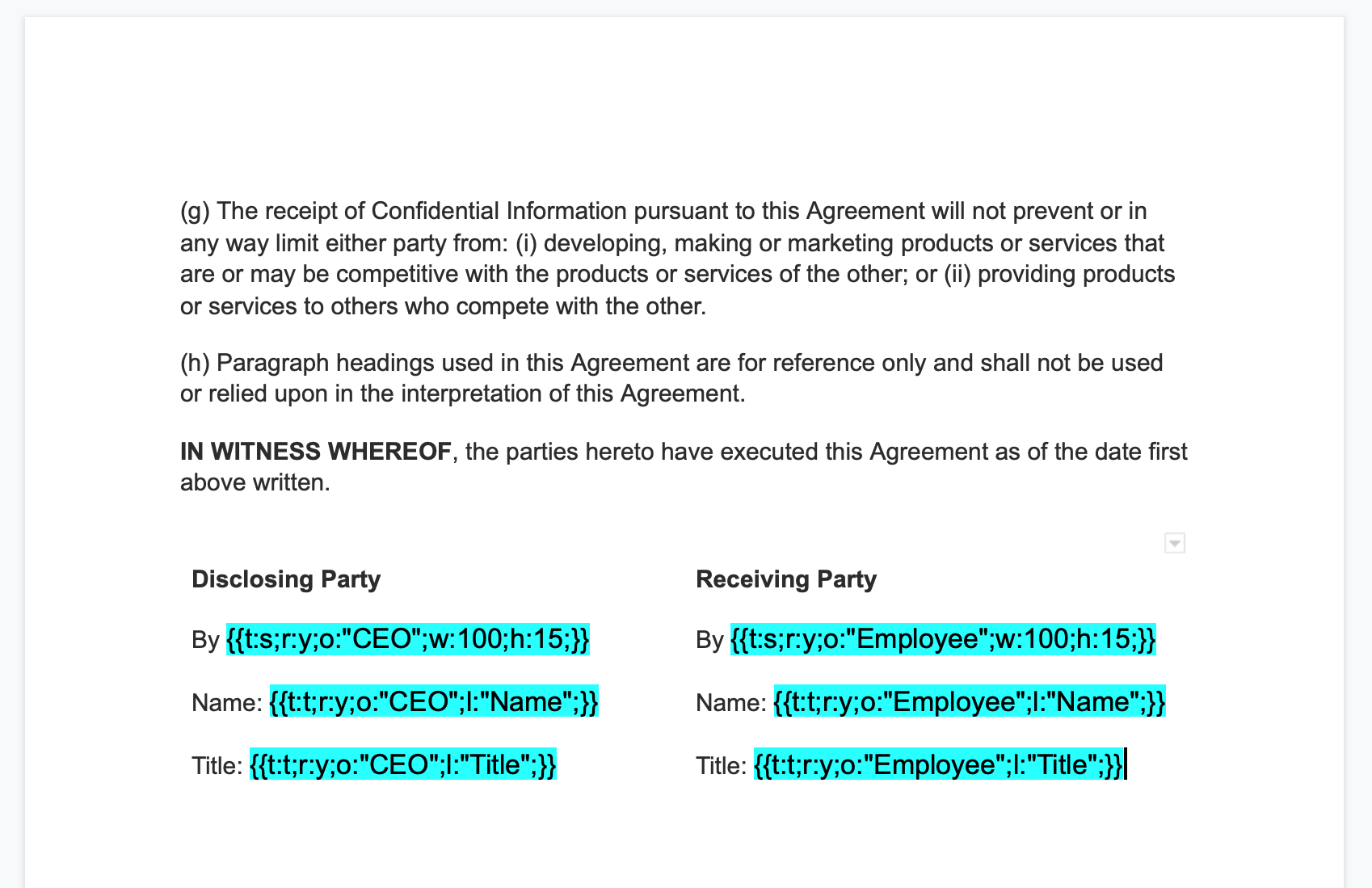
Before uploading a Word file to your airSlate SignNow account, consider including field-generating text tags in it. Once you upload the document, these tags will automatically turn into fillable fields.
Alternatively, upload a Word document as it is and then add fillable fields by using the airSlate SignNow click-and-drop editor.
Open a Word document in any text editor and insert the following text tags where you want fillable fields to appear.
{{ t:t;r:y;o:"Signer 1";l:"Text"; }}
In this tag, “Signer 1” describes the signer role, and “Text” is the field label. You can set these values according to your needs.
Example: {{ t:t;r:y;o:"Client";l:"Name"; }}
{{ t:s;r:y;o:"Signer 1";w:100;h:15; }}
“Signer 1” stands for the signer role. This value can be changed. The field label is “Signature Field” by default. You can adjust the field size by changing the values “w:100” (width) and “h:15” (height).
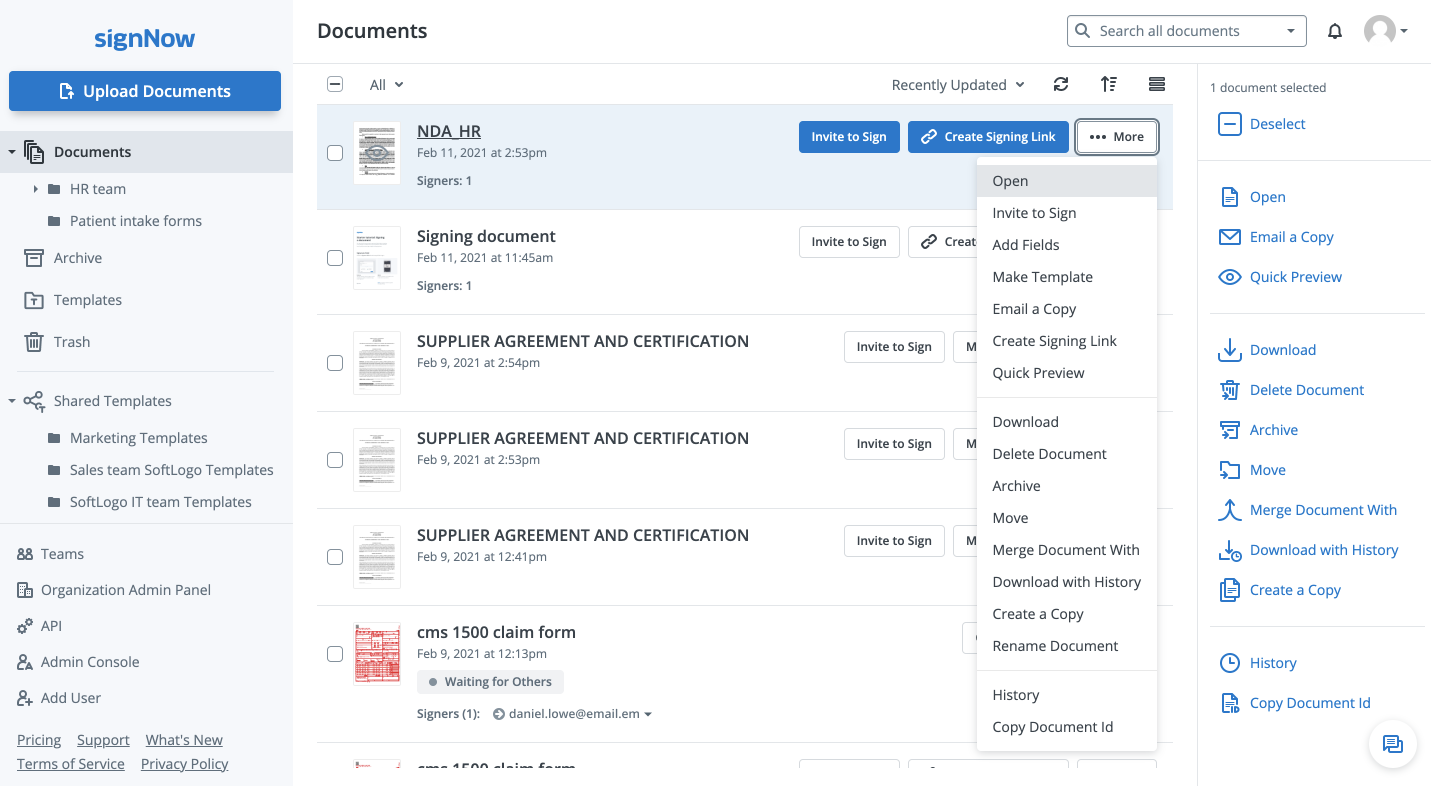
Click Upload Documents and browse for the Word file you just edited. Once uploaded, open the document in the airSlate SignNow editor.
After opening the document in airSlate SignNow, you will see that the text tags you just added have now become fillable fields.
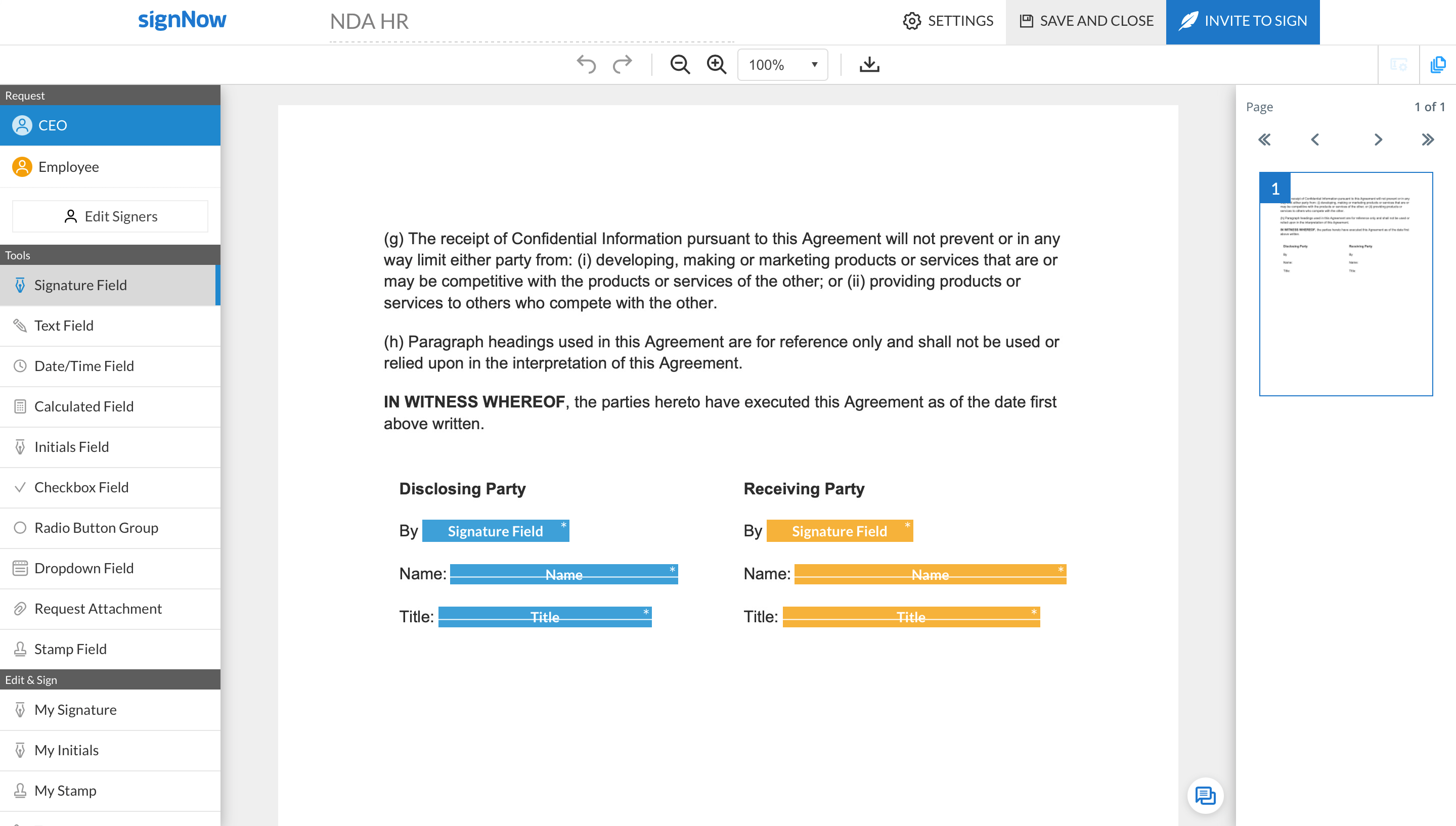
You can now save and close the document or send it for signing. Or you can continue adding fields by selecting items from the toolbar on the left and then clicking on the document where you need to place a field.











