SignNow's Customer Relationship Management Vs Apptivo

Check out the reviews of the airSlate SignNow CRM vs. Apptivo to compare the benefits, features, tools, and pricing of each solution.

Award-winning eSignature solution

Overview: eSignature and CRM considerations for higher education

This comparison examines how signNow's eSignature capabilities pair with customer relationship management needs in higher education versus Apptivo's CRM-focused approach. It focuses on workflows common to admissions, financial aid, registrars, and alumni relations, highlighting integrations, automation, and compliance considerations under U.S. law such as ESIGN and UETA. The intent is to help institutions assess document lifecycle, audit trails, access controls, and how each platform supports student-data protections like FERPA and healthcare-related controls where HIPAA applies.

Why compare these platforms for campus processes

Higher education teams compare signNow and Apptivo to balance secure signatures, CRM data capture, automation, and regulatory compliance while minimizing operational friction and cost per transaction.

Why compare these platforms for campus processes

Common challenges universities face when implementing eSignatures and CRM

  • Fragmented systems: multiple legacy SIS, CRM, and document stores create integration overhead and manual work.
  • Compliance complexity: ensuring FERPA and HIPAA rules are applied consistently to signed records and access logs.
  • User adoption: staff and students may resist new digital workflows without clear training and templates.
  • Data mapping gaps: mismatched field names and formats cause errors during bulk sends or student onboarding.

Representative campus user profiles

Admissions Officer

An admissions officer coordinates application documents, consent forms, and communications with prospective students. They rely on reusable templates, bulk sending for cohorts, clear signer sequencing, and visible status updates to reduce manual follow-up and shorten decision timelines.

IT Administrator

The IT administrator manages integrations between the SIS, CRM, and identity provider, configures SSO, and enforces data retention policies. They value API access, configurable webhooks, role-based permissions, and centralized audit logs for troubleshooting and compliance reporting.

Primary campus users and where they benefit

Admissions, registrars, financial aid offices, and IT teams are the most frequent users of combined eSignature and CRM workflows.

  • Admissions teams: accelerate application agreements and consent forms tied to student records.
  • Registrar offices: manage enrollment documents, transcript requests, and retention workflows.
  • IT and integrations: maintain API connections, SSO, and data mappings across campus systems.

Each group prioritizes different capabilities—templates and bulk sends for operations, strong audit trails for compliance, and API flexibility for IT.

Additional capabilities to evaluate for campus adoption

When selecting a platform, consider supplemental features that affect scalability, compliance, and IT maintenance across departments.

Document merging

Automatic population of forms with CRM or SIS data reduces manual entry and ensures consistent records across systems for each student or donor.


Mobile apps

Native iOS and Android apps support signing on the go for staff and external partners, ensuring accessibility for varied campus users.

Audit trail

Immutable, timestamped logs capture signer actions, IP addresses, and authentication events to support legal validity and internal compliance reviews.

HIPAA-capable

Support for HIPAA workflows and BAAs where health-related student data is processed, relevant for campus health centers.

SSO

Single sign-on with SAML or OIDC simplifies user management and supports institutional identity provider policies.

Team templates

Shared template libraries ensure consistent document versions, reduce duplication, and make governance easier for multi-department use.

be ready to get more

Choose a better solution

Core features that support campus document workflows

Both platforms offer tools relevant to higher education, but capabilities differ: signNow focuses on eSignature and document automation while Apptivo emphasizes CRM and contact management features.

Templates

Reusable document templates reduce repetitive setup for admissions packets, financial aid consents, and internal approvals; templates can include conditional fields and prefilling from data sources to minimize signer effort and errors.

Bulk Send

Send one template to many recipients with personalized prefill; useful for cohort communications such as orientation forms or seasonal compliance acknowledgments, saving staff hours versus individual sends.

API

REST APIs support merging CRM or SIS data into documents and automate post-signature workflows such as updating student records or triggering fulfillment processes in campus systems.

Permissions

Role-based access controls let administrators limit who can send, edit, or access documents, aligning with campus segregation of duties and record-retention requirements.
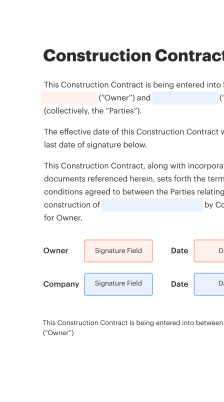
How a student signature flow typically operates

A typical digital signing flow for a student-facing form moves from template preparation to automated delivery and archival.

  • Prepare: Design template with required fields.
  • Initiate: Send via email or link.
  • Authenticate: Verify identity as required.
  • Archive: Store signed copy with audit trail.
Collect signatures
24x
faster
Reduce costs by
$30
per document
Save up to
40h
per employee / month

Quick setup: configuring a signature workflow for campus use

Set up a basic sign-and-store workflow for common higher-education documents in four straightforward steps.

  • 01
    Create template: Upload document and place fields.
  • 02
    Prefill data: Map fields to CSV or CRM.
  • 03
    Set routing: Define signer order and reminders.
  • 04
    Send and monitor: Track status and download records.

Managing audit trails and signed records

Maintaining clear records ensures legal validity and simplifies compliance reviews; follow these steps to manage audit trails effectively.

01

Capture events:

Log all signer actions
02

Store artifacts:

Save PDFs and metadata
03

Index records:

Tag by student ID
04

Access controls:

Limit view to authorized roles
05

Retention:

Apply policy-based deletion
06

Exporting:

Provide CSV or PDF bundles
be ready to get more

Why choose airSlate SignNow

  • Free 7-day trial. Choose the plan you need and try it risk-free.
  • Honest pricing for full-featured plans. airSlate SignNow offers subscription plans with no overages or hidden fees at renewal.
  • Enterprise-grade security. airSlate SignNow helps you comply with global security standards.
illustrations signature

Recommended workflow configuration for campus forms

Suggested default settings streamline common higher-education signing processes while preserving auditability and compliance controls.

Setting Name Configuration
Reminder Frequency 72 hours
Signature Order Sequential
Data Mapping CRM field map
Template Library Centralized
Retention Policy 7 years

Supported platforms and system requirements

Confirm browser and device support to ensure staff and students can access signing links and embedded forms reliably.

  • Web browsers: Recent Chrome, Edge, Safari
  • iOS: iOS 13 or later
  • Android: Android 9 or later

For enterprise deployments, verify SSO configuration, firewall exceptions for API endpoints, and mobile app distribution policies so campus IT can provision access securely and minimize support requests.

Security controls and technical safeguards

Data encryption: AES-256 at rest
Transport security: TLS 1.2+
Access controls: Role-based permissions
Audit logging: Comprehensive event logs
Authentication options: Multi-factor support
Document retention: Configurable policies

Use cases from higher education operations

Two practical examples show workflow choices where signNow and Apptivo serve different needs in campus environments.

Admissions onboarding

An institution needed fast, auditable enrollment signature capture for admitted students and integrated signed forms into the student record system

  • Bulk Send templates and prefilled fields from CSV imports
  • Reduced manual data entry and faster acceptance confirmation

Resulting in same-day enrollment packet completion and clearer audit trails for compliance checks.

Alumni donation processing

A development office required reliable donor agreement signatures that connect to donor CRM records and gift workflows

  • API-driven merge of donation data into signature templates and automatic CRM update
  • Streamlined reconciliation and clearer stewardship reporting

Leading to faster processing of gifts and immediate CRM updates for ongoing engagement.

Best practices for secure, compliant signature workflows

Adopt policies and technical controls that reduce risk while streamlining signatures and CRM interactions across departments.

Use institutional SSO and MFA for user access
Integrate with campus identity providers to centralize authentication and enforce multi-factor authentication for staff accounts. This reduces credential sprawl, simplifies account provisioning, and aligns vendor access with institutional account lifecycle policies.
Standardize templates and field naming conventions
Maintain a controlled template library with approved document versions, standardized field names, and prefilling rules to prevent mapping errors and ensure consistent records across admissions, financial aid, and registrar workflows.
Document retention and legal-hold procedures
Define retention schedules consistent with institutional records policies, implement automated retention rules in the eSignature system, and provide mechanisms to suspend deletions for records subject to legal holds or audits.
Test integrations in a sandbox environment
Validate API mappings, webhook reliability, and error handling in a nonproduction environment before rollout. Include performance tests for bulk sends and concurrent API activity to avoid surprises during peak enrollment periods.

FAQs: common questions and solutions

Answers address frequent implementation and operational questions about using signNow and Apptivo in a campus setting.

Feature availability snapshot: signNow vs Apptivo vs DocuSign

A concise availability table helps clarify which platform components align with campus priorities such as signatures, CRM functions, and integration capabilities.

Criteria signNow (Recommended) Apptivo DocuSign
eSignature availability Limited
Native CRM features
FERPA-aware workflows
API access and webhooks
be ready to get more

Get legally-binding signatures now!

Regulatory and operational risks to consider

FERPA penalties: Civil penalties possible
HIPAA fines: Monetary enforcement risk
Invalid agreements: Improper evidence
Data loss: Recovery costs
Integration failure: Process delays
Reputational harm: Public trust loss

Pricing and plan considerations for campus deployments

Comparing starting prices, free tiers, and support for API or HIPAA can inform budgeting decisions for departmental or enterprise deployments.

Plan / Vendor signNow (Featured) Apptivo DocuSign Adobe Sign Dropbox Sign
Starting price (per user) $8/user/mo $10/user/mo $10/user/mo $14.99/user/mo $15/user/mo
Free tier available No Yes No No Yes
API access included Yes Yes Yes Yes Yes
HIPAA-capable option Yes Limited Yes Yes Limited
Trial length 7 days 30 days 30 days 7 days 14 days
walmart logo
exonMobil logo
apple logo
comcast logo
facebook logo
FedEx logo
be ready to get more

Get legally-binding signatures now!