Certificate Signing
Platform support for applying user or device-bound digital certificates to create cryptographically verifiable signatures with embedded certificate metadata.



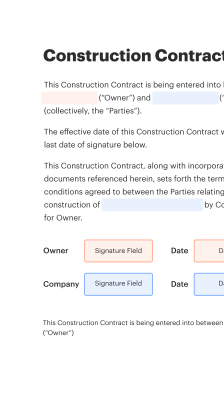
Using an e sign certificate strengthens signer authentication and document integrity, producing cryptographic proof of authorship and tamper evidence for important agreements.

IT Administrators oversee certificate deployment, PKI integration, and system configuration. They manage issuance processes, renewals, revocations, and ensure certificate stores and key management follow organizational security policies and audit requirements.
A Compliance Officer defines certificate usage policies, verifies that signing workflows meet ESIGN and UETA requirements, and documents retention, audit trail, and access controls for regulatory review and internal governance.
Organizations across finance, healthcare, legal, and government use e sign certificates to meet heightened authentication and evidentiary standards for electronic agreements.
Teams adopting certificates usually pair them with policy controls, audit logging, and user training to maintain legal defensibility and operational reliability.
Platform support for applying user or device-bound digital certificates to create cryptographically verifiable signatures with embedded certificate metadata.
Comprehensive logs capture signer details, certificate fingerprints, validation steps, timestamps, and IP addresses for forensic and compliance review.
Multi-factor methods, SAML/SSO, and ID verification can be combined with certificates to strengthen signer authentication.
Reusable templates and bulk send features let teams apply certificate-based signing at scale while maintaining consistent fields and routing.
APIs enable programmatic signing, certificate validation, and integration with backend systems for automated signing workflows.
Secure storage with tamper-evident archives preserves signed documents and certificate metadata to meet retention requirements.
Connect Google Docs to your signing environment to send documents for certificate-based signing directly from the editor, preserving version history and simplifying collaborative preparation workflows.
Link certificates to CRM records so sales and contracting teams can trigger signed agreements from opportunity records, automatically logging signature events and storing signed PDFs in the customer record.
Integrate with Dropbox or other cloud storage providers to pull files, push signed documents back to folders, and maintain consistent retention policies with preserved metadata.
Use templates that reference certificate-based signature fields to ensure consistent placement, enforce signing order, and speed recurring document preparation for regulated transactions.
| Setting Name | Default Configuration Value |
|---|---|
| Default Email Reminder Frequency Setting | Every 48 hours for up to three reminders |
| Signing Order and Routing Logic Setting | Sequential routing with enforced certificate check |
| Certificate Revocation Check Interval Setting | Validate OCSP/CRL at time of signing |
| Audit Log Retention Policy Setting | Retain audit trail for seven years |
| Document Storage Encryption and Backup Setting | AES-256 at rest with daily backups |
Ensure your environment supports certificate storage, secure key access, and certificate validation protocols before enabling certificate-based signing.
Confirm platform compatibility, mobile SDK availability, and network access to certificate revocation services; document these dependencies in your deployment plan to avoid verification failures.
A regional bank issued client-bound certificates to verify borrower identity and sign loan documents
Resulting in faster, auditable closings with verifiable non-repudiation.
A multi-clinic health system integrated certificates into e-consent workflows to secure clinician signatures
Leading to better auditability and clearer regulatory compliance documentation.
| Main Comparison Criteria Header Row | signNow (Recommended) | DocuSign | Adobe Sign |
|---|---|---|---|
| Digital Certificate Support | Supported | Supported | Supported |
| Certificate Types Accepted | X.509 / PKI | X.509 / PKI | X.509 / PKI |
| OCSP/CRL Revocation Checking | Automatic | Automatic | Automatic |
| Mobile Certificate Signing |
Review PKI and certificate policies yearly
Begin renewal 30 to 90 days before expiry
Retain signature logs for at least seven years
Quarterly validation tests and audits
Update policies every 12 months
| Pricing Feature Header Row | signNow (Recommended) | DocuSign | Adobe Sign | HelloSign | PandaDoc |
|---|---|---|---|---|---|
| Free plan or trial availability | Free trial available; paid plans for individuals and teams | Free trial; limited free options historically | Free trial with some Acrobat plans | Free tier with limited monthly envelopes | Free trial; pay-as-you-grow options |
| Starting price and entry tier | Entry plans positioned for teams with per-user billing | Individual and business starter plans available | Included in some Acrobat subscriptions or standalone plans | Affordable individual plans and upgrades | Sales-focused tiers with per-user pricing |
| API access and developer options | API available with developer keys and paid plans | Mature API and SDK ecosystem | API access via Adobe Sign APIs | APIs available with developer support | Robust API focusing on document workflows |
| Storage and retention offerings | Cloud storage with retention controls and exports | Document cloud storage with tier limits | Adobe Document Cloud integration and storage | Basic storage with paid upgrades | Document storage tied to plan level |
| Enterprise services and SLAs | Enterprise plans with account management and SLAs | Extensive enterprise support and compliance options | Enterprise features plus Adobe support tiers | Enterprise onboarding and priority support | Enterprise plans with dedicated services |
Prepare, deliver, and maintain workflows of any complexness, digitally from virtually anywhere. Scalable eSignature functionality let you exchange documents with the right users the right sequence and define roles for every recipient. Complete document workflows faster and easier than ever before.
Enhance complex signing processes with airSlate SignNow�s powerful features to improve your business. Take control of your automated signature workflows to make sure they're running at peak functionality with quick notices and alerts.
Bring teammates together in a secure, shared workspace. Handle documents, use form templates and notifications to deliver better cross-organization collaboration. Free your staff from having to spend time on repetitive activities so that they can give attention to valuable, business-essential tasks.
Run your tasks with industry-leading integration. Capture Salesforce, Microsoft Teams, and SharePoint in one business thread. Link your software to a single unit for unlimited possibilities and more performance.
Feel safe knowing that your information remains secure by the newest in encryption security. airSlate SignNow is GDPR and eIDAS compliant and gives you transparence into your eSigning process with court-admissible audit trails. Configure user access permissions and rights to manage who has access to what.